Using the BLoC Pattern for Enterprise-Grade Flutter Apps

Summary
Summary
Summary
Summary

This tutorial explains applying the BLoC pattern to enterprise Flutter mobile development: architecture, implementation with DI and repositories, testing strategies, and scaling best practices. Emphasize small BLoCs, immutable states, use cases, observability, and CI-friendly patterns to keep apps maintainable and performant.

This tutorial explains applying the BLoC pattern to enterprise Flutter mobile development: architecture, implementation with DI and repositories, testing strategies, and scaling best practices. Emphasize small BLoCs, immutable states, use cases, observability, and CI-friendly patterns to keep apps maintainable and performant.

This tutorial explains applying the BLoC pattern to enterprise Flutter mobile development: architecture, implementation with DI and repositories, testing strategies, and scaling best practices. Emphasize small BLoCs, immutable states, use cases, observability, and CI-friendly patterns to keep apps maintainable and performant.

This tutorial explains applying the BLoC pattern to enterprise Flutter mobile development: architecture, implementation with DI and repositories, testing strategies, and scaling best practices. Emphasize small BLoCs, immutable states, use cases, observability, and CI-friendly patterns to keep apps maintainable and performant.

Key insights:
Key insights:
Key insights:
Key insights:
  • Architecture And Principles: Use single-responsibility BLoCs, unidirectional flow, immutable states, and feature-based folder layout.

  • Implementing BLoC For Enterprise: Inject repositories and use cases, keep mapping functions thin, and scope BLoCs to navigation boundaries.

  • Testing And Maintainability: Unit test BLoCs by emitting events and asserting state sequences; mock external dependencies and model failures explicitly.

  • Scaling And Best Practices: Break large BLoCs into composable units, add throttling, caching, and observability for production readiness.

  • Practical Adoption Tip: Migrate incrementally by wrapping legacy logic with adapters and enforcing contracts at the composition root.

Introduction

Enterprise-grade Flutter apps demand predictable state management, testability, and clear separation of concerns. The BLoC (Business Logic Component) pattern enforces a unidirectional data flow and isolates UI from business logic, which makes it a strong fit for large teams and complex feature sets. This tutorial shows how to apply BLoC in an enterprise context: architecture, implementation patterns, testing strategies, and practical scaling tips.

Architecture And Principles

At its core, BLoC separates events, state, and the logic that maps events to state. For enterprise apps this translates to boundaries that help teams own modules and ship independently. Key principles:

  • Single Responsibility: Each BLoC handles a single domain or feature boundary.

  • Unidirectional Data Flow: UI emits events; BLoC produces states; UI renders states.

  • Immutable State: Keep states immutable to avoid side effects and simplify diffs.

  • Public Contracts: Expose Streams or ValueStreams for state, and a Sink or methods for events. This creates a stable API for consumers.

A typical folder layout for an enterprise app:

lib/ 
  features/
    auth/
      bloc/
      data/
      ui/
    payments/
      bloc/
      data/
      ui/
  core/
    network/
     storage

This organizes teams around features and keeps BLoCs collocated with their feature code.

Implementing BLoC For Enterprise

Use composable, testable BLoCs backed by repositories and services. Keep external dependencies out of BLoC constructors in favor of interfaces; inject implementations at composition time for easier testing and swapping (CI, staging, mock).

Example minimal BLoC structure using rxdart ValueStream for loading state and data exposure:

class ItemsBloc {
  final _events = PublishSubject<ItemsEvent>();
  final _state = BehaviorSubject<ItemsState>.seeded(ItemsInitial());

  Stream<ItemsState> get state => _state.stream;
  Sink<ItemsEvent> get eventSink => _events.sink;

  ItemsBloc(ItemsRepository repo) {
    _events.stream.listen((e) => _mapEventToState(e, repo));
  }
}

Keep mapping functions small and delegating heavy work to repositories or use cases. For enterprise flows, create use case classes that encapsulate single operations (e.g., FetchUser, UpdateSubscription). This produces small, composable units that can be reused across BLoCs.

Dependency injection: use a DI container (get_it, injectable) at app composition root. Register repositories, services, and BLoCs so features can request scoped instances. For large apps, prefer scoped BLoCs per navigation subtree to limit memory footprint.

Testing And Maintainability

Unit test every BLoC by pushing events and asserting emitted states. Mock repositories to simulate success, failure, and edge conditions. Tests should be fast and deterministic.

Sample unit test pattern:

  • Arrange: create mock repository, instantiate BLoC with mock

  • Act: add an event to BLoC

  • Assert: expect state stream to emit specific sequence

Automate static analysis and lint rules. Enforce architecture constraints with folder boundaries and CI checks. Use code reviews to ensure no UI logic leaks into BLoC or repositories.

Error handling: model failure states explicitly. Instead of throwing raw exceptions through streams, map them to Failure objects or error states that the UI can render. This prevents uncaught stream errors that crash isolate or lead to silent failures.

Scaling And Best Practices

  1. Composition Over Monolith: Break large BLoCs into cooperating smaller BLoCs or use cases. For example, separate 'Profile' and 'Settings' flows even if both touch the same backend.

  2. Event Throttling and Debouncing: For search or rapid input, throttle or debounce events at the BLoC boundary to reduce network and processing load.

  3. Caching Strategy: Combine local caches with remote calls inside repositories. Use clear cache invalidation rules and time-to-live policies suitable for enterprise SLA.

  4. Observability: Emit diagnostic events or integrate with telemetry (Sentry, Datadog). Instrument state transitions for critical flows to trace regressions in production.

  5. Migration Strategy: When migrating to BLoC from other patterns, wrap existing logic in adapters, then incrementally refactor. Keep backwards compatibility by exposing the same public contracts while switching internals.

  6. Performance: Prefer snapshot-based updates rather than granular per-field streams when rendering complex UIs. Compute diffs in BLoC if necessary, but keep render-time work minimal.

Vibe Studio
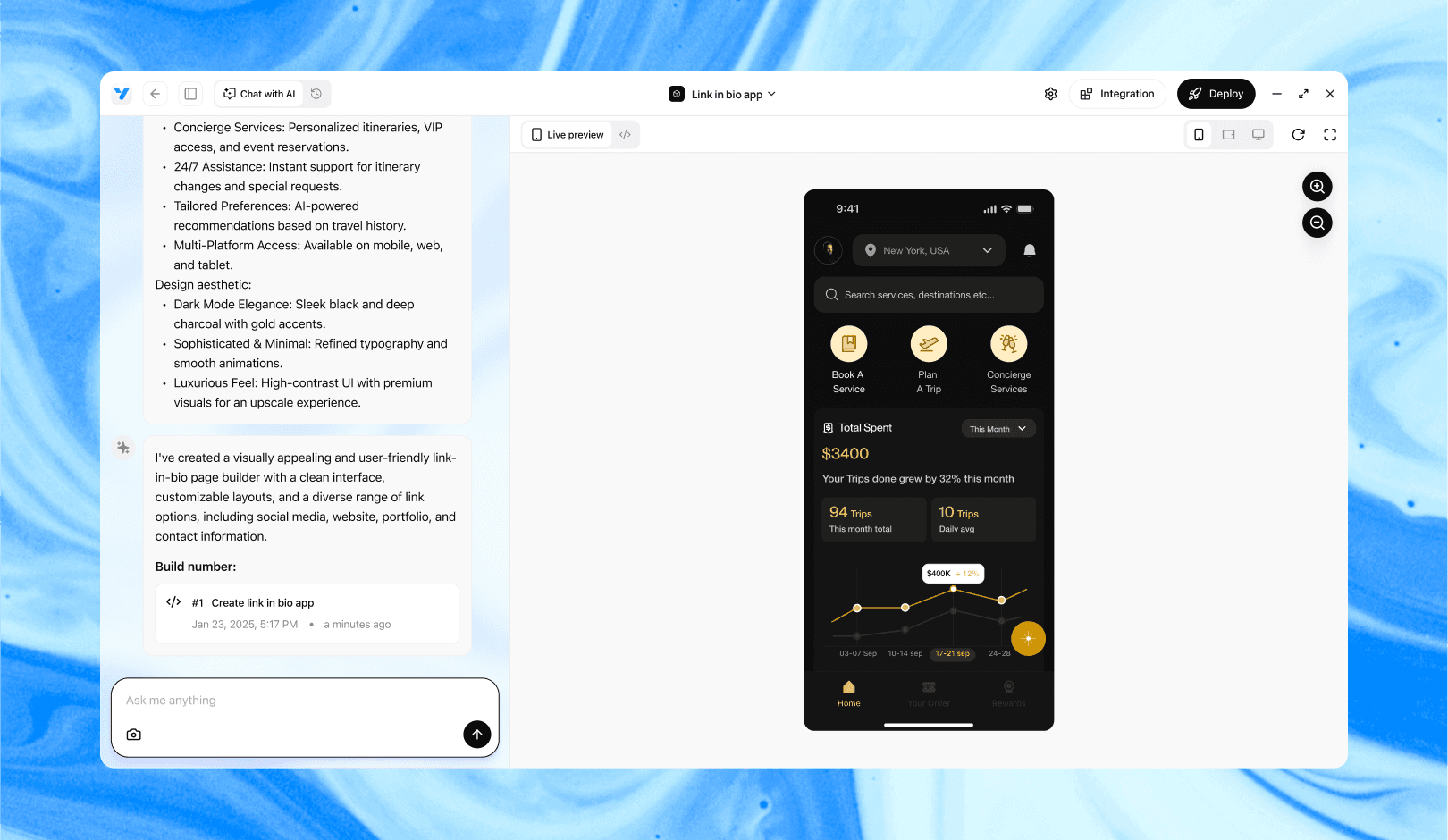
Vibe Studio, powered by Steve’s advanced AI agents, is a revolutionary no-code, conversational platform that empowers users to quickly and efficiently create full-stack Flutter applications integrated seamlessly with Firebase backend services. Ideal for solo founders, startups, and agile engineering teams, Vibe Studio allows users to visually manage and deploy Flutter apps, greatly accelerating the development process. The intuitive conversational interface simplifies complex development tasks, making app creation accessible even for non-coders.

Conclusion

BLoC gives enterprise Flutter apps a predictable, testable architecture. Enforce clear boundaries: small, focused BLoCs; repositories and use cases; DI at composition root; and explicit error and caching strategies. With disciplined structure, observability, and automated testing, BLoC scales from small features to multi-team codebases while keeping the UI reactive and maintainable.

Introduction

Enterprise-grade Flutter apps demand predictable state management, testability, and clear separation of concerns. The BLoC (Business Logic Component) pattern enforces a unidirectional data flow and isolates UI from business logic, which makes it a strong fit for large teams and complex feature sets. This tutorial shows how to apply BLoC in an enterprise context: architecture, implementation patterns, testing strategies, and practical scaling tips.

Architecture And Principles

At its core, BLoC separates events, state, and the logic that maps events to state. For enterprise apps this translates to boundaries that help teams own modules and ship independently. Key principles:

  • Single Responsibility: Each BLoC handles a single domain or feature boundary.

  • Unidirectional Data Flow: UI emits events; BLoC produces states; UI renders states.

  • Immutable State: Keep states immutable to avoid side effects and simplify diffs.

  • Public Contracts: Expose Streams or ValueStreams for state, and a Sink or methods for events. This creates a stable API for consumers.

A typical folder layout for an enterprise app:

lib/ 
  features/
    auth/
      bloc/
      data/
      ui/
    payments/
      bloc/
      data/
      ui/
  core/
    network/
     storage

This organizes teams around features and keeps BLoCs collocated with their feature code.

Implementing BLoC For Enterprise

Use composable, testable BLoCs backed by repositories and services. Keep external dependencies out of BLoC constructors in favor of interfaces; inject implementations at composition time for easier testing and swapping (CI, staging, mock).

Example minimal BLoC structure using rxdart ValueStream for loading state and data exposure:

class ItemsBloc {
  final _events = PublishSubject<ItemsEvent>();
  final _state = BehaviorSubject<ItemsState>.seeded(ItemsInitial());

  Stream<ItemsState> get state => _state.stream;
  Sink<ItemsEvent> get eventSink => _events.sink;

  ItemsBloc(ItemsRepository repo) {
    _events.stream.listen((e) => _mapEventToState(e, repo));
  }
}

Keep mapping functions small and delegating heavy work to repositories or use cases. For enterprise flows, create use case classes that encapsulate single operations (e.g., FetchUser, UpdateSubscription). This produces small, composable units that can be reused across BLoCs.

Dependency injection: use a DI container (get_it, injectable) at app composition root. Register repositories, services, and BLoCs so features can request scoped instances. For large apps, prefer scoped BLoCs per navigation subtree to limit memory footprint.

Testing And Maintainability

Unit test every BLoC by pushing events and asserting emitted states. Mock repositories to simulate success, failure, and edge conditions. Tests should be fast and deterministic.

Sample unit test pattern:

  • Arrange: create mock repository, instantiate BLoC with mock

  • Act: add an event to BLoC

  • Assert: expect state stream to emit specific sequence

Automate static analysis and lint rules. Enforce architecture constraints with folder boundaries and CI checks. Use code reviews to ensure no UI logic leaks into BLoC or repositories.

Error handling: model failure states explicitly. Instead of throwing raw exceptions through streams, map them to Failure objects or error states that the UI can render. This prevents uncaught stream errors that crash isolate or lead to silent failures.

Scaling And Best Practices

  1. Composition Over Monolith: Break large BLoCs into cooperating smaller BLoCs or use cases. For example, separate 'Profile' and 'Settings' flows even if both touch the same backend.

  2. Event Throttling and Debouncing: For search or rapid input, throttle or debounce events at the BLoC boundary to reduce network and processing load.

  3. Caching Strategy: Combine local caches with remote calls inside repositories. Use clear cache invalidation rules and time-to-live policies suitable for enterprise SLA.

  4. Observability: Emit diagnostic events or integrate with telemetry (Sentry, Datadog). Instrument state transitions for critical flows to trace regressions in production.

  5. Migration Strategy: When migrating to BLoC from other patterns, wrap existing logic in adapters, then incrementally refactor. Keep backwards compatibility by exposing the same public contracts while switching internals.

  6. Performance: Prefer snapshot-based updates rather than granular per-field streams when rendering complex UIs. Compute diffs in BLoC if necessary, but keep render-time work minimal.

Vibe Studio

Vibe Studio, powered by Steve’s advanced AI agents, is a revolutionary no-code, conversational platform that empowers users to quickly and efficiently create full-stack Flutter applications integrated seamlessly with Firebase backend services. Ideal for solo founders, startups, and agile engineering teams, Vibe Studio allows users to visually manage and deploy Flutter apps, greatly accelerating the development process. The intuitive conversational interface simplifies complex development tasks, making app creation accessible even for non-coders.

Conclusion

BLoC gives enterprise Flutter apps a predictable, testable architecture. Enforce clear boundaries: small, focused BLoCs; repositories and use cases; DI at composition root; and explicit error and caching strategies. With disciplined structure, observability, and automated testing, BLoC scales from small features to multi-team codebases while keeping the UI reactive and maintainable.

Build Flutter Apps Faster with Vibe Studio

Build Flutter Apps Faster with Vibe Studio

Build Flutter Apps Faster with Vibe Studio

Build Flutter Apps Faster with Vibe Studio

Vibe Studio is your AI-powered Flutter development companion. Skip boilerplate, build in real-time, and deploy without hassle. Start creating apps at lightning speed with zero setup.

Vibe Studio is your AI-powered Flutter development companion. Skip boilerplate, build in real-time, and deploy without hassle. Start creating apps at lightning speed with zero setup.

Vibe Studio is your AI-powered Flutter development companion. Skip boilerplate, build in real-time, and deploy without hassle. Start creating apps at lightning speed with zero setup.

Vibe Studio is your AI-powered Flutter development companion. Skip boilerplate, build in real-time, and deploy without hassle. Start creating apps at lightning speed with zero setup.

Other Insights

Other Insights

Other Insights

Other Insights

Join a growing community of builders today

Join a growing community of builders today

Join a growing community of builders today

Join a growing community of builders today

Join a growing community of builders today

28-07 Jackson Ave

Walturn

New York NY 11101 United States

© Steve • All Rights Reserved 2025

28-07 Jackson Ave

Walturn

New York NY 11101 United States

© Steve • All Rights Reserved 2025

28-07 Jackson Ave

Walturn

New York NY 11101 United States

© Steve • All Rights Reserved 2025

28-07 Jackson Ave

Walturn

New York NY 11101 United States

© Steve • All Rights Reserved 2025

28-07 Jackson Ave

Walturn

New York NY 11101 United States

© Steve • All Rights Reserved 2025

28-07 Jackson Ave

Walturn

New York NY 11101 United States

© Steve • All Rights Reserved 2025