Using AnimationBuilder To Create Delightful UI Effects
Jan 14, 2026


Summary
Summary
Summary
Summary
AnimatedBuilder (AnimatedBuilder) in Flutter gives precise control over animations by separating animation logic from build logic. Use a single controller with multiple tweens, pass static children to the builder to avoid per-frame rebuilds, and prefer transform/opacity for paint-only effects. Choreograph sequences with Intervals and always dispose controllers to keep mobile development performant.
Key insights:
Key insights:
Key insights:
Key insights:
Why Use AnimatedBuilder: Separates animation timing from build logic, reducing unnecessary rebuilds and improving performance.
Core Patterns: Use single controllers with multiple Tweens, pass static children to the builder, and extract reusable animated widgets.
Examples: Simple Bounce And Combined Effects: Combine scale, opacity, and translation in the builder for polished entrance animations.
Performance And Composition: Use Transforms and Opacity for paint-only changes, reuse controllers, and choreograph with Intervals.
Reusable Animation Components: Pack controllers and AnimatedBuilder into small widgets to keep page code clean and testable.
Introduction
Animated interactions are a hallmark of polished mobile development. In Flutter, the low-level building block for custom animation-driven widgets is AnimatedBuilder (commonly referenced as AnimationBuilder). This tutorial shows how to use AnimatedBuilder effectively to create delightful, efficient UI effects: separating animation logic from build logic, composing multiple transforms, and keeping performance predictable.
Why Use AnimatedBuilder
AnimatedBuilder lets you listen to an Animation and rebuild only the widget subtree that depends on it. Unlike implicit animations (AnimatedContainer, AnimatedOpacity), AnimatedBuilder works with AnimationController and Tween to provide precise timing, curves, and synchronization between multiple animated properties. For flutter mobile development, that means smooth transitions without rebuilding unrelated widgets, reduced layout churn, and full control over easing and repeat behavior.
Key benefits:
Fine-grained control: drive several properties from a single controller or multiple controllers.
Separation of concerns: keep animation state in controllers and build logic in the builder callback.
Performance: avoids setState for every tick; AnimatedBuilder calls the builder directly when the animation ticks.
Core Patterns
Pattern 1 — Single Controller, Multiple Tweens: Create one AnimationController and derive several Animations via Tween.animate to drive opacity, scale, and translation in sync.
Pattern 2 — Composition With Transform: Use Transform, Opacity, or Align inside the builder to apply visual effects without changing layout bounds unnecessarily.
Pattern 3 — Extract Reusable Animated Widgets: Pack an AnimatedBuilder and its controller into a small stateful widget when you need the same effect in multiple places. This keeps your page code tidy and testable.
Example skeleton (controller + AnimatedBuilder):
// In a StatefulWidget late final AnimationController controller = AnimationController( vsync: this, duration: Duration(milliseconds: 600)); final Animation<double> scale = Tween(begin: 0.8, end: 1.0).animate( CurvedAnimation(parent: controller, curve: Curves.easeOutBack)); Widget build(BuildContext context) => AnimatedBuilder( animation: controller, builder: (context, child) => Transform.scale( scale: scale.value, child: child, ), child: YourContentWidget(), );
Examples: Simple Bounce And Combined Effects
Example 1 — Bounce-in Card: Drive scale and shadow elevation from the same controller. Scale uses an elastic curve while elevation ramps linearly to avoid an overshoot in shadow.
Example 2 — Cross-Fade With Translate: Animate both opacity and slide offset: opacity uses a linear curve, offset uses Curves.easeOut. Wrap the target child in a Transform.translate and Opacity inside the builder.
Combined example for a compact animated item:
AnimatedBuilder( animation: controller, builder: (ctx, child) { final t = Curves.easeOut.transform(controller.value); return Opacity( opacity: t, child: Transform.translate( offset: Offset(0, (1 - t) * 20), child: child, ), ); }, child: ListTile(title: Text('Animated Item')), )
This pattern keeps the child subtree constant (so it won't rebuild every tick) while the builder applies paint-only transforms.
Performance And Composition
Keep these rules in mind for production mobile development:
Limit rebuilt subtrees: pass expensive widgets as the child parameter to AnimatedBuilder so they are not rebuilt every frame.
Use transforms for visual adjustments: Transform and Opacity are cheaper than changing layout constraints.
Reuse AnimationControllers where possible: creating controllers per frame or per list item can be expensive—dispose controllers in dispose().
Prefer vsync from a TickerProviderStateMixin to avoid unnecessary CPU/GPU usage.
When composing multiple animations, consider using Interval objects on CurvedAnimation to choreograph sequences from a single controller. That reduces the number of controllers and simplifies synchronization.
Vibe Studio
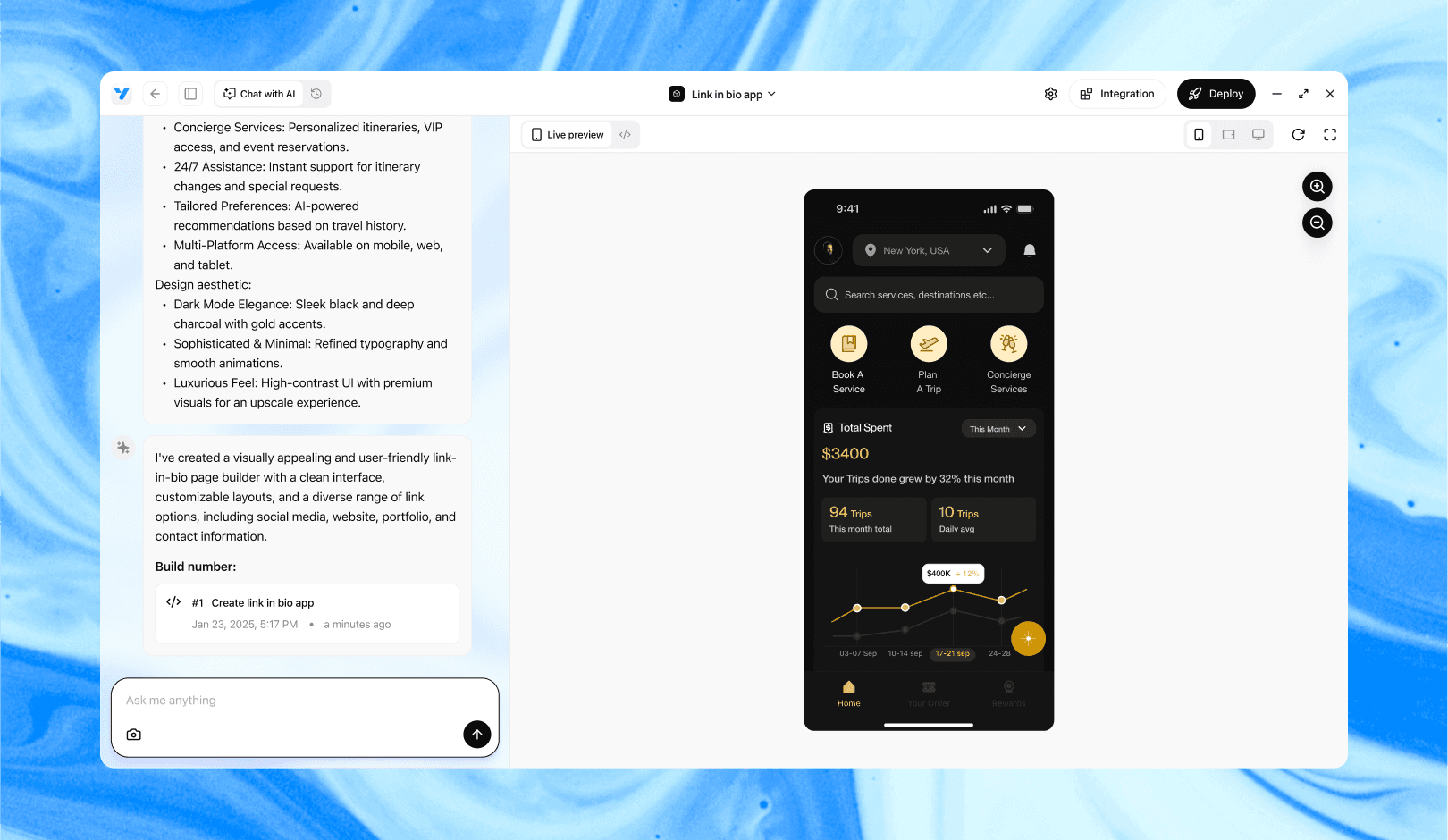
Vibe Studio, powered by Steve’s advanced AI agents, is a revolutionary no-code, conversational platform that empowers users to quickly and efficiently create full-stack Flutter applications integrated seamlessly with Firebase backend services. Ideal for solo founders, startups, and agile engineering teams, Vibe Studio allows users to visually manage and deploy Flutter apps, greatly accelerating the development process. The intuitive conversational interface simplifies complex development tasks, making app creation accessible even for non-coders.
Conclusion
AnimatedBuilder is a foundational tool in Flutter for crafting precise, performant animated UI effects in mobile development. Use it to separate animation timing from widget construction, compose multiple visual effects, and keep heavy widgets out of the per-frame rebuild path by leveraging the builder's child parameter. With controlled controllers, thoughtful curves, and Transform-based painting, you can deliver delightful interactions that feel native and fluid on mobile devices.

Introduction
Animated interactions are a hallmark of polished mobile development. In Flutter, the low-level building block for custom animation-driven widgets is AnimatedBuilder (commonly referenced as AnimationBuilder). This tutorial shows how to use AnimatedBuilder effectively to create delightful, efficient UI effects: separating animation logic from build logic, composing multiple transforms, and keeping performance predictable.
Why Use AnimatedBuilder
AnimatedBuilder lets you listen to an Animation and rebuild only the widget subtree that depends on it. Unlike implicit animations (AnimatedContainer, AnimatedOpacity), AnimatedBuilder works with AnimationController and Tween to provide precise timing, curves, and synchronization between multiple animated properties. For flutter mobile development, that means smooth transitions without rebuilding unrelated widgets, reduced layout churn, and full control over easing and repeat behavior.
Key benefits:
Fine-grained control: drive several properties from a single controller or multiple controllers.
Separation of concerns: keep animation state in controllers and build logic in the builder callback.
Performance: avoids setState for every tick; AnimatedBuilder calls the builder directly when the animation ticks.
Core Patterns
Pattern 1 — Single Controller, Multiple Tweens: Create one AnimationController and derive several Animations via Tween.animate to drive opacity, scale, and translation in sync.
Pattern 2 — Composition With Transform: Use Transform, Opacity, or Align inside the builder to apply visual effects without changing layout bounds unnecessarily.
Pattern 3 — Extract Reusable Animated Widgets: Pack an AnimatedBuilder and its controller into a small stateful widget when you need the same effect in multiple places. This keeps your page code tidy and testable.
Example skeleton (controller + AnimatedBuilder):
// In a StatefulWidget late final AnimationController controller = AnimationController( vsync: this, duration: Duration(milliseconds: 600)); final Animation<double> scale = Tween(begin: 0.8, end: 1.0).animate( CurvedAnimation(parent: controller, curve: Curves.easeOutBack)); Widget build(BuildContext context) => AnimatedBuilder( animation: controller, builder: (context, child) => Transform.scale( scale: scale.value, child: child, ), child: YourContentWidget(), );
Examples: Simple Bounce And Combined Effects
Example 1 — Bounce-in Card: Drive scale and shadow elevation from the same controller. Scale uses an elastic curve while elevation ramps linearly to avoid an overshoot in shadow.
Example 2 — Cross-Fade With Translate: Animate both opacity and slide offset: opacity uses a linear curve, offset uses Curves.easeOut. Wrap the target child in a Transform.translate and Opacity inside the builder.
Combined example for a compact animated item:
AnimatedBuilder( animation: controller, builder: (ctx, child) { final t = Curves.easeOut.transform(controller.value); return Opacity( opacity: t, child: Transform.translate( offset: Offset(0, (1 - t) * 20), child: child, ), ); }, child: ListTile(title: Text('Animated Item')), )
This pattern keeps the child subtree constant (so it won't rebuild every tick) while the builder applies paint-only transforms.
Performance And Composition
Keep these rules in mind for production mobile development:
Limit rebuilt subtrees: pass expensive widgets as the child parameter to AnimatedBuilder so they are not rebuilt every frame.
Use transforms for visual adjustments: Transform and Opacity are cheaper than changing layout constraints.
Reuse AnimationControllers where possible: creating controllers per frame or per list item can be expensive—dispose controllers in dispose().
Prefer vsync from a TickerProviderStateMixin to avoid unnecessary CPU/GPU usage.
When composing multiple animations, consider using Interval objects on CurvedAnimation to choreograph sequences from a single controller. That reduces the number of controllers and simplifies synchronization.
Vibe Studio

Vibe Studio, powered by Steve’s advanced AI agents, is a revolutionary no-code, conversational platform that empowers users to quickly and efficiently create full-stack Flutter applications integrated seamlessly with Firebase backend services. Ideal for solo founders, startups, and agile engineering teams, Vibe Studio allows users to visually manage and deploy Flutter apps, greatly accelerating the development process. The intuitive conversational interface simplifies complex development tasks, making app creation accessible even for non-coders.
Conclusion
AnimatedBuilder is a foundational tool in Flutter for crafting precise, performant animated UI effects in mobile development. Use it to separate animation timing from widget construction, compose multiple visual effects, and keep heavy widgets out of the per-frame rebuild path by leveraging the builder's child parameter. With controlled controllers, thoughtful curves, and Transform-based painting, you can deliver delightful interactions that feel native and fluid on mobile devices.
Build Flutter Apps Faster with Vibe Studio
Vibe Studio is your AI-powered Flutter development companion. Skip boilerplate, build in real-time, and deploy without hassle. Start creating apps at lightning speed with zero setup.
Other Insights