Uploading Large Files With Chunking And Retries In Flutter
Jan 27, 2026


Summary
Summary
Summary
Summary
This tutorial explains how to upload large files in Flutter reliably by breaking files into chunks, persisting progress, and applying per-chunk retries with exponential backoff. It covers client-side flow, code snippets for chunk reads and retry helper, and server expectations (chunk metadata, resume APIs, or signed URLs). The approach reduces failures, enables resume, and improves UX on flaky mobile networks.
Key insights:
Key insights:
Key insights:
Key insights:
Why Chunking Works: Breaking files into chunks reduces memory usage, limits retry scope, and enables resume.
Designing The Client-Side Flow: Persist fileId, currentChunk, and bytesUploaded; stream chunks and save progress to resume uploads.
Implementing Retries And Backoff: Use per-chunk exponential backoff with jitter and a max retry limit; allow cancellation.
Server-Side Considerations: Server should accept chunk metadata, report received chunks, verify checksums, and support signed URLs.
Best Practices: Choose a balanced chunk size, persist state locally, show progress in UI, and handle auth and quota checks.
Introduction
Uploading large files from a Flutter app (videos, backups, datasets) requires more than a single POST request. Mobile networks are flaky, users switch networks, and OS constraints may interrupt long transfers. Chunking plus reliable retry and resume logic makes large uploads practical and user-friendly. This tutorial covers a pragmatic client-side approach in Flutter, including chunking strategy, resumable state, retry with exponential backoff, and server expectations.
Why Chunking Works
Chunking breaks a large file into manageable pieces (chunks). Benefits:
Smaller payloads reduce memory pressure and avoid request timeouts.
Failed chunk uploads are retried independently — avoids restarting the whole file.
Server can validate and assemble chunks, enabling resume after interruptions.
Choose a chunk size balanced between network MTU and latency. Typical ranges: 256KB–5MB. Smaller chunks recover faster; larger chunks reduce overhead. Include a small manifest or metadata (fileId, totalChunks, chunkIndex, checksum) with each chunk request.
Designing The Client-Side Flow
Core client responsibilities:
Generate a unique fileId (UUID) per upload.
Stream file data in fixed-size chunks using RandomAccessFile or file.openRead().
Maintain local state: currentChunk, completedChunks, bytesUploaded; persist this to disk so uploads resume after app restarts.
Send per-chunk metadata so the server can reassemble and verify.
Example: read and POST each chunk. This snippet uses dart:io and http (pseudo-code simplified):
import 'dart:io'; import 'package:http/http.dart' as http; Future<void> uploadChunk(File file, String fileId, int offset, int len, int index) async { final raf = await file.open(); await raf.setPosition(offset); final chunk = await raf.read(len); await raf.close(); final req = http.MultipartRequest('POST', Uri.parse('https://api.example.com/upload')) ..fields['fileId'] = fileId ..fields['chunkIndex'] = '$index' ..files.add(http.MultipartFile.fromBytes('file', chunk, filename: 'chunk_$index')); final res = await req.send(); if (res.statusCode != 200) throw Exception('Chunk upload failed'); }
Persist upload progress in local storage (SharedPreferences, Hive, or a small file). When the app restarts, read saved progress and continue from the next incomplete chunk.
Implementing Retries And Backoff
Transient network failures are expected. Implement per-chunk retry with exponential backoff and jitter. Keep a max retry count (e.g., 5). If a chunk still fails after retries, mark the upload as paused and surface a retry option to the user.
Use an async retry helper that applies exponential backoff to async functions. The helper should:
Retry only on transient errors (timeouts, 5xx). Don't retry on 4xx unless it's rate limiting (429).
Apply jitter to avoid thundering herd.
Allow cancellation (user aborts upload).
Example exponential backoff helper:
Future<T> retryWithBackoff<T>(Future<T> Function() action, {int maxAttempts = 5}) async { int attempt = 0; while (true) { try { return await action(); } catch (e) { attempt++; if (attempt >= maxAttempts) rethrow; final waitMs = (1000 * (1 << attempt)) + (Random().nextInt(300)); await Future.delayed(Duration(milliseconds: waitMs)); } } }
Wrap each chunk upload in this helper. Track cumulative retry counts and expose progress to the UI so users see percentage and can pause/resume.
Server-Side Considerations
A robust server API makes client logic simpler. Required server behaviors:
Accept chunk uploads with metadata: fileId, chunkIndex, totalChunks, checksum.
Persist chunks temporarily and acknowledge each successful chunk with its index.
Offer an endpoint to query which chunks are already received so clients can resume gracefully.
Assemble chunks in order and verify the final checksum before marking the upload complete.
Apply quotas and authentication; validate chunk sizes and indexes.
Security: require authentication tokens per request and use TLS. For large-scale apps, delegate uploads to a storage service (S3, GCS) via signed URLs: server issues per-chunk signed URL and the client PUTs directly to storage, still using the same chunking/retry approach.
Vibe Studio
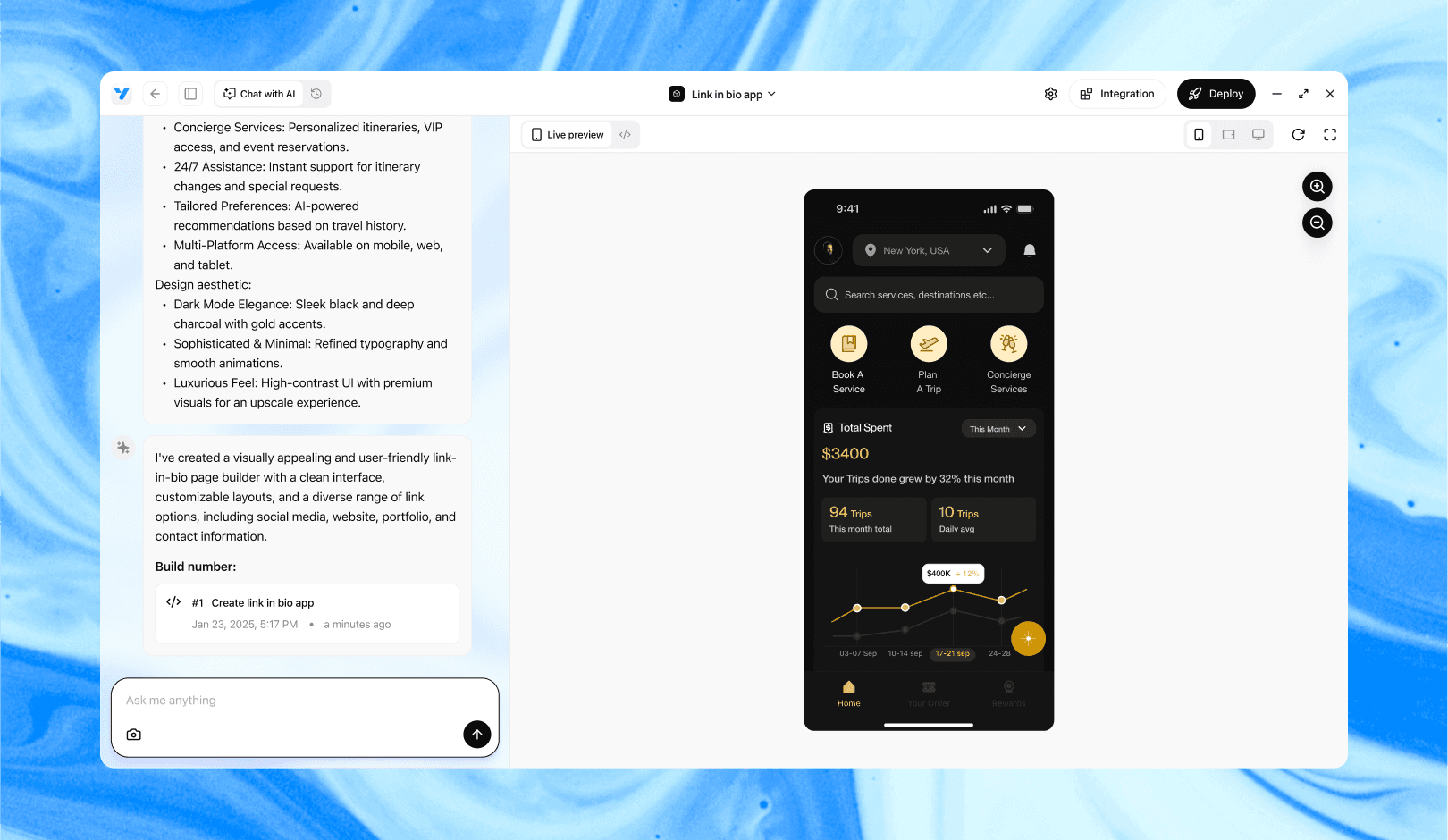
Vibe Studio, powered by Steve’s advanced AI agents, is a revolutionary no-code, conversational platform that empowers users to quickly and efficiently create full-stack Flutter applications integrated seamlessly with Firebase backend services. Ideal for solo founders, startups, and agile engineering teams, Vibe Studio allows users to visually manage and deploy Flutter apps, greatly accelerating the development process. The intuitive conversational interface simplifies complex development tasks, making app creation accessible even for non-coders.
Conclusion
Chunking with retries and persisted state transforms brittle large-file uploads into resilient flows on mobile. In Flutter, stream chunks via RandomAccessFile or file.openRead(), persist progress locally, and wrap chunk uploads with an exponential backoff retry helper. Design the server to accept and report chunk status or provide signed URLs. This combination minimizes wasted bandwidth, supports resume after interruptions, and delivers a reliable UX for large uploads on mobile networks.

Introduction
Uploading large files from a Flutter app (videos, backups, datasets) requires more than a single POST request. Mobile networks are flaky, users switch networks, and OS constraints may interrupt long transfers. Chunking plus reliable retry and resume logic makes large uploads practical and user-friendly. This tutorial covers a pragmatic client-side approach in Flutter, including chunking strategy, resumable state, retry with exponential backoff, and server expectations.
Why Chunking Works
Chunking breaks a large file into manageable pieces (chunks). Benefits:
Smaller payloads reduce memory pressure and avoid request timeouts.
Failed chunk uploads are retried independently — avoids restarting the whole file.
Server can validate and assemble chunks, enabling resume after interruptions.
Choose a chunk size balanced between network MTU and latency. Typical ranges: 256KB–5MB. Smaller chunks recover faster; larger chunks reduce overhead. Include a small manifest or metadata (fileId, totalChunks, chunkIndex, checksum) with each chunk request.
Designing The Client-Side Flow
Core client responsibilities:
Generate a unique fileId (UUID) per upload.
Stream file data in fixed-size chunks using RandomAccessFile or file.openRead().
Maintain local state: currentChunk, completedChunks, bytesUploaded; persist this to disk so uploads resume after app restarts.
Send per-chunk metadata so the server can reassemble and verify.
Example: read and POST each chunk. This snippet uses dart:io and http (pseudo-code simplified):
import 'dart:io'; import 'package:http/http.dart' as http; Future<void> uploadChunk(File file, String fileId, int offset, int len, int index) async { final raf = await file.open(); await raf.setPosition(offset); final chunk = await raf.read(len); await raf.close(); final req = http.MultipartRequest('POST', Uri.parse('https://api.example.com/upload')) ..fields['fileId'] = fileId ..fields['chunkIndex'] = '$index' ..files.add(http.MultipartFile.fromBytes('file', chunk, filename: 'chunk_$index')); final res = await req.send(); if (res.statusCode != 200) throw Exception('Chunk upload failed'); }
Persist upload progress in local storage (SharedPreferences, Hive, or a small file). When the app restarts, read saved progress and continue from the next incomplete chunk.
Implementing Retries And Backoff
Transient network failures are expected. Implement per-chunk retry with exponential backoff and jitter. Keep a max retry count (e.g., 5). If a chunk still fails after retries, mark the upload as paused and surface a retry option to the user.
Use an async retry helper that applies exponential backoff to async functions. The helper should:
Retry only on transient errors (timeouts, 5xx). Don't retry on 4xx unless it's rate limiting (429).
Apply jitter to avoid thundering herd.
Allow cancellation (user aborts upload).
Example exponential backoff helper:
Future<T> retryWithBackoff<T>(Future<T> Function() action, {int maxAttempts = 5}) async { int attempt = 0; while (true) { try { return await action(); } catch (e) { attempt++; if (attempt >= maxAttempts) rethrow; final waitMs = (1000 * (1 << attempt)) + (Random().nextInt(300)); await Future.delayed(Duration(milliseconds: waitMs)); } } }
Wrap each chunk upload in this helper. Track cumulative retry counts and expose progress to the UI so users see percentage and can pause/resume.
Server-Side Considerations
A robust server API makes client logic simpler. Required server behaviors:
Accept chunk uploads with metadata: fileId, chunkIndex, totalChunks, checksum.
Persist chunks temporarily and acknowledge each successful chunk with its index.
Offer an endpoint to query which chunks are already received so clients can resume gracefully.
Assemble chunks in order and verify the final checksum before marking the upload complete.
Apply quotas and authentication; validate chunk sizes and indexes.
Security: require authentication tokens per request and use TLS. For large-scale apps, delegate uploads to a storage service (S3, GCS) via signed URLs: server issues per-chunk signed URL and the client PUTs directly to storage, still using the same chunking/retry approach.
Vibe Studio

Vibe Studio, powered by Steve’s advanced AI agents, is a revolutionary no-code, conversational platform that empowers users to quickly and efficiently create full-stack Flutter applications integrated seamlessly with Firebase backend services. Ideal for solo founders, startups, and agile engineering teams, Vibe Studio allows users to visually manage and deploy Flutter apps, greatly accelerating the development process. The intuitive conversational interface simplifies complex development tasks, making app creation accessible even for non-coders.
Conclusion
Chunking with retries and persisted state transforms brittle large-file uploads into resilient flows on mobile. In Flutter, stream chunks via RandomAccessFile or file.openRead(), persist progress locally, and wrap chunk uploads with an exponential backoff retry helper. Design the server to accept and report chunk status or provide signed URLs. This combination minimizes wasted bandwidth, supports resume after interruptions, and delivers a reliable UX for large uploads on mobile networks.
Build Flutter Apps Faster with Vibe Studio
Vibe Studio is your AI-powered Flutter development companion. Skip boilerplate, build in real-time, and deploy without hassle. Start creating apps at lightning speed with zero setup.
Other Insights