Mastering SliverAppBar for Advanced Header Animations
Jan 14, 2026


Summary
Summary
Summary
Summary
This insight shows how to build advanced header animations with SliverAppBar in Flutter for mobile development. It covers FlexibleSpaceBar customization, synchronizing animations with scroll metrics, using SliverPersistentHeader for precise control, performance tips (RepaintBoundary, asset sizing), and accessibility considerations. Code snippets demonstrate practical patterns for parallax, stretch, and pinned behaviors.
Key insights:
Key insights:
Key insights:
Key insights:
Understanding SliverAppBar Basics: Control expandedHeight, pinned/floating/snap, and flexibleSpace for foundational behavior.
Customizing FlexibleSpace For Animations: Use collapseMode, stretchModes, and progress-driven transforms for rich effects.
Synchronizing Scroll Effects With Slivers: Derive animation progress from ScrollController or shrinkOffset for precise timing.
Performance And Accessibility Considerations: Reduce repaint cost, size images appropriately, and respect textScaleFactor and semantics.
Combining With Material Interactions: Use stretch triggers, snap animations, and status bar coordination for cohesive UX.
Introduction
SliverAppBar is one of Flutter's most powerful widgets for creating animated, responsive headers in mobile development. It sits inside a CustomScrollView alongside other slivers and exposes behaviors—pinned, floating, snap, stretch—that let you craft polished, native-feeling header animations. This tutorial focuses on advanced techniques: combining FlexibleSpace, SliverPersistentHeader, scroll-driven animations, and performance considerations to build refined header experiences.
Understanding SliverAppBar Basics
Before advanced patterns, ensure you control the three main concepts: expandedHeight, pinned/floating/snap flags, and flexibleSpace content. expandedHeight determines the maximum header area. pinned keeps the toolbar visible when collapsed; floating allows the bar to reappear during upward scroll; snap requires floating and animates to the nearest state. flexibleSpace defines what animates inside the expanded area and supports collapseMode and stretchModes.
Use FlexibleSpaceBar for common cases: it handles title scaling, centering, and parallax backgrounds. For custom motion—color shifts, cross-fades, or staggered micro-animations—you'll read scroll metrics or use a SliverPersistentHeader with a delegate that exposes a shrinkOffset to drive transforms.
Customizing FlexibleSpace For Animations
FlexibleSpaceBar supports basic effects via collapseMode: parallax, pin, or none. For richer animation, wrap content in an AnimatedBuilder driven by a ScrollController or by the incoming shrinkOffset from a SliverPersistentHeaderDelegate.
Example: a SliverAppBar with a FlexibleSpaceBar that uses stretch modes and parallax for an immersive header.
SliverAppBar( expandedHeight: 300, pinned: true, stretch: true, flexibleSpace: FlexibleSpaceBar( title: Text('Gallery'), background: Image.asset('assets/bg.jpg', fit: BoxFit.cover), collapseMode: CollapseMode.parallax, stretchModes: [StretchMode.zoomBackground], ), )
To animate elements inside flexibleSpace beyond the built-in title scaling, compute an explicit progress value between 0 and 1 representing collapsed state and map it to opacity, translation, or scale. You can derive this from a ScrollController offset or from a SliverPersistentHeaderDelegate's shrinkOffset ratio.
Synchronizing Scroll Effects With Slivers
When an animation must respond precisely to scroll—e.g., a header image cross-fades to a toolbar color, or action buttons slide in—you should centralize scroll metrics. Use a CustomScrollView with a ScrollController and listen to its offset, or embed NotificationListener around your scroll view. Convert offset into a 0..1 progress and feed it into ValueListenableBuilder or an AnimationController (using animateTo for smooth snaps).
For sticky behaviors that need to remain in the sliver pipeline (so other slivers measure correctly), prefer SliverPersistentHeader. Implement build(context, shrinkOffset, overlapsContent) and compute double t = (shrinkOffset / maxExtent). Use t to interpolate between two widget states: opacity, transform, or layout size. This keeps everything in the sliver lifecycle and prevents jank from overlaying widgets outside the scroll area.
Performance And Accessibility Considerations
Advanced headers frequently use images, blurs, and shadow layers. Keep these rules in mind:
Avoid expensive repainting: mark animated subtrees with RepaintBoundary when they repaint frequently while siblings do not.
Prefer shader-free transformations (translate, scale) over repeated compositing and blur shaders where possible. Use cached network images or resized assets to the largest expected size to reduce decode overhead.
Limit the depth of nested widgets in flexibleSpace. Heavy layout during scroll kills 60fps.
For accessibility, ensure semantic labels for dynamic titles and expose tappable regions with sufficient hit targets. Respect textScaleFactor by avoiding fixed-size containers for title text; use FittedBox sparingly.
Also measure memory on lower-end devices: large background images are common sliver culprits. Use precacheImage and consider a lower-resolution fallback for constrained devices or slow networks.
Combining With Material Interactions
When using floating + snap, combine with a ScrollController.animateTo to programmatically reveal the app bar. For pull-to-refresh interactions, SliverAppBar's stretch and onStretchTrigger provide a native-feeling hook. Use onStretchTrigger to run async refresh logic while keeping your UI responsive.
Keep the visual language coherent: coordinate header color changes with SystemChrome.setSystemUIOverlayStyle when the toolbar contrasts with content. Animate status bar icon brightness only at clear transition points to avoid flicker.
Vibe Studio
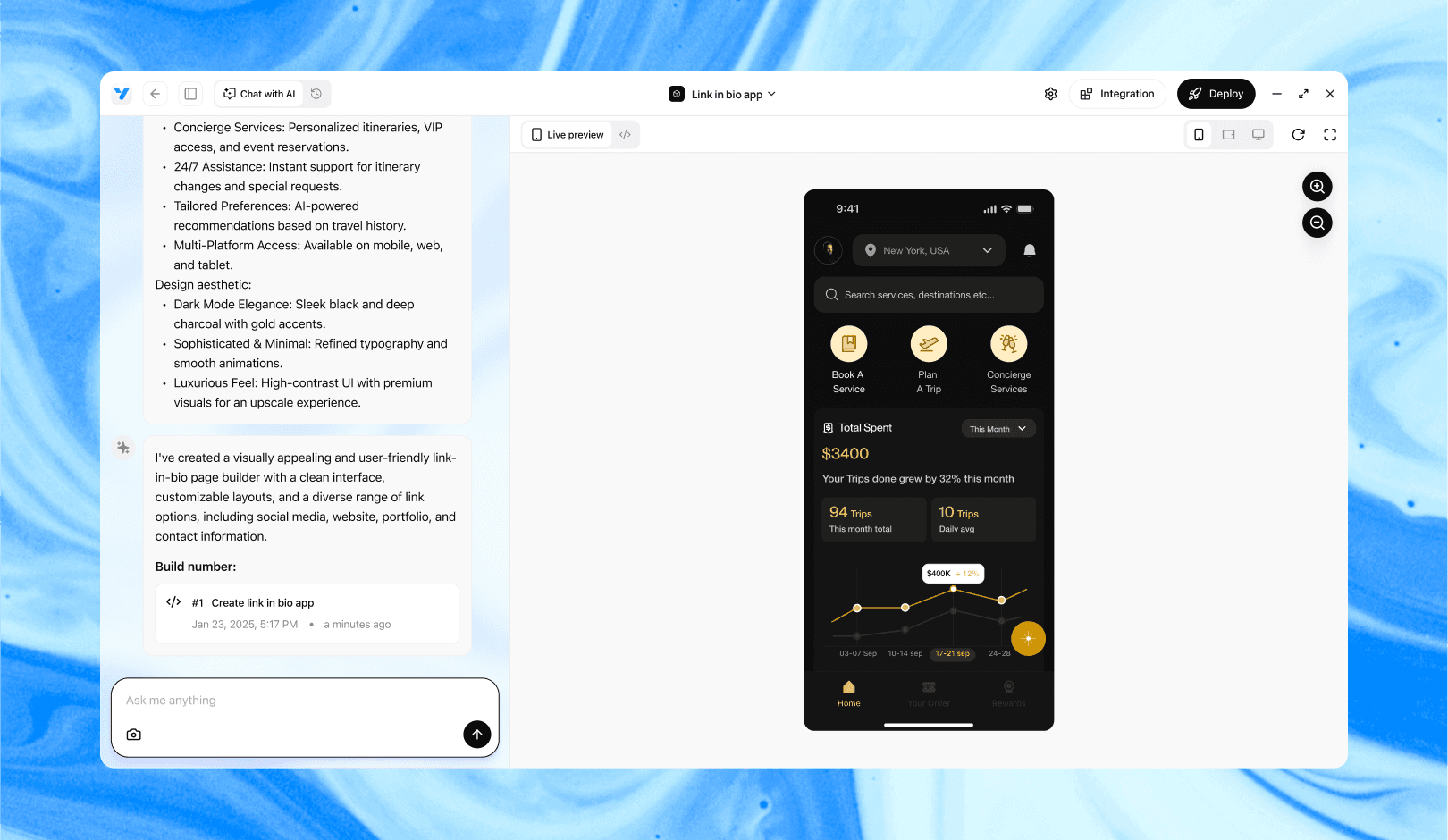
Vibe Studio, powered by Steve’s advanced AI agents, is a revolutionary no-code, conversational platform that empowers users to quickly and efficiently create full-stack Flutter applications integrated seamlessly with Firebase backend services. Ideal for solo founders, startups, and agile engineering teams, Vibe Studio allows users to visually manage and deploy Flutter apps, greatly accelerating the development process. The intuitive conversational interface simplifies complex development tasks, making app creation accessible even for non-coders.
Conclusion
Mastering SliverAppBar for advanced header animations in Flutter means thinking in slivers: keep animations inside the sliver pipeline when possible, derive progress from shrinkOffset or ScrollController, and prefer composable, lightweight widgets for smooth performance. Use FlexibleSpaceBar for common effects and SliverPersistentHeader for bespoke, scroll-driven transforms. With attention to repaint boundaries, image sizing, and accessibility, you can implement sophisticated, high-performance headers that feel native on mobile development platforms.

Introduction
SliverAppBar is one of Flutter's most powerful widgets for creating animated, responsive headers in mobile development. It sits inside a CustomScrollView alongside other slivers and exposes behaviors—pinned, floating, snap, stretch—that let you craft polished, native-feeling header animations. This tutorial focuses on advanced techniques: combining FlexibleSpace, SliverPersistentHeader, scroll-driven animations, and performance considerations to build refined header experiences.
Understanding SliverAppBar Basics
Before advanced patterns, ensure you control the three main concepts: expandedHeight, pinned/floating/snap flags, and flexibleSpace content. expandedHeight determines the maximum header area. pinned keeps the toolbar visible when collapsed; floating allows the bar to reappear during upward scroll; snap requires floating and animates to the nearest state. flexibleSpace defines what animates inside the expanded area and supports collapseMode and stretchModes.
Use FlexibleSpaceBar for common cases: it handles title scaling, centering, and parallax backgrounds. For custom motion—color shifts, cross-fades, or staggered micro-animations—you'll read scroll metrics or use a SliverPersistentHeader with a delegate that exposes a shrinkOffset to drive transforms.
Customizing FlexibleSpace For Animations
FlexibleSpaceBar supports basic effects via collapseMode: parallax, pin, or none. For richer animation, wrap content in an AnimatedBuilder driven by a ScrollController or by the incoming shrinkOffset from a SliverPersistentHeaderDelegate.
Example: a SliverAppBar with a FlexibleSpaceBar that uses stretch modes and parallax for an immersive header.
SliverAppBar( expandedHeight: 300, pinned: true, stretch: true, flexibleSpace: FlexibleSpaceBar( title: Text('Gallery'), background: Image.asset('assets/bg.jpg', fit: BoxFit.cover), collapseMode: CollapseMode.parallax, stretchModes: [StretchMode.zoomBackground], ), )
To animate elements inside flexibleSpace beyond the built-in title scaling, compute an explicit progress value between 0 and 1 representing collapsed state and map it to opacity, translation, or scale. You can derive this from a ScrollController offset or from a SliverPersistentHeaderDelegate's shrinkOffset ratio.
Synchronizing Scroll Effects With Slivers
When an animation must respond precisely to scroll—e.g., a header image cross-fades to a toolbar color, or action buttons slide in—you should centralize scroll metrics. Use a CustomScrollView with a ScrollController and listen to its offset, or embed NotificationListener around your scroll view. Convert offset into a 0..1 progress and feed it into ValueListenableBuilder or an AnimationController (using animateTo for smooth snaps).
For sticky behaviors that need to remain in the sliver pipeline (so other slivers measure correctly), prefer SliverPersistentHeader. Implement build(context, shrinkOffset, overlapsContent) and compute double t = (shrinkOffset / maxExtent). Use t to interpolate between two widget states: opacity, transform, or layout size. This keeps everything in the sliver lifecycle and prevents jank from overlaying widgets outside the scroll area.
Performance And Accessibility Considerations
Advanced headers frequently use images, blurs, and shadow layers. Keep these rules in mind:
Avoid expensive repainting: mark animated subtrees with RepaintBoundary when they repaint frequently while siblings do not.
Prefer shader-free transformations (translate, scale) over repeated compositing and blur shaders where possible. Use cached network images or resized assets to the largest expected size to reduce decode overhead.
Limit the depth of nested widgets in flexibleSpace. Heavy layout during scroll kills 60fps.
For accessibility, ensure semantic labels for dynamic titles and expose tappable regions with sufficient hit targets. Respect textScaleFactor by avoiding fixed-size containers for title text; use FittedBox sparingly.
Also measure memory on lower-end devices: large background images are common sliver culprits. Use precacheImage and consider a lower-resolution fallback for constrained devices or slow networks.
Combining With Material Interactions
When using floating + snap, combine with a ScrollController.animateTo to programmatically reveal the app bar. For pull-to-refresh interactions, SliverAppBar's stretch and onStretchTrigger provide a native-feeling hook. Use onStretchTrigger to run async refresh logic while keeping your UI responsive.
Keep the visual language coherent: coordinate header color changes with SystemChrome.setSystemUIOverlayStyle when the toolbar contrasts with content. Animate status bar icon brightness only at clear transition points to avoid flicker.
Vibe Studio

Vibe Studio, powered by Steve’s advanced AI agents, is a revolutionary no-code, conversational platform that empowers users to quickly and efficiently create full-stack Flutter applications integrated seamlessly with Firebase backend services. Ideal for solo founders, startups, and agile engineering teams, Vibe Studio allows users to visually manage and deploy Flutter apps, greatly accelerating the development process. The intuitive conversational interface simplifies complex development tasks, making app creation accessible even for non-coders.
Conclusion
Mastering SliverAppBar for advanced header animations in Flutter means thinking in slivers: keep animations inside the sliver pipeline when possible, derive progress from shrinkOffset or ScrollController, and prefer composable, lightweight widgets for smooth performance. Use FlexibleSpaceBar for common effects and SliverPersistentHeader for bespoke, scroll-driven transforms. With attention to repaint boundaries, image sizing, and accessibility, you can implement sophisticated, high-performance headers that feel native on mobile development platforms.
Build Flutter Apps Faster with Vibe Studio
Vibe Studio is your AI-powered Flutter development companion. Skip boilerplate, build in real-time, and deploy without hassle. Start creating apps at lightning speed with zero setup.
Other Insights