Mastering Flutter’s AnimationController for Smooth Motion
Nov 18, 2025


Summary
Summary
Summary
Summary
This article explains how to use AnimationController in flutter for smooth mobile animations. Learn proper lifecycle management with vsync and dispose, compose Tween and CurvedAnimation for natural motion, chain and stagger animations with intervals, and apply performance best practices like using AnimatedBuilder and GPU-friendly transforms.
Key insights:
Key insights:
Key insights:
Key insights:
Understanding AnimationController: AnimationController produces 0.0–1.0 values over time and should be driven by a TickerProvider for smooth motion.
Managing Lifecycles And Tickers: Always mix in SingleTickerProviderStateMixin or TickerProviderStateMixin and dispose controllers to prevent resource leaks and battery drain.
Tweening And Curved Animations: Combine Tween with CurvedAnimation and Interval to map controller output to natural, eased motion and staggered sequences.
Performance And Best Practices: Prefer transforms and opacity for GPU-accelerated motion, use AnimatedBuilder to avoid heavy rebuilds, and profile for 60fps.
Staggering And Chaining Animations: Use intervals or addStatusListener to coordinate phases without creating unnecessary controllers, producing smooth transitions.
Introduction
Animation is a core technique for creating polished, responsive mobile apps in flutter. AnimationController is the primitive that drives explicit animations: it produces a value from 0.0 to 1.0 over time and lets you compose tweens, curves, and listeners for complex motion. This article focuses on practical patterns for mastering AnimationController, managing lifecycles, combining tweens and curves, and keeping animations performant in mobile development.
Understanding AnimationController
AnimationController is a special Animation that you instantiate with a TickerProvider (usually a State with SingleTickerProviderStateMixin). Configure duration for the overall timing and call forward, reverse, repeat, or animateTo to drive the value. Key properties: value, status, duration, and vsync. Typical usage embeds an AnimatedBuilder or listens to the controller to call setState.
Minimal example pattern inside a State class:
class _MyWidgetState extends State<MyWidget> with SingleTickerProviderStateMixin {
late final AnimationController controller;
@override
void initState() {
super.initState();
controller = AnimationController(vsync: this, duration: const Duration(milliseconds: 400));
controller.forward();
}
@override
void dispose() {
controller.dispose();
super.dispose();
}
}Use listeners sparingly. Prefer AnimatedBuilder, AnimatedWidget, or widgets that accept an Animation to separate animation logic from build code.
Managing Lifecycles And Tickers
A common source of bugs is creating controllers without a proper vsync or failing to dispose them. Always mix in SingleTickerProviderStateMixin or TickerProviderStateMixin for multiple controllers. When a widget may be removed from the tree, dispose the controller to stop the ticker and free resources.
Use addStatusListener to chain animations: start a second controller when the first completes, or reverse automatically. If you need pause and resume across app lifecycle events, observe WidgetsBinding.instance.lifecycleState and pause the controller when the app is inactive to avoid wasted CPU and battery drain on mobile devices.
When using multiple controllers, prefer TickerProviderStateMixin rather than creating multiple single tickers to manage resources efficiently.
Tweening And Curved Animations
A bare AnimationController outputs linear values. To make motion feel natural, wrap it with Tween and CurvedAnimation.
Tween maps controller values into your target range, for example Tween(begin: 0.0, end: 200.0).
CurvedAnimation applies easing like Curves.easeOutBack or Curves.decelerate.
Compose them like this:
final position = Tween(begin: 0.0, end: 300.0)
.animate(CurvedAnimation(parent: controller, curve: Curves.easeOut));
AnimatedBuilder(
animation: position,
builder: (context, child) => Transform.translate(
offset: Offset(position.value, 0), child: child),
child: myChild,
);Use Interval for staggered sequences: create multiple tweens that map different controller subranges to different motion phases. This avoids multiple controllers and improves coordination.
Performance And Best Practices
Keep these pragmatic rules in mind for production mobile development:
Prefer compositing-friendly primitives: opacity and transforms are GPU-accelerated. Animating layout (rebuilding with expensive layout changes) can be costly.
Avoid calling setState on every tick for complex trees. Use AnimatedBuilder or separate a lightweight widget that rebuilds from the animation.
Limit animation duration and complexity on low-end devices. Provide reduced motion options for accessibility by checking MediaQueryData.disableAnimations or platform accessibility settings.
Reuse controllers when possible. Creating and disposing controllers frequently during fast widget recreation can tax the scheduler.
Test with different frame budgets. Enable performance overlays and profile to ensure your animation runs at 60fps or the device refresh rate.
Edge cases: when interrupting an animation, prefer animateTo with a target and a curve instead of repeatedly reversing forward calls; this produces smoother transitions because the controller computes a single eased path.
Vibe Studio
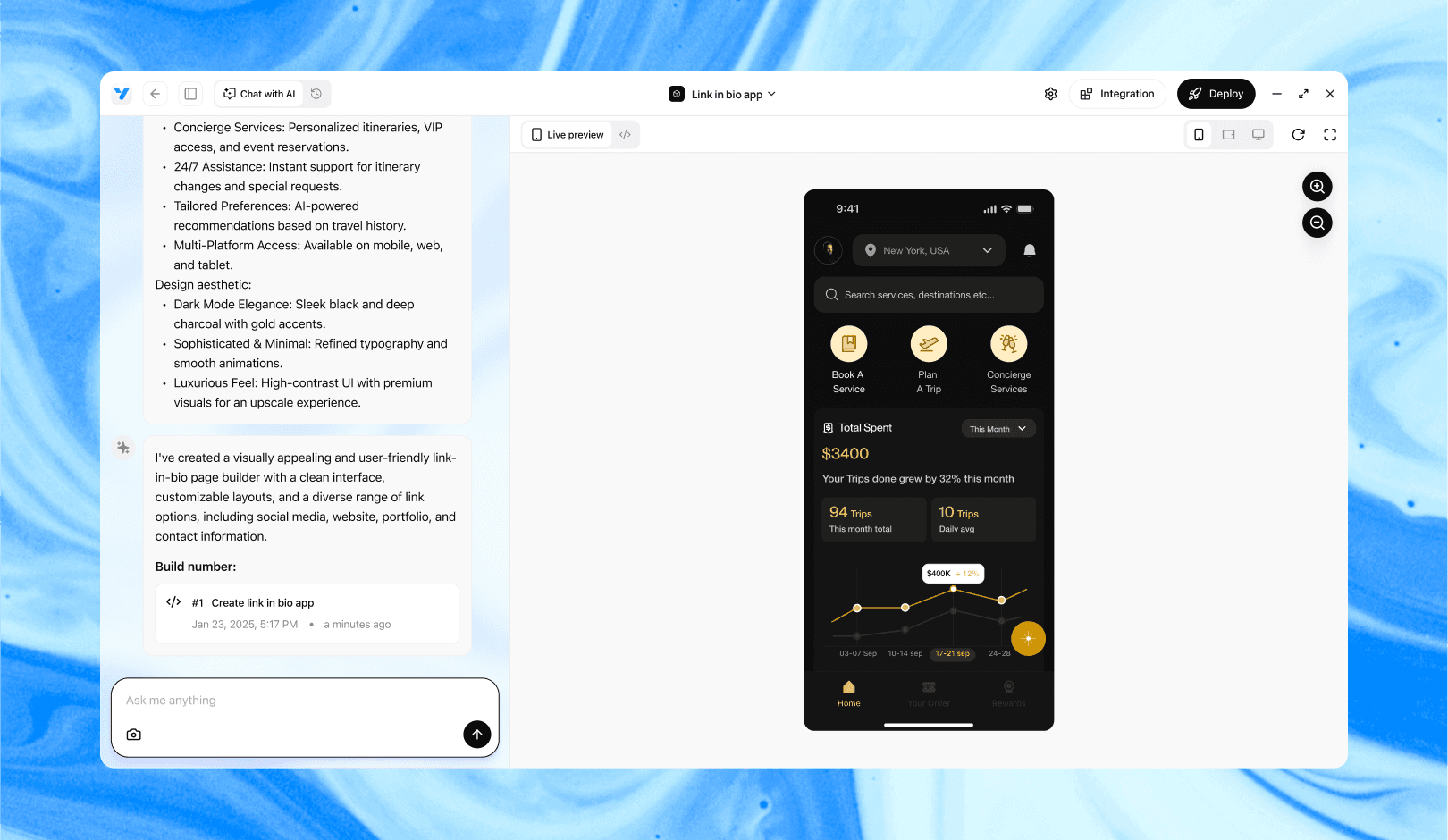
Vibe Studio, powered by Steve’s advanced AI agents, is a revolutionary no-code, conversational platform that empowers users to quickly and efficiently create full-stack Flutter applications integrated seamlessly with Firebase backend services. Ideal for solo founders, startups, and agile engineering teams, Vibe Studio allows users to visually manage and deploy Flutter apps, greatly accelerating the development process. The intuitive conversational interface simplifies complex development tasks, making app creation accessible even for non-coders.
Conclusion
AnimationController is a compact but powerful building block in flutter for creating smooth motion in mobile development. Use proper lifecycle management, compose tweens and curves, prefer AnimatedBuilder to minimize rebuilds, and profile performance on target devices. With these patterns you can build responsive, natural-feeling animations while keeping CPU and battery impact low. Start with short, isolated controllers, compose with CurvedAnimation and Tween, then scale to staggered and coordinated sequences as your UI demands.

Introduction
Animation is a core technique for creating polished, responsive mobile apps in flutter. AnimationController is the primitive that drives explicit animations: it produces a value from 0.0 to 1.0 over time and lets you compose tweens, curves, and listeners for complex motion. This article focuses on practical patterns for mastering AnimationController, managing lifecycles, combining tweens and curves, and keeping animations performant in mobile development.
Understanding AnimationController
AnimationController is a special Animation that you instantiate with a TickerProvider (usually a State with SingleTickerProviderStateMixin). Configure duration for the overall timing and call forward, reverse, repeat, or animateTo to drive the value. Key properties: value, status, duration, and vsync. Typical usage embeds an AnimatedBuilder or listens to the controller to call setState.
Minimal example pattern inside a State class:
class _MyWidgetState extends State<MyWidget> with SingleTickerProviderStateMixin {
late final AnimationController controller;
@override
void initState() {
super.initState();
controller = AnimationController(vsync: this, duration: const Duration(milliseconds: 400));
controller.forward();
}
@override
void dispose() {
controller.dispose();
super.dispose();
}
}Use listeners sparingly. Prefer AnimatedBuilder, AnimatedWidget, or widgets that accept an Animation to separate animation logic from build code.
Managing Lifecycles And Tickers
A common source of bugs is creating controllers without a proper vsync or failing to dispose them. Always mix in SingleTickerProviderStateMixin or TickerProviderStateMixin for multiple controllers. When a widget may be removed from the tree, dispose the controller to stop the ticker and free resources.
Use addStatusListener to chain animations: start a second controller when the first completes, or reverse automatically. If you need pause and resume across app lifecycle events, observe WidgetsBinding.instance.lifecycleState and pause the controller when the app is inactive to avoid wasted CPU and battery drain on mobile devices.
When using multiple controllers, prefer TickerProviderStateMixin rather than creating multiple single tickers to manage resources efficiently.
Tweening And Curved Animations
A bare AnimationController outputs linear values. To make motion feel natural, wrap it with Tween and CurvedAnimation.
Tween maps controller values into your target range, for example Tween(begin: 0.0, end: 200.0).
CurvedAnimation applies easing like Curves.easeOutBack or Curves.decelerate.
Compose them like this:
final position = Tween(begin: 0.0, end: 300.0)
.animate(CurvedAnimation(parent: controller, curve: Curves.easeOut));
AnimatedBuilder(
animation: position,
builder: (context, child) => Transform.translate(
offset: Offset(position.value, 0), child: child),
child: myChild,
);Use Interval for staggered sequences: create multiple tweens that map different controller subranges to different motion phases. This avoids multiple controllers and improves coordination.
Performance And Best Practices
Keep these pragmatic rules in mind for production mobile development:
Prefer compositing-friendly primitives: opacity and transforms are GPU-accelerated. Animating layout (rebuilding with expensive layout changes) can be costly.
Avoid calling setState on every tick for complex trees. Use AnimatedBuilder or separate a lightweight widget that rebuilds from the animation.
Limit animation duration and complexity on low-end devices. Provide reduced motion options for accessibility by checking MediaQueryData.disableAnimations or platform accessibility settings.
Reuse controllers when possible. Creating and disposing controllers frequently during fast widget recreation can tax the scheduler.
Test with different frame budgets. Enable performance overlays and profile to ensure your animation runs at 60fps or the device refresh rate.
Edge cases: when interrupting an animation, prefer animateTo with a target and a curve instead of repeatedly reversing forward calls; this produces smoother transitions because the controller computes a single eased path.
Vibe Studio

Vibe Studio, powered by Steve’s advanced AI agents, is a revolutionary no-code, conversational platform that empowers users to quickly and efficiently create full-stack Flutter applications integrated seamlessly with Firebase backend services. Ideal for solo founders, startups, and agile engineering teams, Vibe Studio allows users to visually manage and deploy Flutter apps, greatly accelerating the development process. The intuitive conversational interface simplifies complex development tasks, making app creation accessible even for non-coders.
Conclusion
AnimationController is a compact but powerful building block in flutter for creating smooth motion in mobile development. Use proper lifecycle management, compose tweens and curves, prefer AnimatedBuilder to minimize rebuilds, and profile performance on target devices. With these patterns you can build responsive, natural-feeling animations while keeping CPU and battery impact low. Start with short, isolated controllers, compose with CurvedAnimation and Tween, then scale to staggered and coordinated sequences as your UI demands.

Build Flutter Apps Faster with Vibe Studio
Vibe Studio is your AI-powered Flutter development companion. Skip boilerplate, build in real-time, and deploy without hassle. Start creating apps at lightning speed with zero setup.