Mastering Advanced Routing Using Navigator 2.0
Dec 8, 2025


Summary
Summary
Summary
Summary
Navigator 2.0 gives Flutter mobile development a declarative navigation model. Build a simple RouteInformationParser to map URLs to route state, implement a RouterDelegate that converts state to Pages, handle deep links and restoration, and write unit tests for deterministic behavior. Use keys and lightweight page wrappers for performance and preserve nested navigation by modeling sub-states.
Key insights:
Key insights:
Key insights:
Key insights:
Why Navigator 2.0: Use a single source of truth—immutable route state maps deterministically to a navigation stack.
RouterDelegate And RouteInformationParser: Separate parsing from presentation; parser → state, delegate → pages.
Handling Deep Links And State Restoration: Persist minimal serializable route state and rehydrate via setNewRoutePath.
Testing And Best Practices: Unit-test parser and delegate transformations and prefer page keys to preserve state.
Performance And User Experience: Build lightweight Page wrappers and lazy-load heavy subtrees to keep navigation fast.
Introduction
Navigator 2.0 replaces imperative route-pushing with a declarative, URL-driven API that maps application state to a navigation stack. For Flutter mobile development teams building complex apps — nested navigation, deep linking, guarded routes, or platform-level back handling — mastering Navigator 2.0 is essential. This article shows how to structure RouterDelegate and RouteInformationParser, model route state, handle deep links and state restoration, and test navigation flows efficiently.
Why Navigator 2.0
Navigator 1.0 works well for simple stacks but becomes brittle for dynamic state, multi-stack UI, or web-like URLs. Navigator 2.0 separates parsing from presentation: RouteInformationParser converts platform URLs into typed application state, RouterDelegate builds a list of Pages from that state, and the Router component ties them together. This separation enables:
Single source of truth for navigation state.
Deterministic stack rendering from state objects.
Smooth deep linking, browser integration, and state restoration.
Design your app state as immutable value objects that represent the current route(s). Avoid storing transient UI details in navigation state; instead, derive UI from your route model.
RouterDelegate And RouteInformationParser
RouterDelegate is responsible for translating your app state into a List and for notifying the Router when state changes. RouteInformationParser translates OS-level RouteInformation into your typed configuration (and back).
Minimal RouterDelegate skeleton:
class AppRouterDelegate extends RouterDelegate<AppRouteState>
with ChangeNotifier, PopNavigatorRouterDelegateMixin<AppRouteState> {
final GlobalKey<NavigatorState> navigatorKey = GlobalKey<NavigatorState>();
AppRouteState state = AppRouteState.home();
@override
Widget build(BuildContext context) {
return Navigator(key: navigatorKey, pages: state.pages, onPopPage: _onPop);
}
}Key points:
Keep RouterDelegate logic small: accept commands (e.g., pushProfile(userId)) that mutate the route state then call notifyListeners().
Build pages from state using MaterialPage/CupertinoPage with unique keys to preserve subtree state when needed.
Implement
setNewRoutePathto update state from parsed configurations when the OS provides a new URL.
A compact RouteInformationParser example:
class AppRouteParser extends RouteInformationParser<AppRouteState> {
@override
Future<AppRouteState> parseRouteInformation(RouteInformation info) async {
final uri = Uri.parse(info.location ?? '/');
if (uri.pathSegments.isEmpty) return AppRouteState.home();
if (uri.pathSegments.first == 'profile') return AppRouteState.profile(id: uri.pathSegments[1]);
return AppRouteState.unknown();
}
}Keep parsing logic simple and testable; map each URL pattern to a deterministic state object.
Handling Deep Links And State Restoration
Deep links should be expressible as URLs that the RouteInformationParser understands. Support both cold start deep links and in-app navigation to update the browser URL (or OS RouteInformation).
For state restoration:
Persist minimal route state (route name, IDs) rather than UI subtree data.
Implement
restoreStateor rehydrate your RouterDelegate state insetNewRoutePathfrom persisted storage.Use Page keys to preserve widget state for long-lived pages.
Guarded routes and auth flows: model auth as part of your route state. When the app state indicates an unauthenticated user tries to access a protected route, RouterDelegate should replace the desired route with a sign-in page and remember an intended destination to navigate to after sign-in.
Testing And Best Practices
Write unit tests for RouteInformationParser and RouterDelegate transformations. Test cases should assert that a given URL yields the correct AppRouteState, and that AppRouteState yields an expected List.
Best practices:
Keep route state serializable (simple strings/ints) so URLs and persistence are trivial.
Co-locate path-to-state parsing logic to avoid duplication.
Prefer Pages with explicit keys to avoid unexpected rebuilds and preserve nested navigator state.
For nested navigation (shell apps, tabbed UIs), maintain independent sub-route states and assemble them in the root RouterDelegate.
Use Navigator.pages API for declarative stack mutations rather than imperative push/pop where possible.
Performance considerations: building pages should be cheap. Avoid building heavy widget subtrees inside RouterDelegate.build; instead, build lightweight page wrappers that lazily initialize content.
Vibe Studio
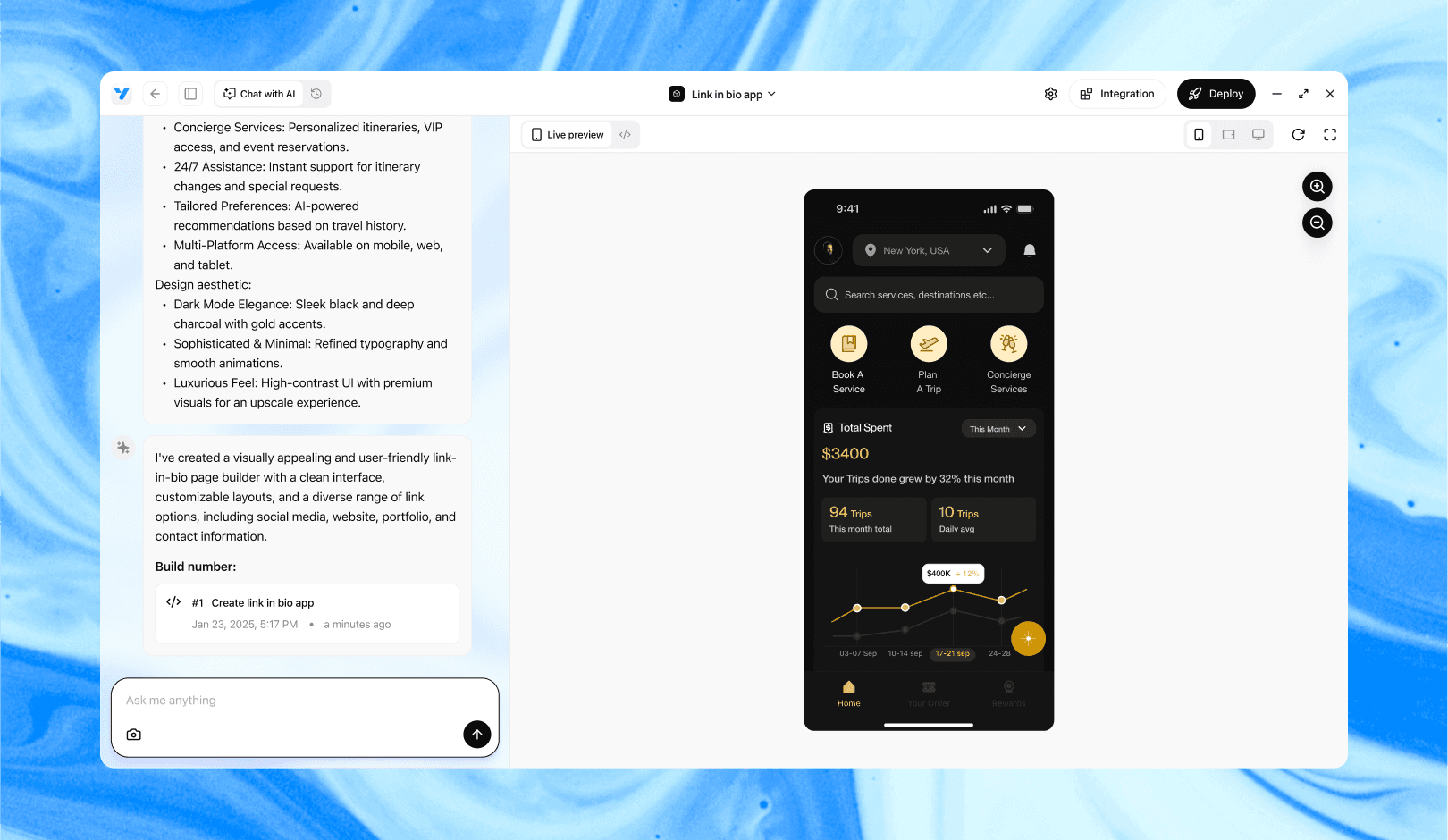
Vibe Studio, powered by Steve’s advanced AI agents, is a revolutionary no-code, conversational platform that empowers users to quickly and efficiently create full-stack Flutter applications integrated seamlessly with Firebase backend services. Ideal for solo founders, startups, and agile engineering teams, Vibe Studio allows users to visually manage and deploy Flutter apps, greatly accelerating the development process. The intuitive conversational interface simplifies complex development tasks, making app creation accessible even for non-coders.
Conclusion
Navigator 2.0 shifts navigation to a declarative, testable model suitable for modern Flutter mobile development. Focus on a clean route state model, simple parsers, and small RouterDelegate command surfaces. With predictable state-to-Page mapping, deep links, restoration, guarded routes, and nested navigation become manageable and robust. Start by extracting a tiny RouteInformationParser and RouterDelegate in a new project and iterate—incremental adoption is practical and low-risk.

Introduction
Navigator 2.0 replaces imperative route-pushing with a declarative, URL-driven API that maps application state to a navigation stack. For Flutter mobile development teams building complex apps — nested navigation, deep linking, guarded routes, or platform-level back handling — mastering Navigator 2.0 is essential. This article shows how to structure RouterDelegate and RouteInformationParser, model route state, handle deep links and state restoration, and test navigation flows efficiently.
Why Navigator 2.0
Navigator 1.0 works well for simple stacks but becomes brittle for dynamic state, multi-stack UI, or web-like URLs. Navigator 2.0 separates parsing from presentation: RouteInformationParser converts platform URLs into typed application state, RouterDelegate builds a list of Pages from that state, and the Router component ties them together. This separation enables:
Single source of truth for navigation state.
Deterministic stack rendering from state objects.
Smooth deep linking, browser integration, and state restoration.
Design your app state as immutable value objects that represent the current route(s). Avoid storing transient UI details in navigation state; instead, derive UI from your route model.
RouterDelegate And RouteInformationParser
RouterDelegate is responsible for translating your app state into a List and for notifying the Router when state changes. RouteInformationParser translates OS-level RouteInformation into your typed configuration (and back).
Minimal RouterDelegate skeleton:
class AppRouterDelegate extends RouterDelegate<AppRouteState>
with ChangeNotifier, PopNavigatorRouterDelegateMixin<AppRouteState> {
final GlobalKey<NavigatorState> navigatorKey = GlobalKey<NavigatorState>();
AppRouteState state = AppRouteState.home();
@override
Widget build(BuildContext context) {
return Navigator(key: navigatorKey, pages: state.pages, onPopPage: _onPop);
}
}Key points:
Keep RouterDelegate logic small: accept commands (e.g., pushProfile(userId)) that mutate the route state then call notifyListeners().
Build pages from state using MaterialPage/CupertinoPage with unique keys to preserve subtree state when needed.
Implement
setNewRoutePathto update state from parsed configurations when the OS provides a new URL.
A compact RouteInformationParser example:
class AppRouteParser extends RouteInformationParser<AppRouteState> {
@override
Future<AppRouteState> parseRouteInformation(RouteInformation info) async {
final uri = Uri.parse(info.location ?? '/');
if (uri.pathSegments.isEmpty) return AppRouteState.home();
if (uri.pathSegments.first == 'profile') return AppRouteState.profile(id: uri.pathSegments[1]);
return AppRouteState.unknown();
}
}Keep parsing logic simple and testable; map each URL pattern to a deterministic state object.
Handling Deep Links And State Restoration
Deep links should be expressible as URLs that the RouteInformationParser understands. Support both cold start deep links and in-app navigation to update the browser URL (or OS RouteInformation).
For state restoration:
Persist minimal route state (route name, IDs) rather than UI subtree data.
Implement
restoreStateor rehydrate your RouterDelegate state insetNewRoutePathfrom persisted storage.Use Page keys to preserve widget state for long-lived pages.
Guarded routes and auth flows: model auth as part of your route state. When the app state indicates an unauthenticated user tries to access a protected route, RouterDelegate should replace the desired route with a sign-in page and remember an intended destination to navigate to after sign-in.
Testing And Best Practices
Write unit tests for RouteInformationParser and RouterDelegate transformations. Test cases should assert that a given URL yields the correct AppRouteState, and that AppRouteState yields an expected List.
Best practices:
Keep route state serializable (simple strings/ints) so URLs and persistence are trivial.
Co-locate path-to-state parsing logic to avoid duplication.
Prefer Pages with explicit keys to avoid unexpected rebuilds and preserve nested navigator state.
For nested navigation (shell apps, tabbed UIs), maintain independent sub-route states and assemble them in the root RouterDelegate.
Use Navigator.pages API for declarative stack mutations rather than imperative push/pop where possible.
Performance considerations: building pages should be cheap. Avoid building heavy widget subtrees inside RouterDelegate.build; instead, build lightweight page wrappers that lazily initialize content.
Vibe Studio

Vibe Studio, powered by Steve’s advanced AI agents, is a revolutionary no-code, conversational platform that empowers users to quickly and efficiently create full-stack Flutter applications integrated seamlessly with Firebase backend services. Ideal for solo founders, startups, and agile engineering teams, Vibe Studio allows users to visually manage and deploy Flutter apps, greatly accelerating the development process. The intuitive conversational interface simplifies complex development tasks, making app creation accessible even for non-coders.
Conclusion
Navigator 2.0 shifts navigation to a declarative, testable model suitable for modern Flutter mobile development. Focus on a clean route state model, simple parsers, and small RouterDelegate command surfaces. With predictable state-to-Page mapping, deep links, restoration, guarded routes, and nested navigation become manageable and robust. Start by extracting a tiny RouteInformationParser and RouterDelegate in a new project and iterate—incremental adoption is practical and low-risk.

Build Flutter Apps Faster with Vibe Studio
Vibe Studio is your AI-powered Flutter development companion. Skip boilerplate, build in real-time, and deploy without hassle. Start creating apps at lightning speed with zero setup.