Introduction
This tutorial shows how to integrate offline map tiles into a Flutter app and animate markers smoothly for responsive mobile development. You'll learn practical choices for map engines, how to prepare and serve offline tiles (MBTiles or local file trees), how to wire tiles into Flutter map widgets, and how to animate marker positions with easing to produce professional UX.
Choosing A Map Engine
Two practical choices dominate Flutter mapping: flutter_map (Leaflet port) and mapbox_gl (Mapbox SDK). flutter_map is plugin-friendly, easy to feed raster tiles from local files or a simple tile provider. mapbox_gl offers native vector conveniences and offline packs but requires Mapbox credentials and more platform configuration. For offline raster tiles and straightforward marker control on pure Flutter widgets, flutter_map is usually the fastest to iterate with for mobile development.
Guidelines:
Use flutter_map when you have MBTiles or prepared PNG/WEBP tile trees.
Use mapbox_gl if you need vector rendering, dynamic style changes, or Mapbox offline packs.
Consider licensing and bundle size when including large tile sets in the app bundle.
Preparing Offline Tiles
Two common formats:
File tree: /tiles/{z}/{x}/{y}.png – simple, easy to access from assets or device storage.
MBTiles: a single SQLite file storing tiles as blobs – convenient for distribution and incremental updates.
To create tiles, use tools like MBUtil, TileMill, or Tippecanoe for vector conversion then rasterize. Compress tiles as WEBP when possible to reduce bundle size. For MBTiles, use sqflite or a tiny local HTTP server inside the app to serve tiles via a tile URL template.
Practical storage patterns:
Bundle small areas in app assets (path_provider to access after install).
Download MBTiles and store in applicationDocumentsDirectory for updates.
Ensure tile coordinate scheme matches map widget (XYZ vs TMS inversion).
Integrating Tiles Into Flutter
Example with flutter_map reading local file tiles. If tiles are in app documents or assets expanded to files, use a file URL template:
TileLayerOptions(
  urlTemplate: 'file://{localPath}/{z}/{x}/{y}.png',
  tileProvider: FileTileProvider(),
  maxZoom: 19,
)
For MBTiles, either:
Query SQLite for tile blobs and serve them via a custom TileProvider implementation that returns ImageProviders, or
Run a small in-app HTTP handler (shelf or simple HttpServer) that responds to /{z}/{x}/{y}.png from MBTiles and point the map URL template at localhost.
Key integration points:
Use path_provider to locate stored tiles.
Implement caching of decoded images to avoid repeated decoding costs.
Match coordinate conventions and handle retina tiles (2x) if needed.
Smooth Marker Animations
Smooth movement is critical for tracking apps and good UX. Approach:
Store marker state as a LatLng value inside a ValueNotifier or equivalent.
When a new location arrives, run an AnimationController plus a Tween from old LatLng to new LatLng and drive a rebuild that updates the marker's screen position.
Simplified pattern (conceptual):
final controller = AnimationController(vsync: this, duration: Duration(milliseconds: 600));
final tween = LatLngTween(begin: oldPos, end: newPos);
controller.addListener(() => markerNotifier.value = tween.evaluate(controller));
controller.forward(from: 0);
Implement LatLngTween by interpolating latitude and longitude separately and apply easing (Curves.easeInOut). For map-centric animation (keeping marker centered or rotating the map), use MapController.move(interpolatedLatLng, zoom) each animation tick. Avoid heavy rebuilds; update only the marker widget via ValueListenableBuilder or AnimatedBuilder.
Tips for realistic motion:
Use a short easing (400–800 ms) for position updates coming from GPS to feel responsive.
Smooth bearing changes with a separate Tween and wrap angle delta around 360 degrees to prevent spin glitches.
Throttle updates when location stream is noisy, and interpolate between sampled points rather than animate to every raw reading.
Vibe Studio
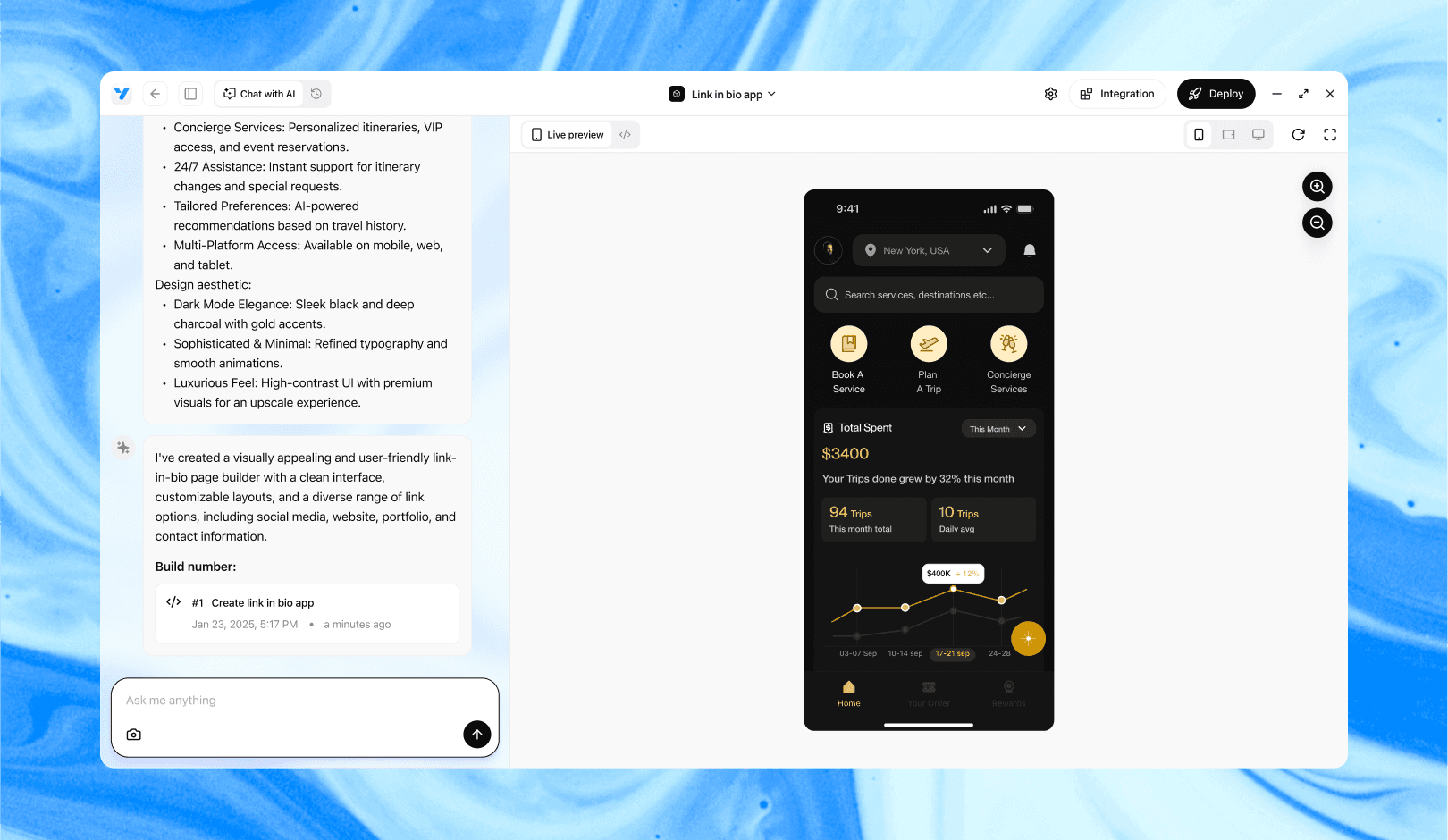
Vibe Studio, powered by Steve’s advanced AI agents, is a revolutionary no-code, conversational platform that empowers users to quickly and efficiently create full-stack Flutter applications integrated seamlessly with Firebase backend services. Ideal for solo founders, startups, and agile engineering teams, Vibe Studio allows users to visually manage and deploy Flutter apps, greatly accelerating the development process. The intuitive conversational interface simplifies complex development tasks, making app creation accessible even for non-coders.
Conclusion
Integrating offline tiles with smooth marker animations in Flutter combines careful asset preparation, the right map engine choice, and lightweight animation patterns. Use flutter_map for fast offline raster workflows or mapbox_gl for native vector/offline packs. Store tiles as MBTiles for compact distribution or as a file tree for simplicity. Drive marker motion with an AnimationController and minimal rebuilds to keep UI smooth on mobile development targets. With these patterns you get robust offline maps and a polished, responsive marker experience.