Introduction
Undoable actions are a common requirement in mobile apps: text editors, drawing tools, settings screens, and complex form flows all benefit from reliable undo/redo. The Command Pattern is an excellent fit because it encapsulates operations and their reversals as objects. In Flutter mobile development, combining Commands with a small invoker/controller and your state management (ChangeNotifier, Provider, Riverpod, Bloc) produces a clean, testable undo/redo pipeline.
Why Use The Command Pattern
The Command Pattern separates intent (what action to perform) from execution (how to perform it). For undo support you need two things: perform and reverse. A Command object bundles both. This removes imperative undo logic scattered through UI code and centralizes state transitions, making them easier to test and serialize.
Benefits for Flutter/mobile development:
Keeps UI widgets thin; widgets call a single controller method.
Commands can capture minimal state needed to undo, reducing snapshot overhead.
Commands are serializable if you need persistence or collaboration.
Designing Commands In Dart
A Command should expose at least do() and undo() methods and carry the state necessary to invert the operation. Prefer storing just the delta or previous value rather than whole app snapshots.
Example minimal Command interface and concrete command that toggles a boolean or sets a value:
abstract class Command {
  void execute();
  void undo();
}

class SetValueCommand<T> implements Command {
  final void Function(T) setter;
  final T newValue;
  late T oldValue;

  SetValueCommand(this.setter, this.newValue, this.oldValue);

  void execute() => setter(newValue);
  void undo() => setter(oldValue);
}
Note: capture oldValue when constructing the command (or on first execute) so undo has the original state. For complex data, consider deep copies or immutables.
Command Manager And Undo/Redo
The invoker — often called CommandManager or History — stores two stacks: undo and redo. Executing a new command pushes it onto the undo stack and clears redo. Undo pops from undo, calls undo(), and pushes onto redo. Redo reverses that flow.
Keep the stacks bounded on mobile to limit memory use. You can compress similar consecutive commands (coalescing) — e.g., text input edits — to avoid excessive history.
A compact CommandManager implementation:
class CommandManager {
  final List<Command> _undo = [];
  final List<Command> _redo = [];
  final int maxHistory;

  CommandManager({this.maxHistory = 100});

  void execute(Command cmd) {
    cmd.execute();
    _undo.add(cmd);
    _redo.clear();
    if (_undo.length > maxHistory) _undo.removeAt(0);
  }

  void undo() {
    if (_undo.isEmpty) return;
    final cmd = _undo.removeLast();
    cmd.undo();
    _redo.add(cmd);
  }

  void redo() {
    if (_redo.isEmpty) return;
    final cmd = _redo.removeLast();
    cmd.execute();
    _undo.add(cmd);
  }
}
Integrating With Flutter State
Wrap CommandManager in a state holder that notifies the UI. If you use ChangeNotifier:
The ViewModel exposes methods like perform(Command) which call manager.execute(cmd) and then notifyListeners().
Widgets call ViewModel.perform or trigger undo/redo actions via buttons bound to ViewModel.undo/redo.
Keep commands pure in terms of UI: they should mutate model data or call setters in your ViewModel, not touch Widgets or context. For asynchronous operations, consider marking commands async and await completion in the manager, but keep undo/redo deterministic.
Example usage pattern:
For editing text fields, accumulate edits into a single ReplaceTextCommand on focus loss or after debounce.
For drawing apps, store vector deltas or layer snapshots; avoid full-canvas copies unless necessary.
Performance And Best Practices
Limit history length and coalesce frequent small actions.
Store only the minimum undo state; prefer previous values to snapshots.
Make commands serializable if you need persistence or server-backed history.
Test commands in isolation; they’re easy to unit test because state mutation is explicit.
Use immutability for complex models to prevent accidental shared-state bugs during undo.
Edge cases:
If a command’s execute fails, ensure you don’t push it onto the undo stack.
For operations that depend on external services, record enough context to reconstruct or prevent undo if impossible.
Vibe Studio
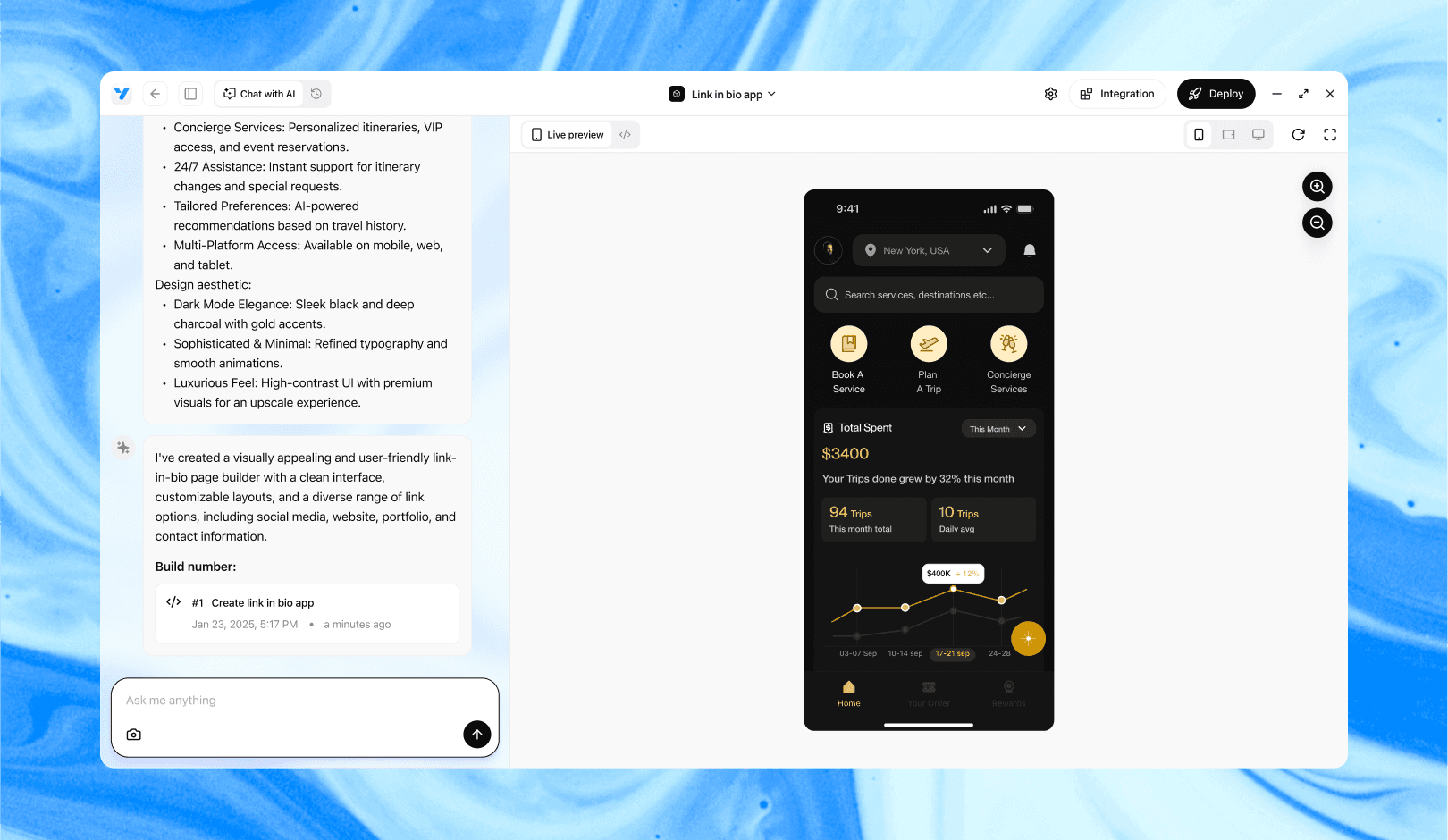
Vibe Studio, powered by Steve’s advanced AI agents, is a revolutionary no-code, conversational platform that empowers users to quickly and efficiently create full-stack Flutter applications integrated seamlessly with Firebase backend services. Ideal for solo founders, startups, and agile engineering teams, Vibe Studio allows users to visually manage and deploy Flutter apps, greatly accelerating the development process. The intuitive conversational interface simplifies complex development tasks, making app creation accessible even for non-coders.
Conclusion
Implementing undoable actions with the Command Pattern in Dart yields a clear, testable architecture for Flutter mobile development. Commands centralize operation and reversal logic; a CommandManager provides predictable undo/redo semantics; and integrating with ChangeNotifier or other state management keeps UI reactive and simple. Applying coalescing, bounded history, and minimal undo state keeps the solution performant on mobile devices.