Implementing OAuth 2.1 PKCE Authentication in Flutter
Nov 14, 2025


Summary
Summary
Summary
Summary
This tutorial guides implementing OAuth 2.1 PKCE in Flutter: setup dependencies, generate PKCE values, open the system browser for auth, handle redirects, exchange codes securely, and store tokens in platform secure storage. Follow S256, avoid embedding secrets, and harden the flow with proper redirect registration and token handling.
Key insights:
Key insights:
Key insights:
Key insights:
Setup And Dependencies: Choose url_launcher, uni_links, http, and flutter_secure_storage; configure platform redirect URIs and avoid embedding secrets.
PKCE Flow Overview: Generate a random code_verifier, derive an S256 code_challenge, open the system browser, then exchange the code with the verifier.
Request, Redirect And Exchange: Use the system browser for authorization, capture the code via deep link, then POST the code and verifier to the token endpoint.
Secure Storage And Best Practices: Store tokens in Keychain/Keystore via flutter_secure_storage, rotate/invalidate tokens, and use HTTPS-only requests.
Security Considerations: Always use S256, prefer system browser over WebView, strictly register redirect URIs, and monitor for anomalous auth activity.
Introduction
OAuth 2.1 with PKCE (Proof Key for Code Exchange) is the recommended pattern for securing native mobile apps. Flutter, as a cross-platform mobile framework, must implement PKCE correctly to avoid exposing client secrets and to maintain user privacy. This tutorial walks through a practical, secure implementation pattern: dependencies and setup, the PKCE flow overview, building the authorization + redirect handling, exchanging the code and storing tokens securely, then hardening considerations for production.
Setup And Dependencies
Use packages that minimize custom network and browser logic. Recommended packages: url_launcher for opening the system browser, uni_links or a platform-specific callback handler for app redirects, http for token requests, and flutter_secure_storage for storing tokens. Add these to pubspec.yaml and configure your Android intent filters and iOS URL schemes (or universal links) to receive the redirect.
Essential configuration items from your OAuth provider: authorization endpoint, token endpoint, client_id (public/native), redirect URI, and requested scopes. Do not embed a client secret in the app.
PKCE Flow Overview
PKCE augments the authorization code flow so public/native clients can securely exchange an auth code for tokens without a secret. Flow summary:
App creates a random code_verifier and derived code_challenge (SHA256, base64url).
App opens the system browser to the authorization endpoint with client_id, redirect_uri, code_challenge, and code_challenge_method=S256.
User authenticates and provider redirects back to the app with an authorization code.
App POSTs that code, along with the original code_verifier, to the token endpoint to receive tokens.
Keep the code_verifier ephemeral in-memory until the token exchange completes.
Request, Redirect And Exchange
Generate the PKCE values and build the authorization URL. Use the system browser (not a WebView) to leverage platform SSO and security. Example generator for code verifier and challenge:
import 'dart:convert';
import 'dart:math';
import 'package:crypto/crypto.dart';
String generateCodeVerifier(int length) {
final rand = Random.secure();
final bytes = List<int>.generate(length, (_) => rand.nextInt(256));
return base64UrlEncode(bytes).replaceAll('=', '');
}
String codeChallengeFromVerifier(String v) =>
base64UrlEncode(sha256.convert(utf8.encode(v)).bytes).replaceAll('=', '');Open the authorization URL built with the code_challenge. Handle the incoming deep link or universal link with uni_links or platform channels to capture the redirect URL and extract the authorization code.
After you receive the code, perform the token exchange with code_verifier. Use a simple POST with application/x-www-form-urlencoded content-type.
import 'package:http/http.dart' as http;
Future<http.Response> exchangeCode(String tokenEndpoint, String code, String verifier, String clientId, String redirectUri) {
final body = {
'grant_type': 'authorization_code',
'code': code,
'code_verifier': verifier,
'client_id': clientId,
'redirect_uri': redirectUri,
};
return http.post(Uri.parse(tokenEndpoint), body: body);
}Check and parse the token response for access_token, id_token (if requested), and refresh_token. Validate ID token claims locally if using OpenID Connect.
Secure Storage And Best Practices
Store tokens in platform-provided secure storage: flutter_secure_storage on both Android and iOS uses Keychain or Keystore. Avoid storing refresh tokens in plaintext or in shared preferences. Keep the following in mind:
Limit token lifetime with short-lived access tokens and use refresh tokens guarded by device-level storage.
Invalidate refresh tokens on logout and revoke tokens on the server when possible.
Always perform token requests over HTTPS and validate server TLS.
Do not embed secrets or hard-coded keys in the app binary.
When refreshing tokens, apply the same care: perform refresh requests from the app with the refresh_token and rotate refresh tokens if supported.
Security Considerations
Use the system browser: it prevents credential capture and allows SSO.
Use S256 code_challenge_method always; plain is insecure and unsupported by many providers.
Resist using custom embedded browsers (WebView) for OAuth flows.
Validate redirect URIs strictly and register platform-specific schemes or universal links to avoid interception.
Implement telemetry for auth errors and monitor for anomalous token requests.
Test your implementation against common providers (Auth0, Okta, Google, Microsoft) and with PKCE enforced. Use automated tests to simulate the redirect and token exchange logic.
Vibe Studio
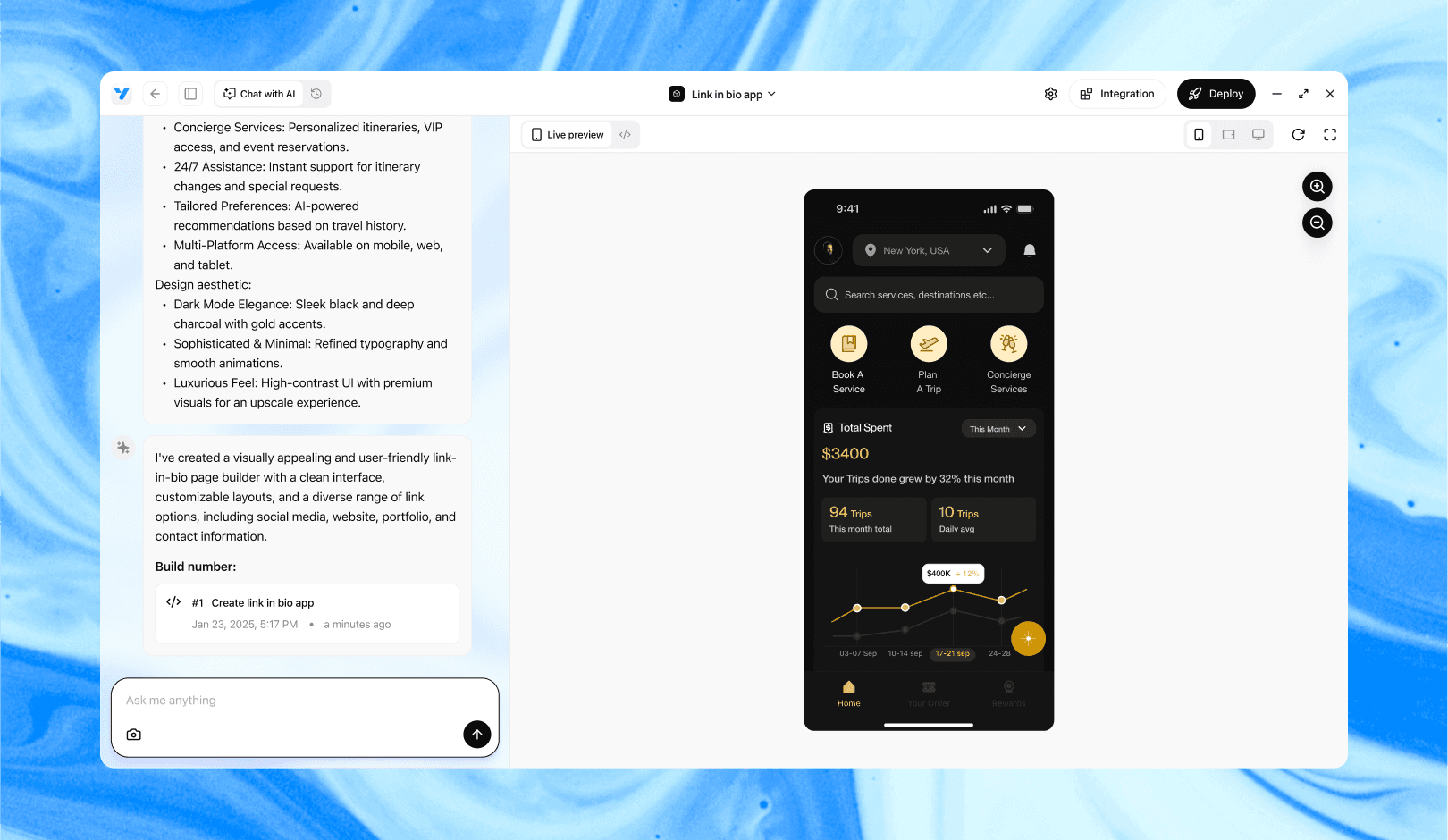
Vibe Studio, powered by Steve’s advanced AI agents, is a revolutionary no-code, conversational platform that empowers users to quickly and efficiently create full-stack Flutter applications integrated seamlessly with Firebase backend services. Ideal for solo founders, startups, and agile engineering teams, Vibe Studio allows users to visually manage and deploy Flutter apps, greatly accelerating the development process. The intuitive conversational interface simplifies complex development tasks, making app creation accessible even for non-coders.
Conclusion
Implementing OAuth 2.1 with PKCE in Flutter requires careful orchestration: generate and keep the code_verifier ephemeral, use the system browser for login, capture the authorization code via deep links, exchange securely for tokens, and store tokens in secure storage. Following these steps and security best practices yields a robust, production-ready authentication flow suitable for mobile development in Flutter.

Introduction
OAuth 2.1 with PKCE (Proof Key for Code Exchange) is the recommended pattern for securing native mobile apps. Flutter, as a cross-platform mobile framework, must implement PKCE correctly to avoid exposing client secrets and to maintain user privacy. This tutorial walks through a practical, secure implementation pattern: dependencies and setup, the PKCE flow overview, building the authorization + redirect handling, exchanging the code and storing tokens securely, then hardening considerations for production.
Setup And Dependencies
Use packages that minimize custom network and browser logic. Recommended packages: url_launcher for opening the system browser, uni_links or a platform-specific callback handler for app redirects, http for token requests, and flutter_secure_storage for storing tokens. Add these to pubspec.yaml and configure your Android intent filters and iOS URL schemes (or universal links) to receive the redirect.
Essential configuration items from your OAuth provider: authorization endpoint, token endpoint, client_id (public/native), redirect URI, and requested scopes. Do not embed a client secret in the app.
PKCE Flow Overview
PKCE augments the authorization code flow so public/native clients can securely exchange an auth code for tokens without a secret. Flow summary:
App creates a random code_verifier and derived code_challenge (SHA256, base64url).
App opens the system browser to the authorization endpoint with client_id, redirect_uri, code_challenge, and code_challenge_method=S256.
User authenticates and provider redirects back to the app with an authorization code.
App POSTs that code, along with the original code_verifier, to the token endpoint to receive tokens.
Keep the code_verifier ephemeral in-memory until the token exchange completes.
Request, Redirect And Exchange
Generate the PKCE values and build the authorization URL. Use the system browser (not a WebView) to leverage platform SSO and security. Example generator for code verifier and challenge:
import 'dart:convert';
import 'dart:math';
import 'package:crypto/crypto.dart';
String generateCodeVerifier(int length) {
final rand = Random.secure();
final bytes = List<int>.generate(length, (_) => rand.nextInt(256));
return base64UrlEncode(bytes).replaceAll('=', '');
}
String codeChallengeFromVerifier(String v) =>
base64UrlEncode(sha256.convert(utf8.encode(v)).bytes).replaceAll('=', '');Open the authorization URL built with the code_challenge. Handle the incoming deep link or universal link with uni_links or platform channels to capture the redirect URL and extract the authorization code.
After you receive the code, perform the token exchange with code_verifier. Use a simple POST with application/x-www-form-urlencoded content-type.
import 'package:http/http.dart' as http;
Future<http.Response> exchangeCode(String tokenEndpoint, String code, String verifier, String clientId, String redirectUri) {
final body = {
'grant_type': 'authorization_code',
'code': code,
'code_verifier': verifier,
'client_id': clientId,
'redirect_uri': redirectUri,
};
return http.post(Uri.parse(tokenEndpoint), body: body);
}Check and parse the token response for access_token, id_token (if requested), and refresh_token. Validate ID token claims locally if using OpenID Connect.
Secure Storage And Best Practices
Store tokens in platform-provided secure storage: flutter_secure_storage on both Android and iOS uses Keychain or Keystore. Avoid storing refresh tokens in plaintext or in shared preferences. Keep the following in mind:
Limit token lifetime with short-lived access tokens and use refresh tokens guarded by device-level storage.
Invalidate refresh tokens on logout and revoke tokens on the server when possible.
Always perform token requests over HTTPS and validate server TLS.
Do not embed secrets or hard-coded keys in the app binary.
When refreshing tokens, apply the same care: perform refresh requests from the app with the refresh_token and rotate refresh tokens if supported.
Security Considerations
Use the system browser: it prevents credential capture and allows SSO.
Use S256 code_challenge_method always; plain is insecure and unsupported by many providers.
Resist using custom embedded browsers (WebView) for OAuth flows.
Validate redirect URIs strictly and register platform-specific schemes or universal links to avoid interception.
Implement telemetry for auth errors and monitor for anomalous token requests.
Test your implementation against common providers (Auth0, Okta, Google, Microsoft) and with PKCE enforced. Use automated tests to simulate the redirect and token exchange logic.
Vibe Studio

Vibe Studio, powered by Steve’s advanced AI agents, is a revolutionary no-code, conversational platform that empowers users to quickly and efficiently create full-stack Flutter applications integrated seamlessly with Firebase backend services. Ideal for solo founders, startups, and agile engineering teams, Vibe Studio allows users to visually manage and deploy Flutter apps, greatly accelerating the development process. The intuitive conversational interface simplifies complex development tasks, making app creation accessible even for non-coders.
Conclusion
Implementing OAuth 2.1 with PKCE in Flutter requires careful orchestration: generate and keep the code_verifier ephemeral, use the system browser for login, capture the authorization code via deep links, exchange securely for tokens, and store tokens in secure storage. Following these steps and security best practices yields a robust, production-ready authentication flow suitable for mobile development in Flutter.

Build Flutter Apps Faster with Vibe Studio
Vibe Studio is your AI-powered Flutter development companion. Skip boilerplate, build in real-time, and deploy without hassle. Start creating apps at lightning speed with zero setup.