Implementing A/B UI Testing with Firebase Analytics
Nov 11, 2025


Summary
Summary
Summary
Summary
This tutorial shows how to implement A/B UI testing in Flutter using Firebase Remote Config to deliver UI variants and Firebase Analytics to measure outcomes. It covers setup, defining experiments and metrics, fetching and applying variants in Flutter, logging exposure and conversion events, using the Firebase A/B Testing console and BigQuery for analysis, and best practices for rollouts and safety.
Key insights:
Key insights:
Key insights:
Key insights:
Setting Up Firebase Remote Config And Analytics: Initialize firebase_core, firebase_remote_config, and firebase_analytics; create Remote Config keys and defaults in the console.
Defining Experiments And Variants: Plan a primary metric, use clear parameter keys and values, and configure variants and rollout percentage in the Firebase A/B Testing UI.
Implementing Variant Logic In Flutter: Fetch and activate Remote Config early, branch UI by parameter value, and log exposure events; keep widgets small and declarative.
Measuring And Analyzing Results: Log a single conversion event, review results in A/B Testing, and export to BigQuery for custom analyses and segment checks.
Gradual Rollouts And Safety: Use percentage rollouts, minimum sample sizes, monitoring, and rollback mechanisms to reduce risk and ensure statistical validity.
Introduction
A/B testing the user interface is essential for data-driven product decisions in mobile development. Firebase provides a streamlined A/B testing workflow that combines Remote Config for delivering variants and Analytics for measuring outcomes. This tutorial shows how to implement A/B UI testing in Flutter: set up Firebase, define experiments, fetch and apply variants, and measure results with best practices for rollouts and analysis.
Setting Up Firebase Remote Config And Analytics
Prerequisites: a Firebase project, an Android/iOS app registered in the console, and the Flutter Firebase plugins: firebase_core, firebase_remote_config, and firebase_analytics. In the Firebase Console, go to Remote Config and create parameter keys representing UI choices (for example, welcome_banner_variant). Use sensible default values so the app behaves predictably when offline.
To run experiments, use the Firebase A/B Testing tool which integrates Remote Config and Analytics. In the A/B Testing UI create an experiment, choose the Remote Config parameter(s) to vary, define variants (A/B/C), set the target audience and percentage rollout, and select an Analytics conversion event to measure.
Defining Experiments And Variants
Design experiments before implementing code: define a single primary metric (e.g., conversion or retention), decide secondary metrics, and determine minimum sample size and duration. Use stable, descriptive parameter keys (e.g., welcome_banner_variant) and standardized values (e.g., 'control', 'variant_red', 'variant_image').
Set default values in Remote Config to match your current live UI. In the A/B test, create conditional values for each variant or use Remote Config experiment assignments. Keep parameter payloads small and avoid embedding large assets (deliver images via CDN and switch URLs in Remote Config).
Implementing Variant Logic In Flutter
Initialize Firebase early (in main()) and fetch Remote Config before rendering variant-dependent screens. Keep fetch intervals reasonable: in development use a low fetch interval, but in production use a longer cache to avoid throttling.
Example: initialize Remote Config and fetch/activate values.
import 'package:firebase_remote_config/firebase_remote_config.dart';
final rc = FirebaseRemoteConfig.instance;
await rc.setConfigSettings(RemoteConfigSettings(fetchTimeout: Duration(seconds: 10), minimumFetchInterval: Duration(hours: 1)));
await rc.setDefaults({'welcome_banner_variant': 'control'});
await rc.fetchAndActivate();
final variant = rc.getString('welcome_banner_variant');Use the variant value to branch UI. Keep widgets small and declarative so switching variants is just a string lookup. Log expose events if desired, and log conversion events with Firebase Analytics when users perform the target action.
import 'package:firebase_analytics/firebase_analytics.dart';
final analytics = FirebaseAnalytics.instance;
await analytics.logEvent(name: 'experiment_exposed', parameters: {'variant': variant});
// On conversion:
await analytics.logEvent(name: 'purchase_complete', parameters: {'variant': variant});Avoid expensive rebuilds during activation: fetch before navigation or show a brief loading state. If the variant affects routes, derive the route in a top-level widget to keep a consistent UX.
Measuring And Analyzing Results
Log a single, well-defined conversion event to Analytics. The A/B Testing console will handle statistical analysis and provide confidence intervals for your chosen primary metric. For custom or backup analysis, enable BigQuery export for Analytics so you can join exposure and conversion events at user level and compute funnel/CDF analyses.
Monitor these practical aspects: sample size (ensure your experiment will reach enough users), duration (run long enough for stable behavior), and segmentation (validate results across OS, geography, or cohorts). Use gradual rollouts and percentage-based targeting to limit risk and detect regressions early.
Vibe Studio
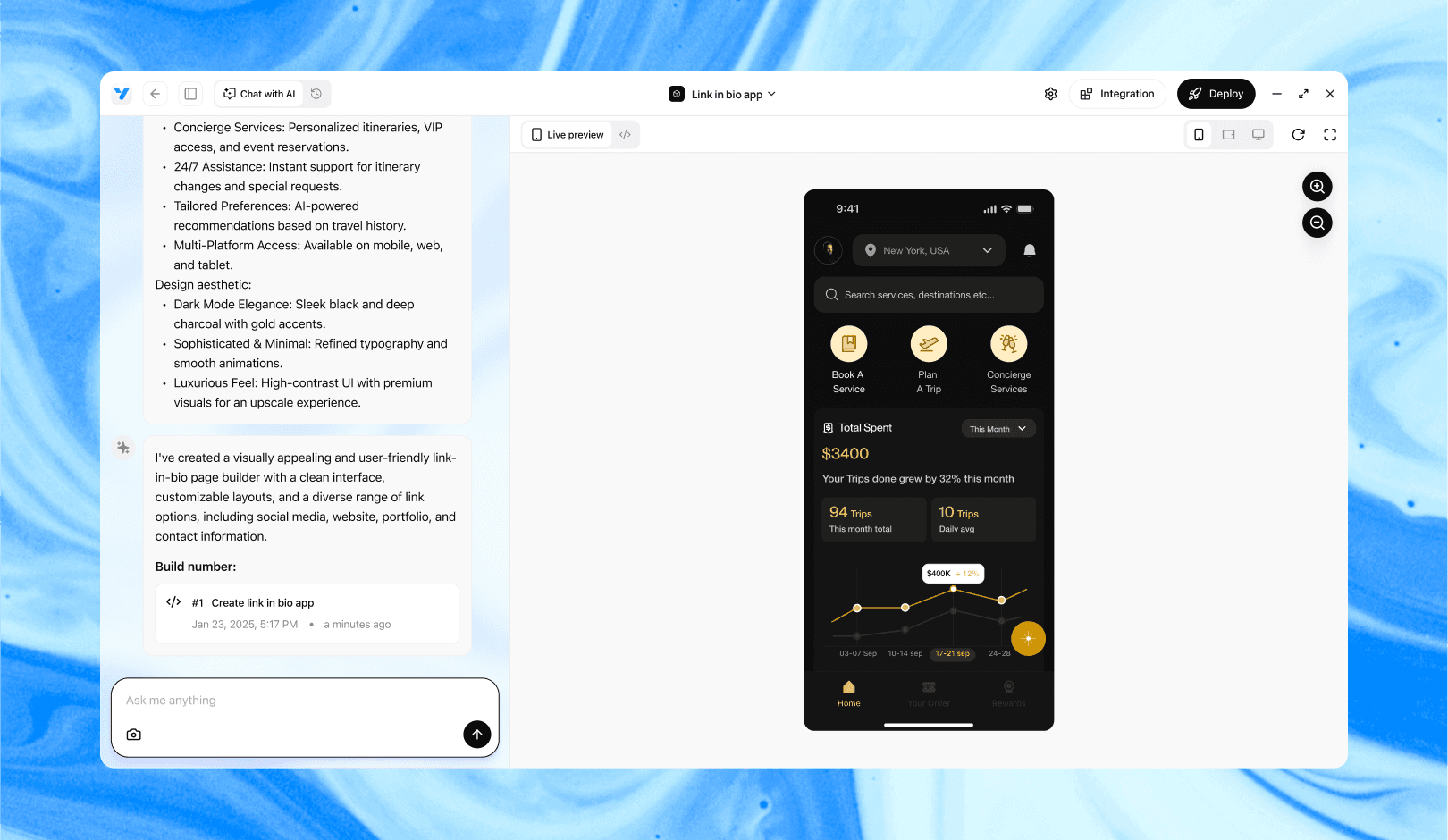
Vibe Studio, powered by Steve’s advanced AI agents, is a revolutionary no-code, conversational platform that empowers users to quickly and efficiently create full-stack Flutter applications integrated seamlessly with Firebase backend services. Ideal for solo founders, startups, and agile engineering teams, Vibe Studio allows users to visually manage and deploy Flutter apps, greatly accelerating the development process. The intuitive conversational interface simplifies complex development tasks, making app creation accessible even for non-coders.
Conclusion
Implementing A/B UI testing with Firebase Analytics in Flutter is a matter of wiring Remote Config to deliver variants, logging exposure and conversion events with Analytics, and using Firebase’s A/B Testing console or BigQuery for analysis. Follow best practices: design clear experiments, keep Remote Config keys stable, fetch and activate configs safely, and measure a single primary metric. With this setup you can iterate on UI changes confidently and roll out winning variants to all users.

Introduction
A/B testing the user interface is essential for data-driven product decisions in mobile development. Firebase provides a streamlined A/B testing workflow that combines Remote Config for delivering variants and Analytics for measuring outcomes. This tutorial shows how to implement A/B UI testing in Flutter: set up Firebase, define experiments, fetch and apply variants, and measure results with best practices for rollouts and analysis.
Setting Up Firebase Remote Config And Analytics
Prerequisites: a Firebase project, an Android/iOS app registered in the console, and the Flutter Firebase plugins: firebase_core, firebase_remote_config, and firebase_analytics. In the Firebase Console, go to Remote Config and create parameter keys representing UI choices (for example, welcome_banner_variant). Use sensible default values so the app behaves predictably when offline.
To run experiments, use the Firebase A/B Testing tool which integrates Remote Config and Analytics. In the A/B Testing UI create an experiment, choose the Remote Config parameter(s) to vary, define variants (A/B/C), set the target audience and percentage rollout, and select an Analytics conversion event to measure.
Defining Experiments And Variants
Design experiments before implementing code: define a single primary metric (e.g., conversion or retention), decide secondary metrics, and determine minimum sample size and duration. Use stable, descriptive parameter keys (e.g., welcome_banner_variant) and standardized values (e.g., 'control', 'variant_red', 'variant_image').
Set default values in Remote Config to match your current live UI. In the A/B test, create conditional values for each variant or use Remote Config experiment assignments. Keep parameter payloads small and avoid embedding large assets (deliver images via CDN and switch URLs in Remote Config).
Implementing Variant Logic In Flutter
Initialize Firebase early (in main()) and fetch Remote Config before rendering variant-dependent screens. Keep fetch intervals reasonable: in development use a low fetch interval, but in production use a longer cache to avoid throttling.
Example: initialize Remote Config and fetch/activate values.
import 'package:firebase_remote_config/firebase_remote_config.dart';
final rc = FirebaseRemoteConfig.instance;
await rc.setConfigSettings(RemoteConfigSettings(fetchTimeout: Duration(seconds: 10), minimumFetchInterval: Duration(hours: 1)));
await rc.setDefaults({'welcome_banner_variant': 'control'});
await rc.fetchAndActivate();
final variant = rc.getString('welcome_banner_variant');Use the variant value to branch UI. Keep widgets small and declarative so switching variants is just a string lookup. Log expose events if desired, and log conversion events with Firebase Analytics when users perform the target action.
import 'package:firebase_analytics/firebase_analytics.dart';
final analytics = FirebaseAnalytics.instance;
await analytics.logEvent(name: 'experiment_exposed', parameters: {'variant': variant});
// On conversion:
await analytics.logEvent(name: 'purchase_complete', parameters: {'variant': variant});Avoid expensive rebuilds during activation: fetch before navigation or show a brief loading state. If the variant affects routes, derive the route in a top-level widget to keep a consistent UX.
Measuring And Analyzing Results
Log a single, well-defined conversion event to Analytics. The A/B Testing console will handle statistical analysis and provide confidence intervals for your chosen primary metric. For custom or backup analysis, enable BigQuery export for Analytics so you can join exposure and conversion events at user level and compute funnel/CDF analyses.
Monitor these practical aspects: sample size (ensure your experiment will reach enough users), duration (run long enough for stable behavior), and segmentation (validate results across OS, geography, or cohorts). Use gradual rollouts and percentage-based targeting to limit risk and detect regressions early.
Vibe Studio

Vibe Studio, powered by Steve’s advanced AI agents, is a revolutionary no-code, conversational platform that empowers users to quickly and efficiently create full-stack Flutter applications integrated seamlessly with Firebase backend services. Ideal for solo founders, startups, and agile engineering teams, Vibe Studio allows users to visually manage and deploy Flutter apps, greatly accelerating the development process. The intuitive conversational interface simplifies complex development tasks, making app creation accessible even for non-coders.
Conclusion
Implementing A/B UI testing with Firebase Analytics in Flutter is a matter of wiring Remote Config to deliver variants, logging exposure and conversion events with Analytics, and using Firebase’s A/B Testing console or BigQuery for analysis. Follow best practices: design clear experiments, keep Remote Config keys stable, fetch and activate configs safely, and measure a single primary metric. With this setup you can iterate on UI changes confidently and roll out winning variants to all users.

Build Flutter Apps Faster with Vibe Studio
Vibe Studio is your AI-powered Flutter development companion. Skip boilerplate, build in real-time, and deploy without hassle. Start creating apps at lightning speed with zero setup.