How To Build An AI-Powered Search Bar in Flutter
Nov 18, 2025


Summary
Summary
Summary
Summary
This tutorial shows how to build an AI-powered search bar in Flutter: design the client-backend flow, generate and store embeddings, implement a debounced TextField, call a search API, and optimize for mobile with caching and lightweight payloads.
Key insights:
Key insights:
Key insights:
Key insights:
Architecture And Data Flow: Separate client responsibilities from embedding and vector search, minimizing round-trips and protecting API keys via a backend.
Embedding And Similarity Search: Use embeddings plus a vector DB or on-device ANN to enable semantic relevance; choose cosine or dot product and handle reindexing strategy.
Building The Flutter UI: Debounce input, show skeleton loading, and fetch compact result objects; prefer local filtering for tiny datasets to improve responsiveness.
Optimizing For Mobile Performance: Debounce, cache TTL, compress payloads, and paginate results to reduce latency and battery impact on mobile devices.
Security And Privacy: Never embed secrets in the app; route embedding/search requests through a backend that enforces rate limits and access control.
Introduction
Building an AI-powered search bar in Flutter brings semantic relevance to mobile development, improving result quality beyond keyword matching. This tutorial explains a practical architecture, UI patterns, API integration, and performance trade-offs so you can ship a responsive, privacy-aware search experience on mobile.
Architecture And Data Flow
Design the search pipeline before coding. Typical architectures separate concerns: the Flutter client handles input, debouncing, display, and local caching; a backend service hosts an embedding model and a vector index (or you can use a managed vector DB). Flow: user types a query -> client debounces -> client sends query to embedding service -> embedding compared against stored item vectors -> backend returns top matches -> client renders suggestions. For smaller apps you can compute embeddings on-device with TFLite or run a tiny similarity model, but cloud-hosted embeddings are simpler for most teams.
Key considerations: API latency, token limits for embedding services, privacy of user queries, and whether your dataset updates frequently (affects reindexing). For mobile development, aim to keep round-trips minimal and use partial local filtering to make the UI feel instant.
Embedding And Similarity Search
Choose how to generate vectors: hosted APIs (for example, an embedding endpoint) or on-device models. Store vectors in a vector database (FAISS, Milvus, or a managed provider) to perform nearest-neighbor search. Use cosine similarity or dot product depending on your embedding normalization.
If you must keep user data on-device, use a compact model and an approximate nearest neighbor index such as HNSW implemented in a native library. Otherwise, the backend can embed and run the vector search, returning lightweight result objects to the client.
Security: never embed secret keys in the Flutter binary. Route through a backend that injects keys and enforces rate limits and access control. Cache recent query embeddings and results on-device to reduce repeated calls and improve perceived performance.
Building The Flutter UI
Implement a search TextField with debouncing, a results list, and graceful loading/error states. Use a state management approach you prefer (Provider, Riverpod, Bloc). Debounce on the client to reduce API calls and show an immediate local filtering layer if you have a small dataset stored locally.
Example: simple debounced TextField and results request.
// Debounced query handling (simplified)
Timer? _debounce;
void onQueryChanged(String q) {
_debounce?.cancel();
_debounce = Timer(const Duration(milliseconds: 300), () {
if (q.trim().isNotEmpty) fetchSearchResults(q.trim());
});
}In fetchSearchResults, call your backend API that returns ranked results. Return compact models to keep network payloads small. Show skeleton rows while awaiting results to maintain a smooth mobile experience.
Future<List<ResultItem>> fetchSearchResults(String query) async {
final resp = await http.post(Uri.parse('https://api.example.com/search'),
body: jsonEncode({'q': query}), headers: {'Content-Type': 'application/json'});
final list = jsonDecode(resp.body) as List;
return list.map((e) => ResultItem.fromJson(e)).toList();
}Optimizing For Mobile Performance
Prioritize perceived speed. Strategies:
Debounce and throttle network requests. 300ms is a common starting point.
Use local filtering for tiny datasets to give instant feedback while the semantic backend responds.
Compress responses and paginate results. Return top N candidates and fetch details lazily on selection.
Cache query-result pairs with TTL to reduce repeated work.
Use incremental updates: optimistic UI when applicable and replace with ranked results when received.
Memory and battery: avoid heavy on-device ML unless necessary. If you choose on-device embeddings, quantize models and use native libraries to avoid Dart-level performance bottlenecks.
Accessibility and UX: support keyboard actions, clear button, and highlight matched snippets. On mobile development, adapt UI for smaller screens and touch interaction; ensure tappable areas meet platform guidelines.
Vibe Studio
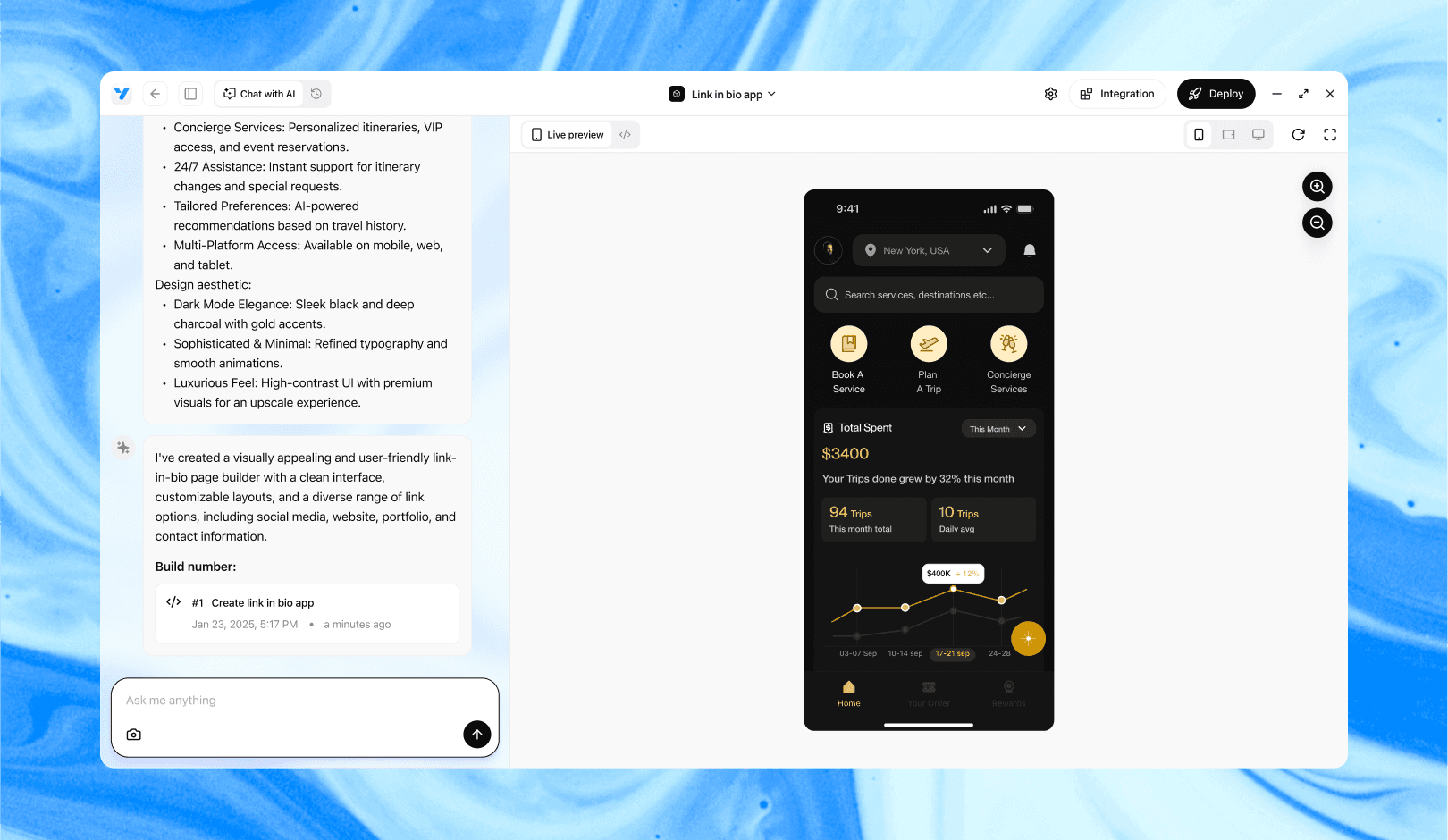
Vibe Studio, powered by Steve’s advanced AI agents, is a revolutionary no-code, conversational platform that empowers users to quickly and efficiently create full-stack Flutter applications integrated seamlessly with Firebase backend services. Ideal for solo founders, startups, and agile engineering teams, Vibe Studio allows users to visually manage and deploy Flutter apps, greatly accelerating the development process. The intuitive conversational interface simplifies complex development tasks, making app creation accessible even for non-coders.
Conclusion
An AI-powered search bar in Flutter is built from a responsive UI, a debounce strategy, and a robust embedding and vector search backend (or an on-device alternative). Focus on reducing latency through caching and local filtering, protect secrets by routing requests through a backend, and optimize payloads for mobile conditions. Following these steps yields a semantic search experience that elevates mobile development results beyond keyword matching.

Introduction
Building an AI-powered search bar in Flutter brings semantic relevance to mobile development, improving result quality beyond keyword matching. This tutorial explains a practical architecture, UI patterns, API integration, and performance trade-offs so you can ship a responsive, privacy-aware search experience on mobile.
Architecture And Data Flow
Design the search pipeline before coding. Typical architectures separate concerns: the Flutter client handles input, debouncing, display, and local caching; a backend service hosts an embedding model and a vector index (or you can use a managed vector DB). Flow: user types a query -> client debounces -> client sends query to embedding service -> embedding compared against stored item vectors -> backend returns top matches -> client renders suggestions. For smaller apps you can compute embeddings on-device with TFLite or run a tiny similarity model, but cloud-hosted embeddings are simpler for most teams.
Key considerations: API latency, token limits for embedding services, privacy of user queries, and whether your dataset updates frequently (affects reindexing). For mobile development, aim to keep round-trips minimal and use partial local filtering to make the UI feel instant.
Embedding And Similarity Search
Choose how to generate vectors: hosted APIs (for example, an embedding endpoint) or on-device models. Store vectors in a vector database (FAISS, Milvus, or a managed provider) to perform nearest-neighbor search. Use cosine similarity or dot product depending on your embedding normalization.
If you must keep user data on-device, use a compact model and an approximate nearest neighbor index such as HNSW implemented in a native library. Otherwise, the backend can embed and run the vector search, returning lightweight result objects to the client.
Security: never embed secret keys in the Flutter binary. Route through a backend that injects keys and enforces rate limits and access control. Cache recent query embeddings and results on-device to reduce repeated calls and improve perceived performance.
Building The Flutter UI
Implement a search TextField with debouncing, a results list, and graceful loading/error states. Use a state management approach you prefer (Provider, Riverpod, Bloc). Debounce on the client to reduce API calls and show an immediate local filtering layer if you have a small dataset stored locally.
Example: simple debounced TextField and results request.
// Debounced query handling (simplified)
Timer? _debounce;
void onQueryChanged(String q) {
_debounce?.cancel();
_debounce = Timer(const Duration(milliseconds: 300), () {
if (q.trim().isNotEmpty) fetchSearchResults(q.trim());
});
}In fetchSearchResults, call your backend API that returns ranked results. Return compact models to keep network payloads small. Show skeleton rows while awaiting results to maintain a smooth mobile experience.
Future<List<ResultItem>> fetchSearchResults(String query) async {
final resp = await http.post(Uri.parse('https://api.example.com/search'),
body: jsonEncode({'q': query}), headers: {'Content-Type': 'application/json'});
final list = jsonDecode(resp.body) as List;
return list.map((e) => ResultItem.fromJson(e)).toList();
}Optimizing For Mobile Performance
Prioritize perceived speed. Strategies:
Debounce and throttle network requests. 300ms is a common starting point.
Use local filtering for tiny datasets to give instant feedback while the semantic backend responds.
Compress responses and paginate results. Return top N candidates and fetch details lazily on selection.
Cache query-result pairs with TTL to reduce repeated work.
Use incremental updates: optimistic UI when applicable and replace with ranked results when received.
Memory and battery: avoid heavy on-device ML unless necessary. If you choose on-device embeddings, quantize models and use native libraries to avoid Dart-level performance bottlenecks.
Accessibility and UX: support keyboard actions, clear button, and highlight matched snippets. On mobile development, adapt UI for smaller screens and touch interaction; ensure tappable areas meet platform guidelines.
Vibe Studio

Vibe Studio, powered by Steve’s advanced AI agents, is a revolutionary no-code, conversational platform that empowers users to quickly and efficiently create full-stack Flutter applications integrated seamlessly with Firebase backend services. Ideal for solo founders, startups, and agile engineering teams, Vibe Studio allows users to visually manage and deploy Flutter apps, greatly accelerating the development process. The intuitive conversational interface simplifies complex development tasks, making app creation accessible even for non-coders.
Conclusion
An AI-powered search bar in Flutter is built from a responsive UI, a debounce strategy, and a robust embedding and vector search backend (or an on-device alternative). Focus on reducing latency through caching and local filtering, protect secrets by routing requests through a backend, and optimize payloads for mobile conditions. Following these steps yields a semantic search experience that elevates mobile development results beyond keyword matching.

Build Flutter Apps Faster with Vibe Studio
Vibe Studio is your AI-powered Flutter development companion. Skip boilerplate, build in real-time, and deploy without hassle. Start creating apps at lightning speed with zero setup.