How To Build A Responsive Admin Dashboard In Flutter Web
Dec 5, 2025


Summary
Summary
Summary
Summary
This tutorial shows how to build a responsive admin dashboard in Flutter Web: define breakpoints, implement adaptive navigation (bottom bar, drawer, NavigationRail), create adaptive content grids and cards, and manage state and routing for deep linking and performance. Focus on small widgets, lazy builds, and accessibility.
Key insights:
Key insights:
Key insights:
Key insights:
Planning Responsive Layout: Centralize breakpoints and use LayoutBuilder to switch scaffolds across mobile, tablet, and desktop.
Implementing Adaptive Navigation: Build one navigation component that returns BottomNavigationBar, Drawer, or NavigationRail based on width.
Responsive Content Grid And Cards: Use GridView with adaptive crossAxisCount and compact card variants to optimize space and performance.
State And Routing Considerations: Use go_router or Navigator 2.0 for deep links; scope state to modules to avoid large rebuilds.
Performance And Accessibility: Lazy-load heavy widgets, use const constructors, and provide keyboard/focus semantics for web users.
Introduction
Building a responsive admin dashboard in Flutter Web lets you reuse Flutter UI skills from mobile development while targeting desktop and browser form factors. This tutorial walks through a pragmatic approach: plan breakpoints, create adaptive navigation, design a responsive content grid, and handle state and routing. Code-forward examples show practical implementations you can copy into a Flutter web project.
Planning Responsive Layout
Start with clear breakpoints: mobile (<600px), tablet (600–1024px), and desktop (>1024px). Use LayoutBuilder and MediaQuery to read available width and adapt layout. Keep a single source of truth for breakpoints to avoid magic numbers scattered across widgets. Consider a responsive scaffold that switches between a bottom navigation (mobile), a drawer (tablet), and a persistent side rail (desktop).
A small helper class centralizes breakpoints and layout decisions. This reduces conditional clutter in UI code and makes testing easier.
class Breakpoints {
static const double mobile = 600;
static const double tablet = 1024;
static bool isMobile(double w) => w < mobile;
static bool isTablet(double w) => w >= mobile && w < tablet;
}Implementing Adaptive Navigation
Navigation is the most visible adaptation. For mobile, prefer a BottomNavigationBar or a Drawer opened by an AppBar. For desktop, use NavigationRail or a left-side Column with icons and labels. Navigation should be consistent: the same routes and actions, different containers.
Use a single NavigationWidget that builds the appropriate child based on width. Keep the navigation state (selected index) in a top-level State or a provider so content and navigation stay in sync across breakpoints.
Widget buildNavigation(BuildContext context, double width, int index, ValueChanged<int> onSelect) {
if (Breakpoints.isMobile(width)) return BottomNavigationBar(...);
if (Breakpoints.isTablet(width)) return Drawer(child: ListView(...));
return NavigationRail(selectedIndex: index, onDestinationSelected: onSelect, destinations: [...]);
}Make icons and labels adaptive: show only icons on narrow rails, show labels on expansion or hover for accessibility.
Responsive Content Grid And Cards
Admin dashboards present lots of data: metrics, charts, tables, and lists. Use GridView with adaptive crossAxisCount to reshape the grid across breakpoints. Prefer flexible, card-based components that can collapse into summary rows for narrow widths.
A common pattern: define card widgets that accept a compact boolean and render a condensed view when true. Use SliverGrid or GridView.builder with a dynamic crossAxisCount calculated from width.
Keep heavy visualizations lazy: wrap charts in sized containers and only build when visible. For large tables, prefer PaginatedDataTable or virtualization (ListView.builder) to maintain performance in web contexts.
State And Routing Considerations
Choose a routing and state solution early. For Flutter web, use go_router or Flutter's Navigator 2.0 for deep links and browser history. Make sure route changes update the selected navigation index. For state, Provider, Riverpod, or Bloc work well; prefer providers scoped to dashboard modules to avoid global rebuilds.
Synchronize URL parameters with filter state (date range, search, pagination) so users can share links. Debounce user input from filters to reduce rebuilds and network calls. For API data fetching, use caching with a clear invalidation strategy when filters change.
Performance tips: avoid unnecessary rebuilds by splitting the dashboard into small StatefulWidgets or Consumer widgets. Use const constructors where possible. On Flutter web, reduce asset sizes and use svg_icons or icon fonts instead of bitmap assets.
Accessibility: ensure keyboard focus, semantic labels, and sufficient color contrast. On web, ensure focus outlines are visible and that interactive areas are large enough for mouse and touch.
Vibe Studio
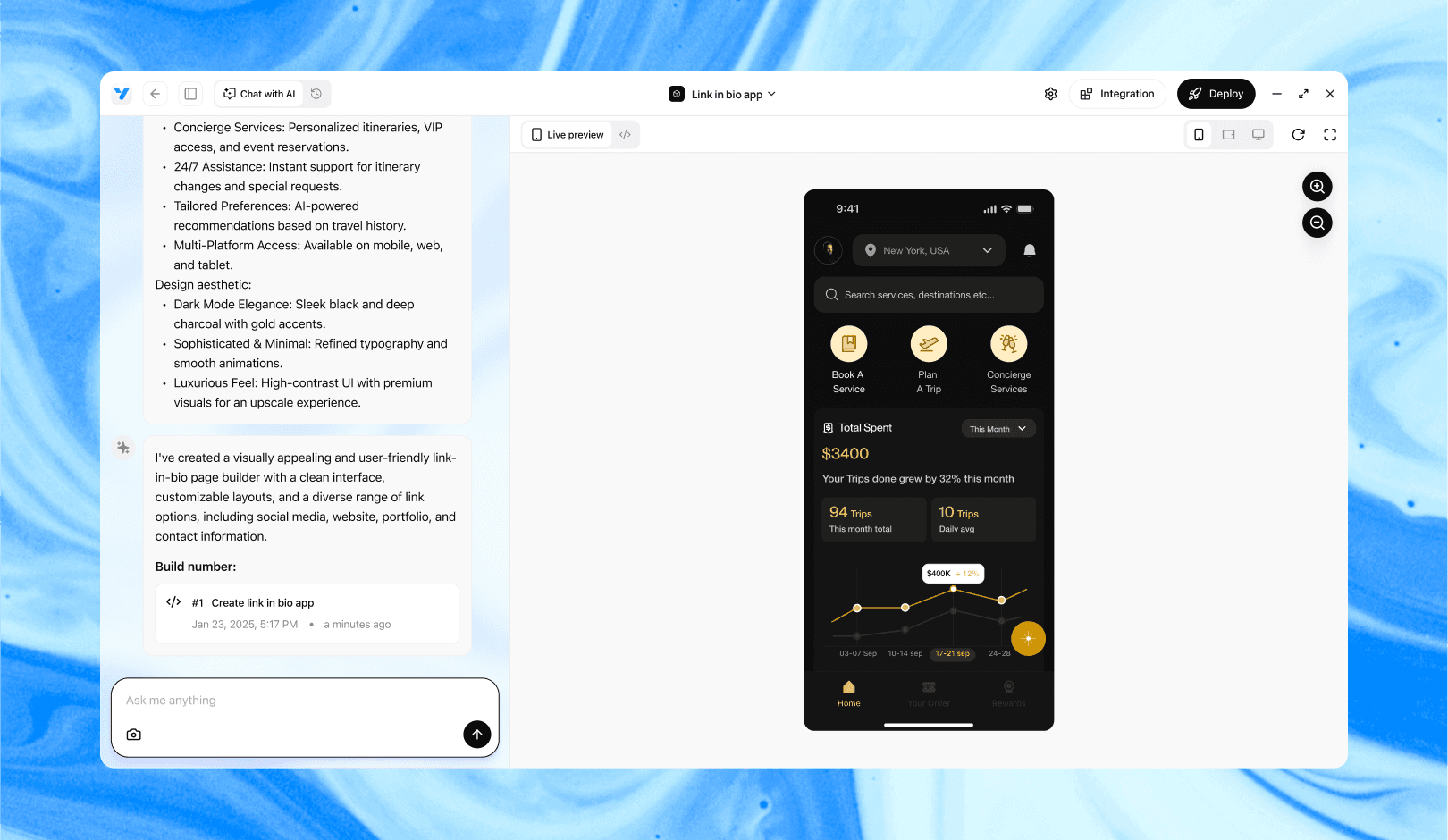
Vibe Studio, powered by Steve’s advanced AI agents, is a revolutionary no-code, conversational platform that empowers users to quickly and efficiently create full-stack Flutter applications integrated seamlessly with Firebase backend services. Ideal for solo founders, startups, and agile engineering teams, Vibe Studio allows users to visually manage and deploy Flutter apps, greatly accelerating the development process. The intuitive conversational interface simplifies complex development tasks, making app creation accessible even for non-coders.
Conclusion
A responsive admin dashboard in Flutter Web reuses mobile development strengths while adapting layout and navigation for larger screens. Centralize breakpoints, implement an adaptive navigation component, build grid-driven card UIs that can collapse, and choose routing/state patterns that provide deep linking and efficient updates. Start small: scaffold your responsive layout first, then progressively add modules and data interactions. The result is a maintainable, high-performance admin interface that works across mobile, tablet, and desktop browser targets.

Introduction
Building a responsive admin dashboard in Flutter Web lets you reuse Flutter UI skills from mobile development while targeting desktop and browser form factors. This tutorial walks through a pragmatic approach: plan breakpoints, create adaptive navigation, design a responsive content grid, and handle state and routing. Code-forward examples show practical implementations you can copy into a Flutter web project.
Planning Responsive Layout
Start with clear breakpoints: mobile (<600px), tablet (600–1024px), and desktop (>1024px). Use LayoutBuilder and MediaQuery to read available width and adapt layout. Keep a single source of truth for breakpoints to avoid magic numbers scattered across widgets. Consider a responsive scaffold that switches between a bottom navigation (mobile), a drawer (tablet), and a persistent side rail (desktop).
A small helper class centralizes breakpoints and layout decisions. This reduces conditional clutter in UI code and makes testing easier.
class Breakpoints {
static const double mobile = 600;
static const double tablet = 1024;
static bool isMobile(double w) => w < mobile;
static bool isTablet(double w) => w >= mobile && w < tablet;
}Implementing Adaptive Navigation
Navigation is the most visible adaptation. For mobile, prefer a BottomNavigationBar or a Drawer opened by an AppBar. For desktop, use NavigationRail or a left-side Column with icons and labels. Navigation should be consistent: the same routes and actions, different containers.
Use a single NavigationWidget that builds the appropriate child based on width. Keep the navigation state (selected index) in a top-level State or a provider so content and navigation stay in sync across breakpoints.
Widget buildNavigation(BuildContext context, double width, int index, ValueChanged<int> onSelect) {
if (Breakpoints.isMobile(width)) return BottomNavigationBar(...);
if (Breakpoints.isTablet(width)) return Drawer(child: ListView(...));
return NavigationRail(selectedIndex: index, onDestinationSelected: onSelect, destinations: [...]);
}Make icons and labels adaptive: show only icons on narrow rails, show labels on expansion or hover for accessibility.
Responsive Content Grid And Cards
Admin dashboards present lots of data: metrics, charts, tables, and lists. Use GridView with adaptive crossAxisCount to reshape the grid across breakpoints. Prefer flexible, card-based components that can collapse into summary rows for narrow widths.
A common pattern: define card widgets that accept a compact boolean and render a condensed view when true. Use SliverGrid or GridView.builder with a dynamic crossAxisCount calculated from width.
Keep heavy visualizations lazy: wrap charts in sized containers and only build when visible. For large tables, prefer PaginatedDataTable or virtualization (ListView.builder) to maintain performance in web contexts.
State And Routing Considerations
Choose a routing and state solution early. For Flutter web, use go_router or Flutter's Navigator 2.0 for deep links and browser history. Make sure route changes update the selected navigation index. For state, Provider, Riverpod, or Bloc work well; prefer providers scoped to dashboard modules to avoid global rebuilds.
Synchronize URL parameters with filter state (date range, search, pagination) so users can share links. Debounce user input from filters to reduce rebuilds and network calls. For API data fetching, use caching with a clear invalidation strategy when filters change.
Performance tips: avoid unnecessary rebuilds by splitting the dashboard into small StatefulWidgets or Consumer widgets. Use const constructors where possible. On Flutter web, reduce asset sizes and use svg_icons or icon fonts instead of bitmap assets.
Accessibility: ensure keyboard focus, semantic labels, and sufficient color contrast. On web, ensure focus outlines are visible and that interactive areas are large enough for mouse and touch.
Vibe Studio

Vibe Studio, powered by Steve’s advanced AI agents, is a revolutionary no-code, conversational platform that empowers users to quickly and efficiently create full-stack Flutter applications integrated seamlessly with Firebase backend services. Ideal for solo founders, startups, and agile engineering teams, Vibe Studio allows users to visually manage and deploy Flutter apps, greatly accelerating the development process. The intuitive conversational interface simplifies complex development tasks, making app creation accessible even for non-coders.
Conclusion
A responsive admin dashboard in Flutter Web reuses mobile development strengths while adapting layout and navigation for larger screens. Centralize breakpoints, implement an adaptive navigation component, build grid-driven card UIs that can collapse, and choose routing/state patterns that provide deep linking and efficient updates. Start small: scaffold your responsive layout first, then progressively add modules and data interactions. The result is a maintainable, high-performance admin interface that works across mobile, tablet, and desktop browser targets.
Build Flutter Apps Faster with Vibe Studio
Vibe Studio is your AI-powered Flutter development companion. Skip boilerplate, build in real-time, and deploy without hassle. Start creating apps at lightning speed with zero setup.