Embedding Flutter UIs Inside Unity3D Environments

Summary
Summary
Summary
Summary

This tutorial explains embedding Flutter UIs inside Unity3D for mobile development. It compares platform view and offscreen texture architectures, details communication via MethodChannel and EventChannel, and presents a Flutter-side snippet to receive a texture ID and display rendered frames. Focus on engine reuse, frame synchronization, and performance when integrating Flutter and Unity.

This tutorial explains embedding Flutter UIs inside Unity3D for mobile development. It compares platform view and offscreen texture architectures, details communication via MethodChannel and EventChannel, and presents a Flutter-side snippet to receive a texture ID and display rendered frames. Focus on engine reuse, frame synchronization, and performance when integrating Flutter and Unity.

This tutorial explains embedding Flutter UIs inside Unity3D for mobile development. It compares platform view and offscreen texture architectures, details communication via MethodChannel and EventChannel, and presents a Flutter-side snippet to receive a texture ID and display rendered frames. Focus on engine reuse, frame synchronization, and performance when integrating Flutter and Unity.

This tutorial explains embedding Flutter UIs inside Unity3D for mobile development. It compares platform view and offscreen texture architectures, details communication via MethodChannel and EventChannel, and presents a Flutter-side snippet to receive a texture ID and display rendered frames. Focus on engine reuse, frame synchronization, and performance when integrating Flutter and Unity.

Key insights:
Key insights:
Key insights:
Key insights:
  • Why Embed Flutter In Unity: Use Flutter for adaptive UI and Unity for real-time 3D; combine strengths for richer mobile experiences.

  • Architecture And Communication: Choose Platform View for overlays or Texture/Offscreen for world-space UIs; use MethodChannel/EventChannel for messaging.

  • Rendering Approaches: Platform views are easier; texture rendering allows transformations but requires engine-level integration and sync.

  • Practical Integration Example: The Flutter side requests a texture ID via MethodChannel and displays it with a Texture widget; native code supplies the rendered frames.

  • Performance And Lifecycle Tip: Reuse a FlutterEngine, throttle high-frequency events, and synchronize frame pacing between Unity and Flutter.

Introduction

Embedding Flutter UIs inside Unity3D environments lets you combine Unity's real-time 3D capabilities with Flutter's expressive, high-performance widget system. This hybrid approach is valuable for mobile development where you want native-like UI, rapid iteration, and the rendering power of Unity for AR/VR, 3D scenes, or gamified interfaces. This tutorial explains architectures, communication patterns, rendering options, and a compact integration example to get you started.

Why Embed Flutter In Unity

Use cases include complex 3D scenes driven by Unity with overlays, HUDs, or interactive panels rendered with Flutter. Flutter excels at lists, forms, adaptive layouts, and animations — ideal for menus, dashboards, or configuration UIs — while Unity handles physics, shaders, and 3D assets. Embedding Flutter gives designers the UI speed of Flutter and the immersive power of Unity without reimplementing widgets in Unity's UI toolkit.

Architecture And Communication

Two main architectural models exist:

  • Platform View Model: Host a Flutter view (Android View or iOS UIView) as a native view layered into the Unity view hierarchy. This is simpler on Android/iOS because Flutter can run as a Fragment/UIViewController and be composed by native code. Communication uses MethodChannel/EventChannel for method calls and streams.

  • Texture/Offscreen Model: Render Flutter to an offscreen texture and pass pixel frames to Unity as a native texture. This decouples input and lifecycle but is more complex. It uses Flutter's TextureRegistry on the engine side and platform APIs to register and share textures with Unity.

For mobile development, choose Platform View for quick overlays and Texture approach when Flutter content must be composited inside 3D space or should be transformed by Unity shaders.

Communication patterns:

  • MethodChannel: for RPC-style commands, e.g., open screen, send data.

  • EventChannel/BinaryMessenger: for streaming events from Flutter to Unity.

  • Shared Memory or Native Plugins: for high-bandwidth data like continuous gesture streams or video frames.

Keep messages small and avoid blocking UI threads. Serialize only necessary data and throttle frequent events.

Rendering Approaches

Platform View (View Composition):

  • Pros: Easier integration, Flutter manages its own lifecycle and input.

  • Cons: Z-order and clipping are tied to platform view limitations. Not natively transformable in 3D.

Texture/Offscreen Rendering:

  • Pros: Unity can treat Flutter output as any texture, apply shaders, world-space placement, and transformations.

  • Cons: Requires engine-level plugins, synchronization of frame updates, and potentially higher CPU/GPU cost.

Implementation tips:

  • On Android, create a FlutterEngine and attach a FlutterNativeView or use Flutter's RenderSurface to render to a surface texture. Export that SurfaceTexture to Unity via JNI as an Android SurfaceTexture bound to a Unity texture.

  • On iOS, host a FlutterEngine and use Flutter's TextureRegistry to produce pixel buffers bridged to Metal or OpenGL textures for Unity.

Manage frame pacing carefully: Unity's render loop and Flutter's frame scheduler must be synchronized to avoid stuttering.

Practical Integration Example

This example outlines a minimal Flutter-side pattern using MethodChannel to expose a texture id and receive commands from Unity. The native side is responsible for creating the texture and sending the texture id via channel.

import 'package:flutter/material.dart';
import 'package:flutter/services.dart';

final _channel = MethodChannel('unity_flutter_channel');

class UnityPanel extends StatefulWidget {
  @override
  _UnityPanelState createState() => _UnityPanelState();
}

class _UnityPanelState extends State<UnityPanel> {
  int? _textureId;

  @override
  void initState() {
    super.initState();
    _channel.invokeMethod('requestTextureId').then(
      (id) => setState(() => _textureId = id),
    );
  }

  @override
  Widget build(BuildContext context) => _textureId == null
      ? Container(color: Colors.black)
      : Texture(textureId: _textureId!);
}

On the native side (Android/iOS), you implement creation of an external texture and return its id through 'unity_flutter_channel'. Implement touch forwarding: Unity captures touches and forwards pointers to Flutter via the same MethodChannel.

Performance checklist:

  • Reuse a single FlutterEngine when possible to avoid cold starts.

  • Minimize binary payloads over channels; send compact JSON or binary buffers.

  • Batch frequent updates and throttle when Unity and Flutter run at different frame rates.

  • Test memory usage on target devices and profile GPU/CPU in both engines.

Vibe Studio
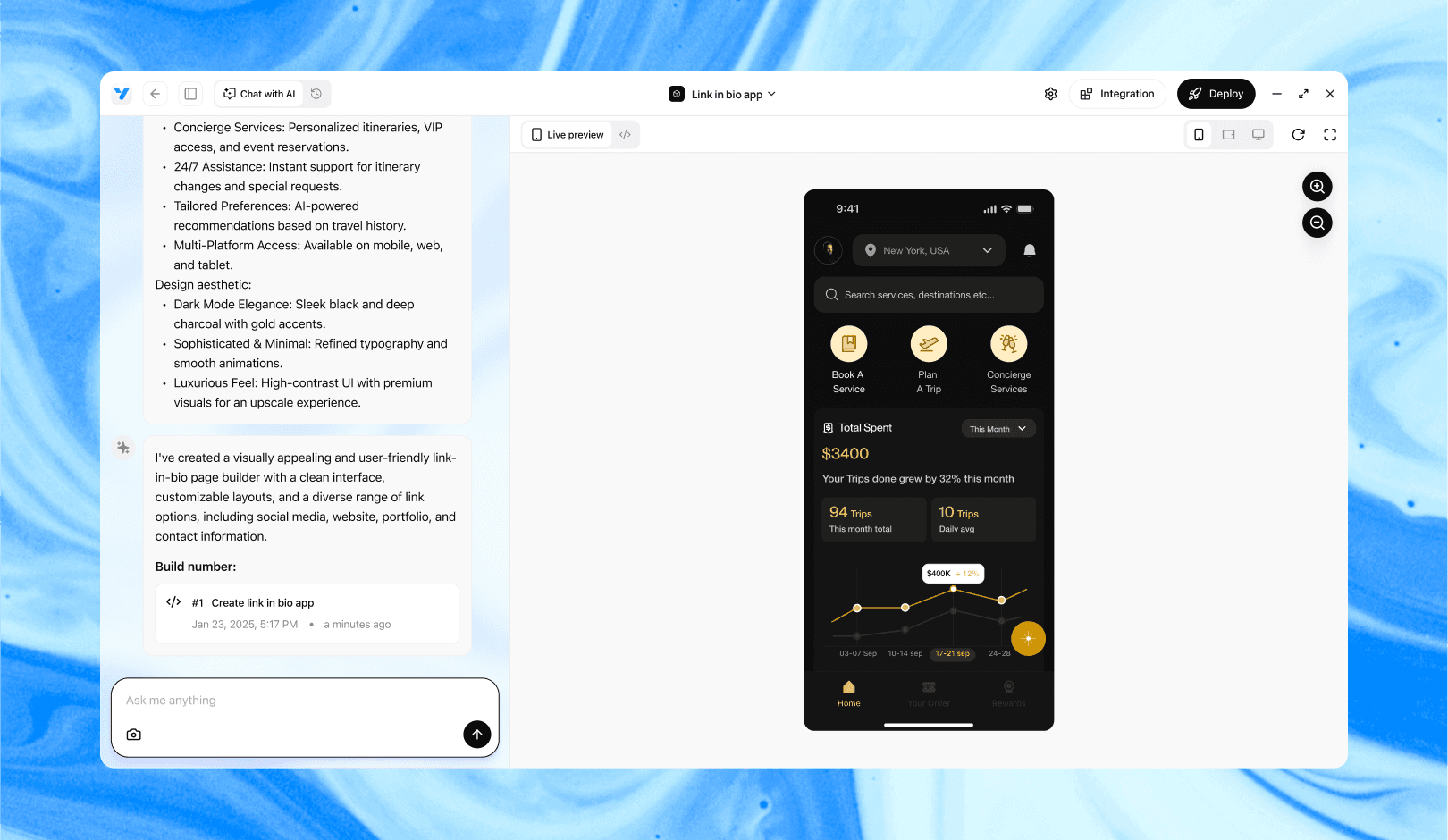
Vibe Studio, powered by Steve’s advanced AI agents, is a revolutionary no-code, conversational platform that empowers users to quickly and efficiently create full-stack Flutter applications integrated seamlessly with Firebase backend services. Ideal for solo founders, startups, and agile engineering teams, Vibe Studio allows users to visually manage and deploy Flutter apps, greatly accelerating the development process. The intuitive conversational interface simplifies complex development tasks, making app creation accessible even for non-coders.

Conclusion

Embedding Flutter UI inside Unity3D bridges two strong ecosystems for mobile development: Flutter for expressive UI and Unity for 3D graphics. Choose platform views for overlays and offscreen textures when you need world-space placement. Use MethodChannel/EventChannel for command and event exchange, and prioritize engine reuse and throttling for performance. Start small: prototype a single panel, measure, then expand to larger interactive UIs.

Introduction

Embedding Flutter UIs inside Unity3D environments lets you combine Unity's real-time 3D capabilities with Flutter's expressive, high-performance widget system. This hybrid approach is valuable for mobile development where you want native-like UI, rapid iteration, and the rendering power of Unity for AR/VR, 3D scenes, or gamified interfaces. This tutorial explains architectures, communication patterns, rendering options, and a compact integration example to get you started.

Why Embed Flutter In Unity

Use cases include complex 3D scenes driven by Unity with overlays, HUDs, or interactive panels rendered with Flutter. Flutter excels at lists, forms, adaptive layouts, and animations — ideal for menus, dashboards, or configuration UIs — while Unity handles physics, shaders, and 3D assets. Embedding Flutter gives designers the UI speed of Flutter and the immersive power of Unity without reimplementing widgets in Unity's UI toolkit.

Architecture And Communication

Two main architectural models exist:

  • Platform View Model: Host a Flutter view (Android View or iOS UIView) as a native view layered into the Unity view hierarchy. This is simpler on Android/iOS because Flutter can run as a Fragment/UIViewController and be composed by native code. Communication uses MethodChannel/EventChannel for method calls and streams.

  • Texture/Offscreen Model: Render Flutter to an offscreen texture and pass pixel frames to Unity as a native texture. This decouples input and lifecycle but is more complex. It uses Flutter's TextureRegistry on the engine side and platform APIs to register and share textures with Unity.

For mobile development, choose Platform View for quick overlays and Texture approach when Flutter content must be composited inside 3D space or should be transformed by Unity shaders.

Communication patterns:

  • MethodChannel: for RPC-style commands, e.g., open screen, send data.

  • EventChannel/BinaryMessenger: for streaming events from Flutter to Unity.

  • Shared Memory or Native Plugins: for high-bandwidth data like continuous gesture streams or video frames.

Keep messages small and avoid blocking UI threads. Serialize only necessary data and throttle frequent events.

Rendering Approaches

Platform View (View Composition):

  • Pros: Easier integration, Flutter manages its own lifecycle and input.

  • Cons: Z-order and clipping are tied to platform view limitations. Not natively transformable in 3D.

Texture/Offscreen Rendering:

  • Pros: Unity can treat Flutter output as any texture, apply shaders, world-space placement, and transformations.

  • Cons: Requires engine-level plugins, synchronization of frame updates, and potentially higher CPU/GPU cost.

Implementation tips:

  • On Android, create a FlutterEngine and attach a FlutterNativeView or use Flutter's RenderSurface to render to a surface texture. Export that SurfaceTexture to Unity via JNI as an Android SurfaceTexture bound to a Unity texture.

  • On iOS, host a FlutterEngine and use Flutter's TextureRegistry to produce pixel buffers bridged to Metal or OpenGL textures for Unity.

Manage frame pacing carefully: Unity's render loop and Flutter's frame scheduler must be synchronized to avoid stuttering.

Practical Integration Example

This example outlines a minimal Flutter-side pattern using MethodChannel to expose a texture id and receive commands from Unity. The native side is responsible for creating the texture and sending the texture id via channel.

import 'package:flutter/material.dart';
import 'package:flutter/services.dart';

final _channel = MethodChannel('unity_flutter_channel');

class UnityPanel extends StatefulWidget {
  @override
  _UnityPanelState createState() => _UnityPanelState();
}

class _UnityPanelState extends State<UnityPanel> {
  int? _textureId;

  @override
  void initState() {
    super.initState();
    _channel.invokeMethod('requestTextureId').then(
      (id) => setState(() => _textureId = id),
    );
  }

  @override
  Widget build(BuildContext context) => _textureId == null
      ? Container(color: Colors.black)
      : Texture(textureId: _textureId!);
}

On the native side (Android/iOS), you implement creation of an external texture and return its id through 'unity_flutter_channel'. Implement touch forwarding: Unity captures touches and forwards pointers to Flutter via the same MethodChannel.

Performance checklist:

  • Reuse a single FlutterEngine when possible to avoid cold starts.

  • Minimize binary payloads over channels; send compact JSON or binary buffers.

  • Batch frequent updates and throttle when Unity and Flutter run at different frame rates.

  • Test memory usage on target devices and profile GPU/CPU in both engines.

Vibe Studio

Vibe Studio, powered by Steve’s advanced AI agents, is a revolutionary no-code, conversational platform that empowers users to quickly and efficiently create full-stack Flutter applications integrated seamlessly with Firebase backend services. Ideal for solo founders, startups, and agile engineering teams, Vibe Studio allows users to visually manage and deploy Flutter apps, greatly accelerating the development process. The intuitive conversational interface simplifies complex development tasks, making app creation accessible even for non-coders.

Conclusion

Embedding Flutter UI inside Unity3D bridges two strong ecosystems for mobile development: Flutter for expressive UI and Unity for 3D graphics. Choose platform views for overlays and offscreen textures when you need world-space placement. Use MethodChannel/EventChannel for command and event exchange, and prioritize engine reuse and throttling for performance. Start small: prototype a single panel, measure, then expand to larger interactive UIs.

Build Flutter Apps Faster with Vibe Studio

Build Flutter Apps Faster with Vibe Studio

Build Flutter Apps Faster with Vibe Studio

Build Flutter Apps Faster with Vibe Studio

Vibe Studio is your AI-powered Flutter development companion. Skip boilerplate, build in real-time, and deploy without hassle. Start creating apps at lightning speed with zero setup.

Vibe Studio is your AI-powered Flutter development companion. Skip boilerplate, build in real-time, and deploy without hassle. Start creating apps at lightning speed with zero setup.

Vibe Studio is your AI-powered Flutter development companion. Skip boilerplate, build in real-time, and deploy without hassle. Start creating apps at lightning speed with zero setup.

Vibe Studio is your AI-powered Flutter development companion. Skip boilerplate, build in real-time, and deploy without hassle. Start creating apps at lightning speed with zero setup.

Other Insights

Other Insights

Other Insights

Other Insights

Join a growing community of builders today

Join a growing community of builders today

Join a growing community of builders today

Join a growing community of builders today

Join a growing community of builders today

28-07 Jackson Ave

Walturn

New York NY 11101 United States

© Steve • All Rights Reserved 2025

28-07 Jackson Ave

Walturn

New York NY 11101 United States

© Steve • All Rights Reserved 2025

28-07 Jackson Ave

Walturn

New York NY 11101 United States

© Steve • All Rights Reserved 2025

28-07 Jackson Ave

Walturn

New York NY 11101 United States

© Steve • All Rights Reserved 2025

28-07 Jackson Ave

Walturn

New York NY 11101 United States

© Steve • All Rights Reserved 2025

28-07 Jackson Ave

Walturn

New York NY 11101 United States

© Steve • All Rights Reserved 2025