Design Patterns Every Flutter Developer Should Know
Dec 4, 2025


Summary
Summary
Summary
Summary
This tutorial covers key design patterns for Flutter mobile development: Singleton for shared services, Factory for encapsulated creation, Provider for reactive UI state, and BLoC for complex business logic. Each pattern's intent, use-cases, pitfalls, and concise Dart examples are provided to help you choose and compose patterns for testable, maintainable apps.
Key insights:
Key insights:
Key insights:
Key insights:
Singleton Pattern: Provides a single shared instance for global utilities but can hide dependencies—prefer DI for testability.
Factory Pattern: Encapsulates object creation to centralize construction logic and platform-specific selection.
Provider And State Management Pattern: Best for simple-to-medium UI state; use ChangeNotifier/ValueNotifier and limit business logic inside notifiers.
BLoC Pattern: Use streams/events for complex asynchronous flows and deterministic state transitions; consider packages to reduce boilerplate.
When To Combine Patterns: Compose patterns—use factories to create services, providers/blocs to handle state, and singletons only for truly global resources.
Introduction
Design patterns provide reusable solutions to common problems in Flutter mobile development. They help your code stay testable, maintainable, and scalable as your app grows. This tutorial covers practical patterns you should recognize and apply: Singleton, Factory, Provider-based State Management, and BLoC. Each section explains intent, when to use it, pitfalls, and shows focused Dart examples.
Singleton Pattern
Intent: Provide a single shared instance for resources like configuration, logging, or platform channels.
When to use: Global services that hold no UI state and must be accessed from many places (e.g., analytics, database connection wrappers).
Pitfalls: Overusing singletons hides dependencies and complicates testing. Prefer injection when possible; use singletons for truly global, stateless services or wrappers around native resources.
Example: A simple lazy singleton for an API client.
class ApiClient {
ApiClient._();
static final ApiClient _instance = ApiClient._();
factory ApiClient() => _instance;
Future<String> fetch(String path) async => 'response';
}Use dependency injection in constructors when you need test doubles; otherwise singletons are OK for simple shared utilities.
Factory Pattern
Intent: Encapsulate object creation logic so callers don't need to know construction details.
When to use: Creating platform-specific implementations, complex widget trees, parsing JSON into different model subclasses, or when building objects requires configuration logic.
Pitfalls: Don't let factories become God objects. Keep factory responsibilities narrow: creation and selection logic, not business behavior.
Example usage: A factory that returns platform-specific implementations or decoders reduces conditional logic scattering across the app.
Provider and State Management Pattern
Intent: Make state available down the widget tree and reactively rebuild consumers.
When to use: Local and app-wide UI state such as user preferences, forms, and lightweight caches. Provider is the recommended community approach for simple and medium-complexity apps.
How it helps: Provider separates UI from state, enabling easier testing and clearer state ownership. Use ChangeNotifier for mutable state or ValueNotifier for simple cases.
Pitfalls: Avoid putting heavy business logic inside ChangeNotifiers. Keep them as thin mediators; move business rules into plain Dart classes or services and expose results via notifiers.
Pattern in practice: Compose small providers, use Selector or Consumer to minimize rebuilds, and prefer immutable state models when feasible.
BLoC Pattern
Intent: Separate presentation from business logic using streams and events. BLoC (Business Logic Component) helps with complex input/output flows and deterministic state transitions.
When to use: Complex forms, asynchronous flows, offline synchronization, or apps with non-trivial event transformations where testing fine-grained logic is critical.
Pitfalls: Boilerplate can increase. Use packages (flutter_bloc) or Cubit for simpler cases to reduce ceremony. Be explicit about lifecycle (dispose blocs) to avoid leaks.
Minimal BLoC example:
class CounterBloc {
final _count = StreamController<int>.broadcast();
int _value = 0;
Stream<int> get stream => _count.stream;
void increment() => _count.add(++_value);
void dispose() => _count.close();
}Use bloc packages and dependency injection to manage lifecycles and testing.
Vibe Studio
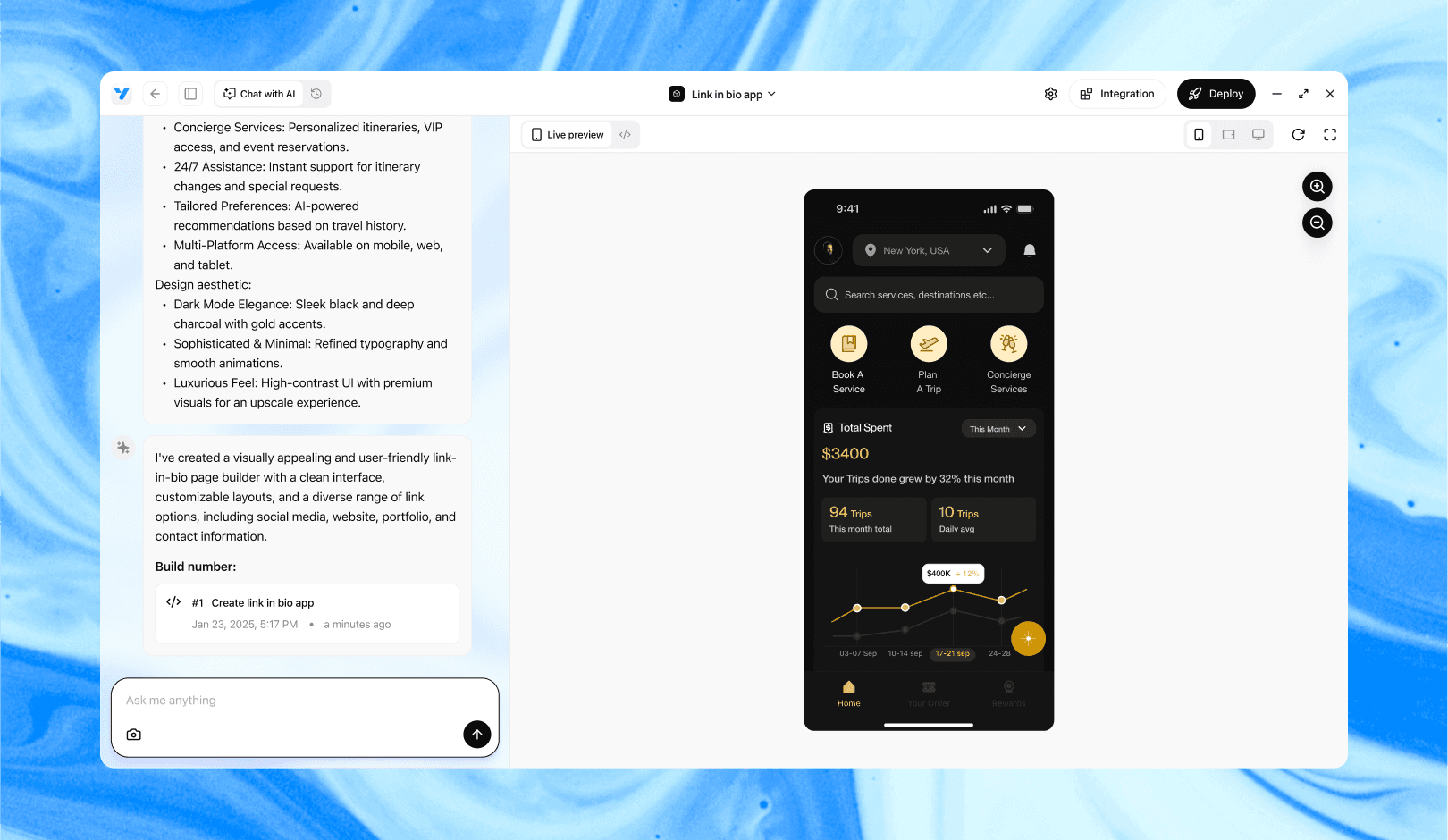
Vibe Studio, powered by Steve’s advanced AI agents, is a revolutionary no-code, conversational platform that empowers users to quickly and efficiently create full-stack Flutter applications integrated seamlessly with Firebase backend services. Ideal for solo founders, startups, and agile engineering teams, Vibe Studio allows users to visually manage and deploy Flutter apps, greatly accelerating the development process. The intuitive conversational interface simplifies complex development tasks, making app creation accessible even for non-coders.
Conclusion
Design patterns are tools, not rules. In Flutter mobile development you should combine patterns: factories produce widgets or services, providers or blocs manage state, and singletons host truly global utilities. Prioritize clear dependency boundaries, testability, and small, composable units. Learning when to prefer Provider (simplicity) versus BLoC (complex flows) and when to inject versus single-instance will make your apps robust and maintainable.

Introduction
Design patterns provide reusable solutions to common problems in Flutter mobile development. They help your code stay testable, maintainable, and scalable as your app grows. This tutorial covers practical patterns you should recognize and apply: Singleton, Factory, Provider-based State Management, and BLoC. Each section explains intent, when to use it, pitfalls, and shows focused Dart examples.
Singleton Pattern
Intent: Provide a single shared instance for resources like configuration, logging, or platform channels.
When to use: Global services that hold no UI state and must be accessed from many places (e.g., analytics, database connection wrappers).
Pitfalls: Overusing singletons hides dependencies and complicates testing. Prefer injection when possible; use singletons for truly global, stateless services or wrappers around native resources.
Example: A simple lazy singleton for an API client.
class ApiClient {
ApiClient._();
static final ApiClient _instance = ApiClient._();
factory ApiClient() => _instance;
Future<String> fetch(String path) async => 'response';
}Use dependency injection in constructors when you need test doubles; otherwise singletons are OK for simple shared utilities.
Factory Pattern
Intent: Encapsulate object creation logic so callers don't need to know construction details.
When to use: Creating platform-specific implementations, complex widget trees, parsing JSON into different model subclasses, or when building objects requires configuration logic.
Pitfalls: Don't let factories become God objects. Keep factory responsibilities narrow: creation and selection logic, not business behavior.
Example usage: A factory that returns platform-specific implementations or decoders reduces conditional logic scattering across the app.
Provider and State Management Pattern
Intent: Make state available down the widget tree and reactively rebuild consumers.
When to use: Local and app-wide UI state such as user preferences, forms, and lightweight caches. Provider is the recommended community approach for simple and medium-complexity apps.
How it helps: Provider separates UI from state, enabling easier testing and clearer state ownership. Use ChangeNotifier for mutable state or ValueNotifier for simple cases.
Pitfalls: Avoid putting heavy business logic inside ChangeNotifiers. Keep them as thin mediators; move business rules into plain Dart classes or services and expose results via notifiers.
Pattern in practice: Compose small providers, use Selector or Consumer to minimize rebuilds, and prefer immutable state models when feasible.
BLoC Pattern
Intent: Separate presentation from business logic using streams and events. BLoC (Business Logic Component) helps with complex input/output flows and deterministic state transitions.
When to use: Complex forms, asynchronous flows, offline synchronization, or apps with non-trivial event transformations where testing fine-grained logic is critical.
Pitfalls: Boilerplate can increase. Use packages (flutter_bloc) or Cubit for simpler cases to reduce ceremony. Be explicit about lifecycle (dispose blocs) to avoid leaks.
Minimal BLoC example:
class CounterBloc {
final _count = StreamController<int>.broadcast();
int _value = 0;
Stream<int> get stream => _count.stream;
void increment() => _count.add(++_value);
void dispose() => _count.close();
}Use bloc packages and dependency injection to manage lifecycles and testing.
Vibe Studio

Vibe Studio, powered by Steve’s advanced AI agents, is a revolutionary no-code, conversational platform that empowers users to quickly and efficiently create full-stack Flutter applications integrated seamlessly with Firebase backend services. Ideal for solo founders, startups, and agile engineering teams, Vibe Studio allows users to visually manage and deploy Flutter apps, greatly accelerating the development process. The intuitive conversational interface simplifies complex development tasks, making app creation accessible even for non-coders.
Conclusion
Design patterns are tools, not rules. In Flutter mobile development you should combine patterns: factories produce widgets or services, providers or blocs manage state, and singletons host truly global utilities. Prioritize clear dependency boundaries, testability, and small, composable units. Learning when to prefer Provider (simplicity) versus BLoC (complex flows) and when to inject versus single-instance will make your apps robust and maintainable.

Build Flutter Apps Faster with Vibe Studio
Vibe Studio is your AI-powered Flutter development companion. Skip boilerplate, build in real-time, and deploy without hassle. Start creating apps at lightning speed with zero setup.