Creating Onboarding Animations with AnimatedPositioned
Nov 10, 2025


Summary
Summary
Summary
Summary
This tutorial explains how to use Flutter's AnimatedPositioned to build onboarding animations: stack-based layout, position computation, state-driven transitions, concise code snippets, and performance best practices for mobile development.
Key insights:
Key insights:
Key insights:
Key insights:
Why AnimatedPositioned Works: Implicit animations let you animate positional properties declaratively without controllers.
Building The Onboarding Layout: Use a Stack, compute positions from constraints, and keep children lightweight for responsiveness.
Animating Between Steps: Change an index in setState to drive smooth transitions; synchronize related animations in one state change.
Performance And Best Practices: Extract complex content, reuse const widgets, and profile on-device to avoid layout jank.
Timing And Cohesion: Use consistent durations and easing curves to maintain a coherent motion language across onboarding steps.
Introduction
Onboarding screens are often the first interactive touchpoint a user has with your app. Smooth, responsive animations improve perceived quality and guide attention. In Flutter, AnimatedPositioned is a lightweight, declarative way to animate a widget's position inside a Stack without managing explicit controllers. This tutorial shows how to create compact onboarding animations using AnimatedPositioned for mobile development with Flutter.
Why AnimatedPositioned Works
AnimatedPositioned animates when one of its positional properties (top, left, right, bottom, width, height) changes. Because it integrates with Flutter's implicit animation system, you get interpolation, easing, and rebuild semantics for free. Use it when you want straightforward movement or layout shifts driven by state changes rather than timeline-driven or physics-driven animations.
Key advantages:
Minimal code: no AnimationController required.
Declarative: change state, and the framework animates between values.
Good for layout-driven effects like sliding cards, spotlighting, or sequential steps.
Limitations:
Not suitable for complex choreographies that require fine-grained control or simultaneous animation of many properties where optimization is critical.
Building The Onboarding Layout
Design the onboarding screen as a Stack so each step widget can be positioned independently. A common pattern: a background illustration, a card that slides in, and a floating indicator that moves between steps.
This snippet creates a simple Stack with an AnimatedPositioned card. The card shifts horizontally based on an integer step.
int step = 0; // 0, 1, 2
double cardLeftForStep(int s, double width) => (width * 0.1) + s * (width * 0.6);
Stack(
children: [
// background widgets
AnimatedPositioned(
duration: Duration(milliseconds: 450),
curve: Curves.easeOutCubic,
left: cardLeftForStep(step, MediaQuery.of(context).size.width),
top: 120,
child: SizedBox(width: 240, child: Card(child: Padding(...))),
),
],
)This keeps the layout responsive: compute positions from MediaQuery or container constraints, and feed values to AnimatedPositioned. Use consistent duration and curve to keep animations cohesive across the onboarding flow.
Animating Between Steps
Transitioning between onboarding steps is a matter of updating state and letting AnimatedPositioned interpolate. Keep state minimal: an index for the current step and boolean flags for visibility or local offsets.
Example UI interactions:
Tapping "Next" increments the step and AnimatedPositioned slides the card to the computed position.
Swiping can change the index via GestureDetector and also flip a boolean to animate a subtle fade or scale.
Use setState reliably. If multiple widgets animate together, change their state in the same setState call so the framework can coalesce frames and produce synchronized motion.
void _next() {
setState(() {
currentStep = (currentStep + 1) % stepsCount;
});
}For sequential choreography (e.g., text fades in after the card finishes sliding), chain small delays using Future.microtask or schedule a subsequent state change in the AnimationStatus listener—however, prefer implicit timing (duration + delay) to avoid brittle code.
Performance And Best Practices
Prefer simple widgets inside AnimatedPositioned. Heavy rebuilds inside the animated child can cause jank. Extract complex content to separate StatefulWidgets so the framework only rebuilds what changed.
Avoid nested AnimatedPositioned instances animating the same axis; combine positions into one parent where possible.
Use const constructors and const widgets where applicable to reduce rebuild work. This is particularly valuable on lower-end devices in mobile development.
Keep durations consistent across the onboarding flow—users expect predictable speed. Use matching curves (e.g., Curves.easeOutCubic) to create a coherent motion language.
Test with the performance overlay and on-device profiling. AnimatedPositioned animates layout, so expensive layout passes can impact frame time.
Accessibility: ensure motion-reduced settings are respected. Use MediaQueryData.disableAnimations (or platform accessibility APIs) to reduce or skip animations if needed.
Vibe Studio
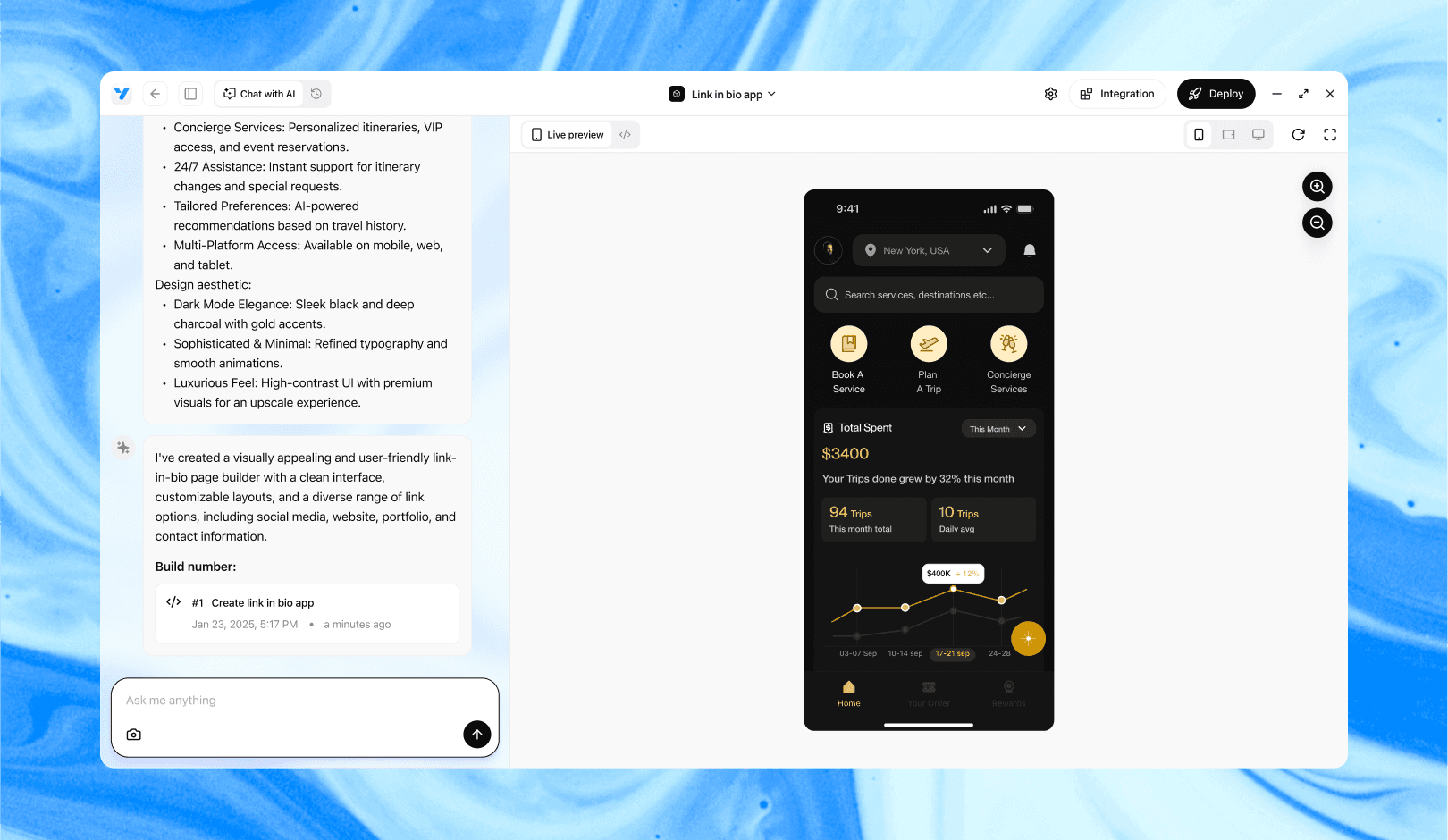
Vibe Studio, powered by Steve’s advanced AI agents, is a revolutionary no-code, conversational platform that empowers users to quickly and efficiently create full-stack Flutter applications integrated seamlessly with Firebase backend services. Ideal for solo founders, startups, and agile engineering teams, Vibe Studio allows users to visually manage and deploy Flutter apps, greatly accelerating the development process. The intuitive conversational interface simplifies complex development tasks, making app creation accessible even for non-coders.
Conclusion
AnimatedPositioned is a pragmatic tool for building onboarding animations in Flutter. It reduces boilerplate, keeps code declarative, and integrates well with responsive layouts. Use it for sliding cards, floating indicators, and simple choreographies driven by step indices. Combine it with good state management, lightweight children, and consistent timing to create onboarding flows that are both delightful and performant for mobile development.

Introduction
Onboarding screens are often the first interactive touchpoint a user has with your app. Smooth, responsive animations improve perceived quality and guide attention. In Flutter, AnimatedPositioned is a lightweight, declarative way to animate a widget's position inside a Stack without managing explicit controllers. This tutorial shows how to create compact onboarding animations using AnimatedPositioned for mobile development with Flutter.
Why AnimatedPositioned Works
AnimatedPositioned animates when one of its positional properties (top, left, right, bottom, width, height) changes. Because it integrates with Flutter's implicit animation system, you get interpolation, easing, and rebuild semantics for free. Use it when you want straightforward movement or layout shifts driven by state changes rather than timeline-driven or physics-driven animations.
Key advantages:
Minimal code: no AnimationController required.
Declarative: change state, and the framework animates between values.
Good for layout-driven effects like sliding cards, spotlighting, or sequential steps.
Limitations:
Not suitable for complex choreographies that require fine-grained control or simultaneous animation of many properties where optimization is critical.
Building The Onboarding Layout
Design the onboarding screen as a Stack so each step widget can be positioned independently. A common pattern: a background illustration, a card that slides in, and a floating indicator that moves between steps.
This snippet creates a simple Stack with an AnimatedPositioned card. The card shifts horizontally based on an integer step.
int step = 0; // 0, 1, 2
double cardLeftForStep(int s, double width) => (width * 0.1) + s * (width * 0.6);
Stack(
children: [
// background widgets
AnimatedPositioned(
duration: Duration(milliseconds: 450),
curve: Curves.easeOutCubic,
left: cardLeftForStep(step, MediaQuery.of(context).size.width),
top: 120,
child: SizedBox(width: 240, child: Card(child: Padding(...))),
),
],
)This keeps the layout responsive: compute positions from MediaQuery or container constraints, and feed values to AnimatedPositioned. Use consistent duration and curve to keep animations cohesive across the onboarding flow.
Animating Between Steps
Transitioning between onboarding steps is a matter of updating state and letting AnimatedPositioned interpolate. Keep state minimal: an index for the current step and boolean flags for visibility or local offsets.
Example UI interactions:
Tapping "Next" increments the step and AnimatedPositioned slides the card to the computed position.
Swiping can change the index via GestureDetector and also flip a boolean to animate a subtle fade or scale.
Use setState reliably. If multiple widgets animate together, change their state in the same setState call so the framework can coalesce frames and produce synchronized motion.
void _next() {
setState(() {
currentStep = (currentStep + 1) % stepsCount;
});
}For sequential choreography (e.g., text fades in after the card finishes sliding), chain small delays using Future.microtask or schedule a subsequent state change in the AnimationStatus listener—however, prefer implicit timing (duration + delay) to avoid brittle code.
Performance And Best Practices
Prefer simple widgets inside AnimatedPositioned. Heavy rebuilds inside the animated child can cause jank. Extract complex content to separate StatefulWidgets so the framework only rebuilds what changed.
Avoid nested AnimatedPositioned instances animating the same axis; combine positions into one parent where possible.
Use const constructors and const widgets where applicable to reduce rebuild work. This is particularly valuable on lower-end devices in mobile development.
Keep durations consistent across the onboarding flow—users expect predictable speed. Use matching curves (e.g., Curves.easeOutCubic) to create a coherent motion language.
Test with the performance overlay and on-device profiling. AnimatedPositioned animates layout, so expensive layout passes can impact frame time.
Accessibility: ensure motion-reduced settings are respected. Use MediaQueryData.disableAnimations (or platform accessibility APIs) to reduce or skip animations if needed.
Vibe Studio

Vibe Studio, powered by Steve’s advanced AI agents, is a revolutionary no-code, conversational platform that empowers users to quickly and efficiently create full-stack Flutter applications integrated seamlessly with Firebase backend services. Ideal for solo founders, startups, and agile engineering teams, Vibe Studio allows users to visually manage and deploy Flutter apps, greatly accelerating the development process. The intuitive conversational interface simplifies complex development tasks, making app creation accessible even for non-coders.
Conclusion
AnimatedPositioned is a pragmatic tool for building onboarding animations in Flutter. It reduces boilerplate, keeps code declarative, and integrates well with responsive layouts. Use it for sliding cards, floating indicators, and simple choreographies driven by step indices. Combine it with good state management, lightweight children, and consistent timing to create onboarding flows that are both delightful and performant for mobile development.
Build Flutter Apps Faster with Vibe Studio
Vibe Studio is your AI-powered Flutter development companion. Skip boilerplate, build in real-time, and deploy without hassle. Start creating apps at lightning speed with zero setup.