Creating AI-Based Recommendations in Flutter E-Commerce Apps
Nov 11, 2025


Summary
Summary
Summary
Summary
This tutorial outlines a practical approach to adding AI recommendations to Flutter e-commerce apps: design a hybrid server-side pipeline, export embeddings, expose a simple inference API, and integrate in Flutter using batched network requests, caching, and lightweight client logging. Optimize for mobile by minimizing payloads, using skeleton UIs, and optionally running tiny on-device models for offline needs.
Key insights:
Key insights:
Key insights:
Key insights:
Designing The Recommendation Pipeline: Use a hybrid pipeline with server-side embedding storage and a fast nearest-neighbor search for scalable recommendations.
Implementing Server-Side Models: Keep training and heavy inference server-side; expose simple session/user endpoints and cache popular queries.
Integrating Recommendations In Flutter: Fetch batched recommendations, prefetch images, use skeleton UIs, and batch client-side event logs to reduce latency.
Optimizing For Mobile Performance: Minimize payloads, leverage HTTP/2/gRPC, cache aggressively, and consider tiny on-device models only when necessary.
Evaluation And Iteration: Instrument impressions and downstream actions, track offline and online metrics, and retrain regularly to prevent model drift.
Introduction
Building AI-based recommendations for Flutter e-commerce apps delivers personalized shopping experiences that increase engagement and conversion. This tutorial walks through a pragmatic architecture, model choices, and concrete Flutter integration patterns. You will learn how to collect signals, serve recommendations, and integrate them in a performant mobile UI while respecting privacy and bandwidth constraints.
Designing The Recommendation Pipeline
Start by defining input signals and objectives. Typical inputs: product metadata (category, price, tags), user behavior (views, add-to-cart, purchases), and implicit signals (dwell time, scroll depth). Objectives usually include click-through rate and conversion lift.
Architecture recommendation: keep model training and heavy inference on the server. Use a hybrid approach combining collaborative filtering (to capture user-product relationships) and content-based vectors (to handle cold start). Store product embeddings and user-session vectors in a fast key-value store (Redis) or a vector database (Milvus, Pinecone).
Data pipeline essentials: event ingestion (Kafka or serverless logging), feature engineering (batch and streaming), model training (Spark or Python), and a REST/gRPC inference layer. Log every recommendation impression and downstream action for continuous evaluation.
Implementing Server-Side Models
Choose a model that matches data scale. Small catalogs: matrix factorization or LightFM. Large catalogs: neural embeddings (SASRec, BERT4Rec) or specialized retrieval models. Export product embeddings and provide a nearest-neighbor search endpoint. Keep the inference API simple: input a user id or session vector, return ranked product IDs with scores and optional explanations.
Ensure the API supports these flows:
Session-only recommendations: compute a session vector from recent interactions and return nearest product vectors.
User-based recommendations: use long-term user embeddings plus recency weighting.
Add caching for popular queries and an offline fallback: top-sellers or category-based suggestions when the model is unavailable.
Integrating Recommendations In Flutter
On the Flutter side, call your inference API and present results in existing UI components (horizontal carousels, “Recommended for you” sections). Keep network usage efficient: request batched recommendations and prefetch images using cached_network_image.
Example: fetch recommendations for a session and update state. This snippet illustrates an HTTP call and basic error handling.
import 'dart:convert';
import 'package:http/http.dart' as http;
Future<List<String>> fetchRecs(String sessionId) async {
final res = await http.post(Uri.parse('https://api.example.com/recs'),
body: jsonEncode({'sessionId': sessionId}),
headers: {'Content-Type': 'application/json'});
if (res.statusCode == 200) return List<String>.from(jsonDecode(res.body)['productIds']);
throw Exception('Recommendation fetch failed');
}Log client-side events efficiently. Batch user events (view, click, add-to-cart) and upload periodically or on critical actions. Minimizing synchronous calls improves UI responsiveness.
void logEvent(Map<String, dynamic> event) {
// Add to in-memory queue and flush periodically
eventQueue.add(event);
}Design UI placeholders to avoid layout shifts when recommendations arrive. Show skeleton cards and animate populated content.
Optimizing For Mobile Performance
Minimize payload: return only product IDs, scores, and small metadata; fetch full details via separate batch endpoints if needed. Use HTTP/2 or gRPC for lower latency. Compress responses and enable caching headers.
For low-latency personalization on-device, consider shipping small models using TensorFlow Lite if privacy or offline functionality is critical. On-device models suit simple ranking or reranking tasks but require frequent model updates and careful size constraints.
Measure end-to-end latency, memory use, and energy. A/B test recommendation variants and use offline metrics (precision@k, recall@k) plus online metrics (CTR, conversion). Periodically retrain models with fresh data and monitor drift.
Vibe Studio
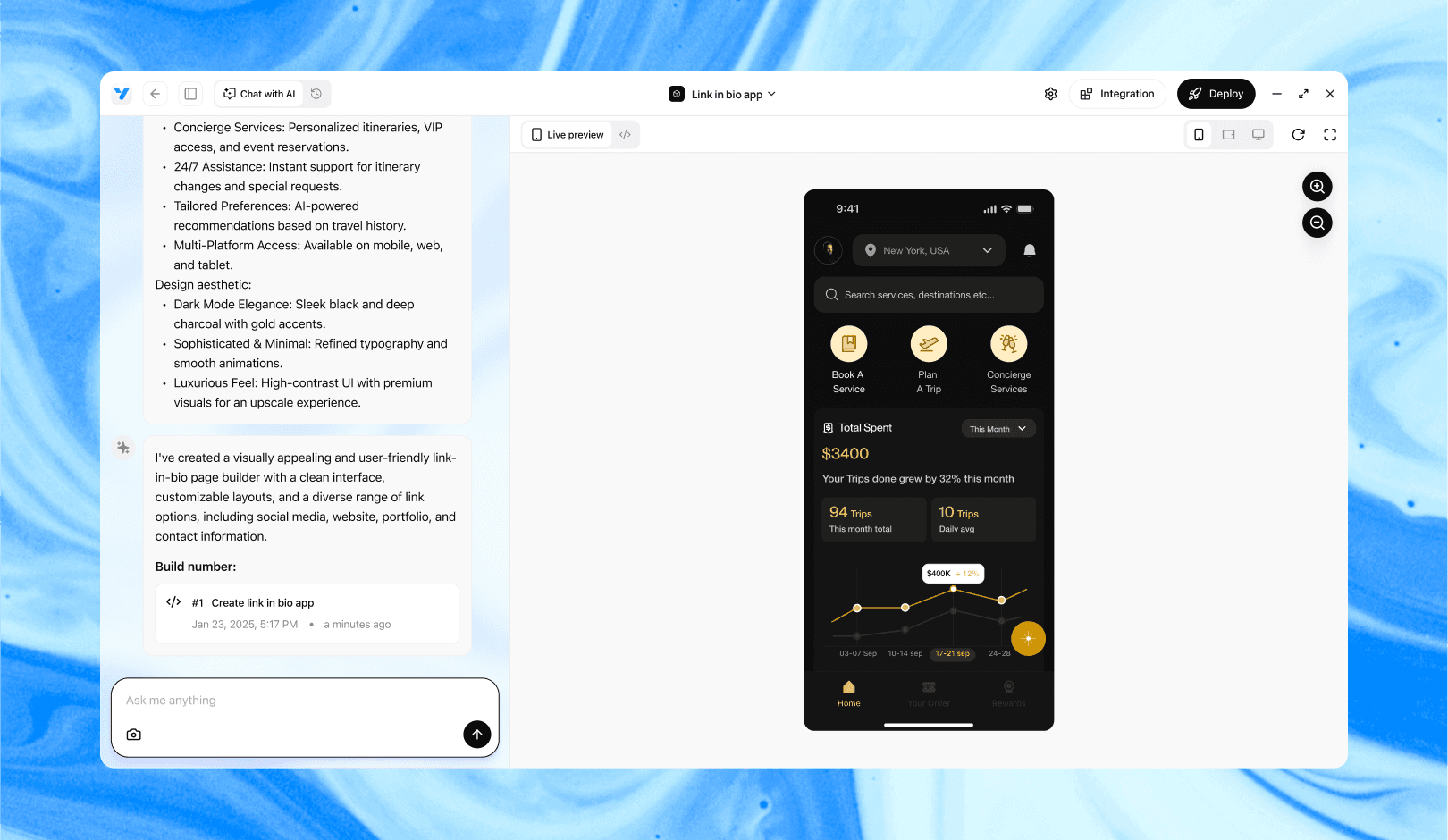
Vibe Studio, powered by Steve’s advanced AI agents, is a revolutionary no-code, conversational platform that empowers users to quickly and efficiently create full-stack Flutter applications integrated seamlessly with Firebase backend services. Ideal for solo founders, startups, and agile engineering teams, Vibe Studio allows users to visually manage and deploy Flutter apps, greatly accelerating the development process. The intuitive conversational interface simplifies complex development tasks, making app creation accessible even for non-coders.
Conclusion
Integrating AI-powered recommendations into a Flutter e-commerce app combines backend model engineering and pragmatic mobile integration. Keep heavy inference server-side, simplify APIs for the client, batch and cache aggressively, and instrument everything for continuous improvement. With careful design you can deliver personalized experiences that scale while preserving app performance and user privacy.

Introduction
Building AI-based recommendations for Flutter e-commerce apps delivers personalized shopping experiences that increase engagement and conversion. This tutorial walks through a pragmatic architecture, model choices, and concrete Flutter integration patterns. You will learn how to collect signals, serve recommendations, and integrate them in a performant mobile UI while respecting privacy and bandwidth constraints.
Designing The Recommendation Pipeline
Start by defining input signals and objectives. Typical inputs: product metadata (category, price, tags), user behavior (views, add-to-cart, purchases), and implicit signals (dwell time, scroll depth). Objectives usually include click-through rate and conversion lift.
Architecture recommendation: keep model training and heavy inference on the server. Use a hybrid approach combining collaborative filtering (to capture user-product relationships) and content-based vectors (to handle cold start). Store product embeddings and user-session vectors in a fast key-value store (Redis) or a vector database (Milvus, Pinecone).
Data pipeline essentials: event ingestion (Kafka or serverless logging), feature engineering (batch and streaming), model training (Spark or Python), and a REST/gRPC inference layer. Log every recommendation impression and downstream action for continuous evaluation.
Implementing Server-Side Models
Choose a model that matches data scale. Small catalogs: matrix factorization or LightFM. Large catalogs: neural embeddings (SASRec, BERT4Rec) or specialized retrieval models. Export product embeddings and provide a nearest-neighbor search endpoint. Keep the inference API simple: input a user id or session vector, return ranked product IDs with scores and optional explanations.
Ensure the API supports these flows:
Session-only recommendations: compute a session vector from recent interactions and return nearest product vectors.
User-based recommendations: use long-term user embeddings plus recency weighting.
Add caching for popular queries and an offline fallback: top-sellers or category-based suggestions when the model is unavailable.
Integrating Recommendations In Flutter
On the Flutter side, call your inference API and present results in existing UI components (horizontal carousels, “Recommended for you” sections). Keep network usage efficient: request batched recommendations and prefetch images using cached_network_image.
Example: fetch recommendations for a session and update state. This snippet illustrates an HTTP call and basic error handling.
import 'dart:convert';
import 'package:http/http.dart' as http;
Future<List<String>> fetchRecs(String sessionId) async {
final res = await http.post(Uri.parse('https://api.example.com/recs'),
body: jsonEncode({'sessionId': sessionId}),
headers: {'Content-Type': 'application/json'});
if (res.statusCode == 200) return List<String>.from(jsonDecode(res.body)['productIds']);
throw Exception('Recommendation fetch failed');
}Log client-side events efficiently. Batch user events (view, click, add-to-cart) and upload periodically or on critical actions. Minimizing synchronous calls improves UI responsiveness.
void logEvent(Map<String, dynamic> event) {
// Add to in-memory queue and flush periodically
eventQueue.add(event);
}Design UI placeholders to avoid layout shifts when recommendations arrive. Show skeleton cards and animate populated content.
Optimizing For Mobile Performance
Minimize payload: return only product IDs, scores, and small metadata; fetch full details via separate batch endpoints if needed. Use HTTP/2 or gRPC for lower latency. Compress responses and enable caching headers.
For low-latency personalization on-device, consider shipping small models using TensorFlow Lite if privacy or offline functionality is critical. On-device models suit simple ranking or reranking tasks but require frequent model updates and careful size constraints.
Measure end-to-end latency, memory use, and energy. A/B test recommendation variants and use offline metrics (precision@k, recall@k) plus online metrics (CTR, conversion). Periodically retrain models with fresh data and monitor drift.
Vibe Studio

Vibe Studio, powered by Steve’s advanced AI agents, is a revolutionary no-code, conversational platform that empowers users to quickly and efficiently create full-stack Flutter applications integrated seamlessly with Firebase backend services. Ideal for solo founders, startups, and agile engineering teams, Vibe Studio allows users to visually manage and deploy Flutter apps, greatly accelerating the development process. The intuitive conversational interface simplifies complex development tasks, making app creation accessible even for non-coders.
Conclusion
Integrating AI-powered recommendations into a Flutter e-commerce app combines backend model engineering and pragmatic mobile integration. Keep heavy inference server-side, simplify APIs for the client, batch and cache aggressively, and instrument everything for continuous improvement. With careful design you can deliver personalized experiences that scale while preserving app performance and user privacy.

Build Flutter Apps Faster with Vibe Studio
Vibe Studio is your AI-powered Flutter development companion. Skip boilerplate, build in real-time, and deploy without hassle. Start creating apps at lightning speed with zero setup.