Building Your First Flutter AI Chat Interface
Jan 14, 2026


Summary
Summary
Summary
Summary
This tutorial shows how to build a minimal AI chat interface in Flutter for mobile development: project setup, UI construction with a message list and composer, integrating an AI model via HTTP, and managing messages and state with a ChangeNotifier pattern. Emphasizes secure key handling, error management, and mobile performance practices.
Key insights:
Key insights:
Key insights:
Key insights:
Project Setup: Use http and flutter_dotenv, load API keys from .env, and isolate networking in a service layer.
Building The UI: Compose an AppBar, reverse ListView for messages, and a SafeArea composer; prioritize keyboard handling and accessibility.
Integrating The AI Model: Post prompts to an AI endpoint, parse responses, and never embed production API keys in the client.
Managing Messages And State: Add user message immediately, show loading indicator, append AI response, and prevent parallel sends.
Security And Performance: Route through a backend for key protection and filtering; optimize widget rebuilding and persist recent chats.
Introduction
This tutorial walks through building a minimal AI chat interface in Flutter for mobile development. You’ll create a responsive UI, wire it to an AI model endpoint, and manage message state. The goal is a practical, production-minded blueprint you can extend — not a fully featured product. Prerequisites: Flutter SDK installed, familiarity with Dart, and an AI REST endpoint (OpenAI-compatible or custom).
Project Setup
Create a new Flutter app and add two lightweight packages: http for network calls and flutter_dotenv for environment variables (API keys). In pubspec.yaml add:
http: ^0.13.0
flutter_dotenv: ^5.0.0
Run flutter pub get and store your API key in a .env file (do not commit). Use dotenv.load() in main() before runApp(). Keep networking code isolated in a service class so you can swap providers or add auth headers later — a recommended practice in mobile development.
Building The UI
The UI for a chat app has three parts: an AppBar, a scrollable message list, and a composer (text field + send button). Use ListView.builder for the message feed and reverse: true so the latest messages appear at the bottom. For messages, create a minimal model describing author, text, and timestamp. Use simple Row + Container widgets to differentiate user vs. AI bubbles.
Key considerations:
Make the composer persist above the keyboard using SafeArea and Scaffold.resizeToAvoidBottomInset.
Use Expanded for the ListView to fill remaining vertical space.
For accessibility, ensure semantics labels on buttons and proper contrast in bubbles.
Example message model:
class ChatMessage { final String id; final String text; final bool fromUser; ChatMessage({required this.id, required this.text, required this.fromUser}); }
Integrating The AI Model
Treat the AI as a backend service. Create a ChatService with a sendMessage(text) method that posts the user prompt and returns the model response. Keep the HTTP payload small — only send what's necessary (prompt, model name, max tokens). Handle errors: network timeouts, 429 rate limits, and non-2xx responses.
Example send flow (simplified):
Future<String> sendToModel(String prompt) async { final res = await http.post(Uri.parse(apiUrl), headers: {'Authorization': 'Bearer $apiKey', 'Content-Type': 'application/json'}, body: jsonEncode({'prompt': prompt, 'max_tokens': 150}), ); if (res.statusCode != 200) throw Exception('Model error'); final body = jsonDecode(res.body); return body['choices']?[0]?['text'] ?? ''; }
Notes:
Replace apiUrl and response parsing to match your provider.
Consider streaming responses for long outputs — implement SSE or chunked decoding if supported.
Never embed API keys in the client for production. Use a proxy service that hides credentials and enforces rate limits.
Managing Messages And State
Use a simple ChangeNotifier to keep the message list and loading state. The pattern is: add a user message immediately, set a loading/typing indicator, await model response, append AI message, notify listeners. Debounce rapid sends and disable the send button while awaiting a response to prevent parallel calls.
Performance tips for mobile development:
Use const constructors where possible.
Reuse widgets and avoid rebuilding the full ListView on every state change by using keys or selective rebuilding.
Persist recent conversation locally (sqflite or hive) so users can resume sessions offline.
Error handling and UX:
Show inline error messages for failed sends and allow retry.
Provide a clear affordance to clear conversation or export chat history.
Security and compliance:
Route requests through your server to apply content filtering, audit logs, or user quotas.
Mask or redact PII before sending prompts.
Vibe Studio
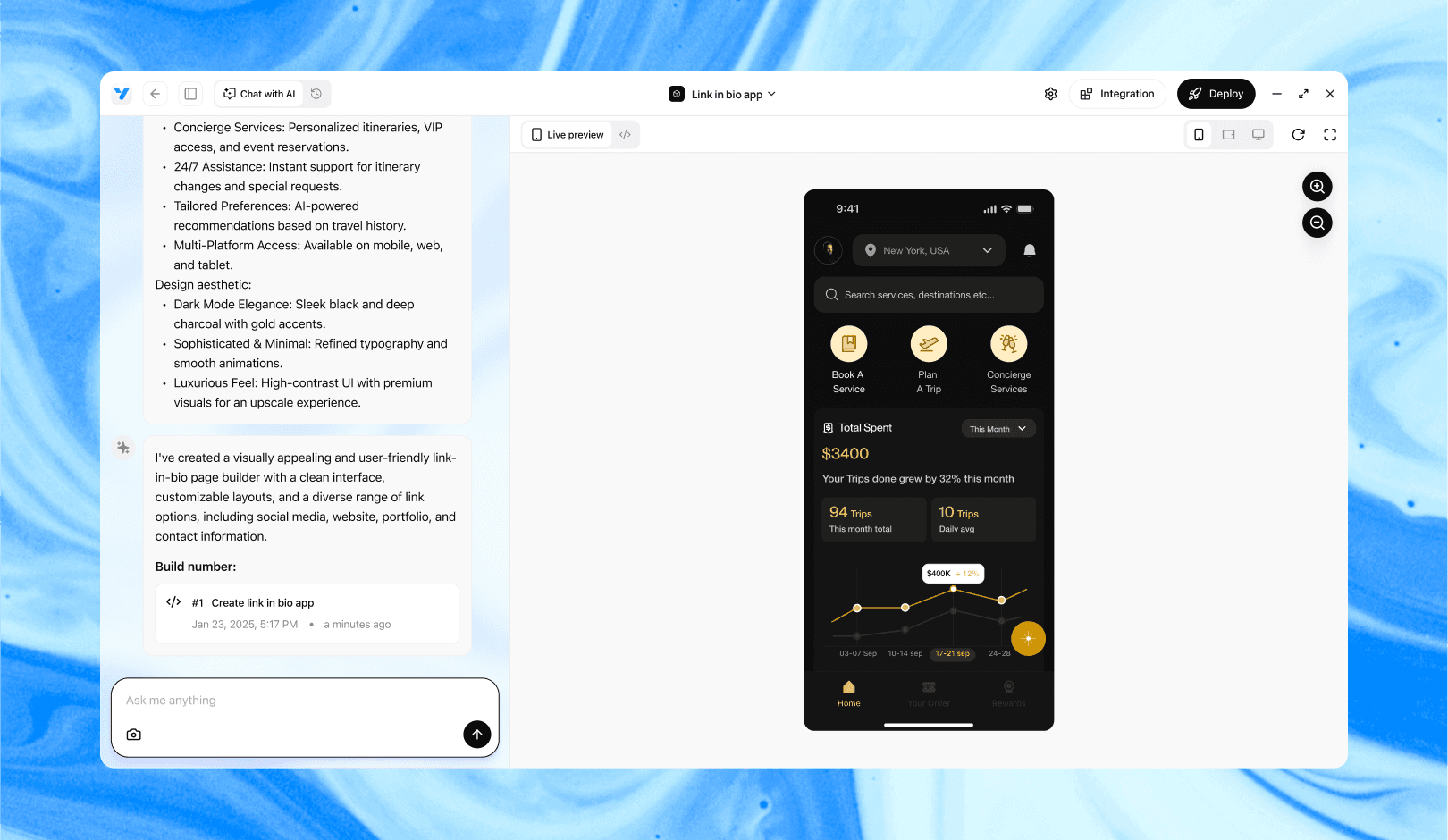
Vibe Studio, powered by Steve’s advanced AI agents, is a revolutionary no-code, conversational platform that empowers users to quickly and efficiently create full-stack Flutter applications integrated seamlessly with Firebase backend services. Ideal for solo founders, startups, and agile engineering teams, Vibe Studio allows users to visually manage and deploy Flutter apps, greatly accelerating the development process. The intuitive conversational interface simplifies complex development tasks, making app creation accessible even for non-coders.
Conclusion
You now have a concise blueprint for a Flutter AI chat interface suitable for mobile development. The main components: a responsive UI with a message list and composer, a networking layer that communicates with an AI model, and a small state manager to sequence messages and indicate loading. From here, you can add streaming, attachments, authentication, caching, and analytics. Keep networking thin in the client, secure keys on a backend, and prioritize responsiveness for a smooth mobile experience.

Introduction
This tutorial walks through building a minimal AI chat interface in Flutter for mobile development. You’ll create a responsive UI, wire it to an AI model endpoint, and manage message state. The goal is a practical, production-minded blueprint you can extend — not a fully featured product. Prerequisites: Flutter SDK installed, familiarity with Dart, and an AI REST endpoint (OpenAI-compatible or custom).
Project Setup
Create a new Flutter app and add two lightweight packages: http for network calls and flutter_dotenv for environment variables (API keys). In pubspec.yaml add:
http: ^0.13.0
flutter_dotenv: ^5.0.0
Run flutter pub get and store your API key in a .env file (do not commit). Use dotenv.load() in main() before runApp(). Keep networking code isolated in a service class so you can swap providers or add auth headers later — a recommended practice in mobile development.
Building The UI
The UI for a chat app has three parts: an AppBar, a scrollable message list, and a composer (text field + send button). Use ListView.builder for the message feed and reverse: true so the latest messages appear at the bottom. For messages, create a minimal model describing author, text, and timestamp. Use simple Row + Container widgets to differentiate user vs. AI bubbles.
Key considerations:
Make the composer persist above the keyboard using SafeArea and Scaffold.resizeToAvoidBottomInset.
Use Expanded for the ListView to fill remaining vertical space.
For accessibility, ensure semantics labels on buttons and proper contrast in bubbles.
Example message model:
class ChatMessage { final String id; final String text; final bool fromUser; ChatMessage({required this.id, required this.text, required this.fromUser}); }
Integrating The AI Model
Treat the AI as a backend service. Create a ChatService with a sendMessage(text) method that posts the user prompt and returns the model response. Keep the HTTP payload small — only send what's necessary (prompt, model name, max tokens). Handle errors: network timeouts, 429 rate limits, and non-2xx responses.
Example send flow (simplified):
Future<String> sendToModel(String prompt) async { final res = await http.post(Uri.parse(apiUrl), headers: {'Authorization': 'Bearer $apiKey', 'Content-Type': 'application/json'}, body: jsonEncode({'prompt': prompt, 'max_tokens': 150}), ); if (res.statusCode != 200) throw Exception('Model error'); final body = jsonDecode(res.body); return body['choices']?[0]?['text'] ?? ''; }
Notes:
Replace apiUrl and response parsing to match your provider.
Consider streaming responses for long outputs — implement SSE or chunked decoding if supported.
Never embed API keys in the client for production. Use a proxy service that hides credentials and enforces rate limits.
Managing Messages And State
Use a simple ChangeNotifier to keep the message list and loading state. The pattern is: add a user message immediately, set a loading/typing indicator, await model response, append AI message, notify listeners. Debounce rapid sends and disable the send button while awaiting a response to prevent parallel calls.
Performance tips for mobile development:
Use const constructors where possible.
Reuse widgets and avoid rebuilding the full ListView on every state change by using keys or selective rebuilding.
Persist recent conversation locally (sqflite or hive) so users can resume sessions offline.
Error handling and UX:
Show inline error messages for failed sends and allow retry.
Provide a clear affordance to clear conversation or export chat history.
Security and compliance:
Route requests through your server to apply content filtering, audit logs, or user quotas.
Mask or redact PII before sending prompts.
Vibe Studio

Vibe Studio, powered by Steve’s advanced AI agents, is a revolutionary no-code, conversational platform that empowers users to quickly and efficiently create full-stack Flutter applications integrated seamlessly with Firebase backend services. Ideal for solo founders, startups, and agile engineering teams, Vibe Studio allows users to visually manage and deploy Flutter apps, greatly accelerating the development process. The intuitive conversational interface simplifies complex development tasks, making app creation accessible even for non-coders.
Conclusion
You now have a concise blueprint for a Flutter AI chat interface suitable for mobile development. The main components: a responsive UI with a message list and composer, a networking layer that communicates with an AI model, and a small state manager to sequence messages and indicate loading. From here, you can add streaming, attachments, authentication, caching, and analytics. Keep networking thin in the client, secure keys on a backend, and prioritize responsiveness for a smooth mobile experience.
Build Flutter Apps Faster with Vibe Studio
Vibe Studio is your AI-powered Flutter development companion. Skip boilerplate, build in real-time, and deploy without hassle. Start creating apps at lightning speed with zero setup.
Other Insights