Building Offline AI Assistants with Flutter and Ollama
Nov 11, 2025


Summary
Summary
Summary
Summary
This tutorial shows how to build an offline AI assistant using Flutter and a local Ollama runtime. It covers installing Ollama, calling the local inference API from Flutter, structuring conversation state, streaming responses, and enriching prompts via local retrieval. Focus on model size, background execution, and graceful offline UX to deliver responsive mobile assistants.
Key insights:
Key insights:
Key insights:
Key insights:
Setting Up Ollama Locally: Keep models local, pre-download them, and choose mobile-optimized/quantized versions to fit device constraints.
Integrating Ollama With Flutter: Use background execution and the http package (or native plugin) to call Ollama's local API; stream responses when possible.
Building Conversational UI: Optimistically render user messages, display typing indicators, support cancelation, and persist conversations locally.
Handling Offline Data And Prompting: Index and retrieve local documents to enrich prompts, keeping index size and context length bounded for mobile.
Performance Considerations: Profile latency, limit concurrent inferences, provide a small-model quick path, and use incremental indexing to manage resources.
Introduction
Building an offline AI assistant for mobile requires combining a lightweight, local model runtime with a responsive Flutter UI. Ollama provides a local inference engine you can run on-device or on a nearby server; Flutter gives you a cross-platform mobile framework to build the interface and glue logic. This tutorial focuses on practical integration patterns: running Ollama locally, calling its API from Flutter, handling offline data, and designing a conversational UI that feels native and responsive.
Setting Up Ollama Locally
Install and run Ollama on the development machine or a local edge device. The core idea is to keep inference local so the assistant works without external network access and to control model downloads and resource usage. After installing, download the model(s) you need and verify the local HTTP endpoint is reachable (typically a localhost port). Keep models minimal for mobile hardware: choose a quantized or mobile-optimized version.
Key operational points:
Ensure correct model placement and disk permissions.
Pre-download models before packaging or provide an in-app updater that downloads models to a secured local path.
Limit concurrent inferences to avoid memory spikes.
Integrating Ollama With Flutter
From Flutter, call the local Ollama HTTP API. Use the http package for straightforward requests or a native plugin for optimized transports. Run network calls in a background Isolate or use compute to avoid jank. Keep payloads small and stream responses when available so you can render partial outputs.
Minimal example: POST a prompt and receive a streaming/text response. Replace the endpoint and request body to match your Ollama version.
import 'package:http/http.dart' as http;
Future<String> generateFromOllama(String prompt) async {
final url = Uri.parse('http://127.0.0.1:11434/api/generate');
final resp = await http.post(url, body: '{"model":"local-model","prompt":"$prompt"}');
if (resp.statusCode == 200) return resp.body;
throw Exception('Ollama error: ${resp.statusCode}');
}Notes:
Wrap calls in try/catch and display offline-friendly errors.
When possible, use chunked responses and update the UI as tokens arrive.
Building Conversational UI
Design the UI to reflect local inference constraints: show progress indicators, allow interruption, and persist the conversation locally. Keep the conversation model simple: messages with role (user/assistant), timestamp, and optional metadata like source or confidence.
Example conversation state management (keeps in-memory list and persists to local storage):
class Message {
final String role;
final String text;
Message(this.role, this.text);
}
class ConversationState {
final List<Message> messages = [];
void addUser(String text) => messages.add(Message('user', text));
void addAssistant(String text) => messages.add(Message('assistant', text));
}Tips for UI responsiveness:
Optimistically append the user message and show a typing indicator while inference runs.
Allow Cancel: call a local cancel endpoint or drop the inflight future and mark the response as canceled.
Keep messages small: segment long tasks into chunked prompts to keep memory and latency bounded.
Handling Offline Data And Prompting
Offline assistants benefit immensely from local knowledge: preloaded documents, app state snapshots, and cached embeddings. Create a local retrieval step to enrich prompts. Workflow:
Index local documents (small corpus) into an on-device vector store or a simple inverted index.
At query time, retrieve the top-k relevant passages and include them as context in your prompt.
Use prompt templates to bound context length and ensure predictable token usage.
Practical constraints:
Maintain a small index size to fit mobile storage.
Update indexes incrementally when the user adds local content.
Sanitize context to avoid leaking private data into shared prompts or logs.
Performance considerations:
Profile model latency on your target device and set timeouts.
Use batching for background tasks like reindexing.
Provide a low-latency “quick answer” mode using smaller models and a fallback to larger models when needed.
Vibe Studio
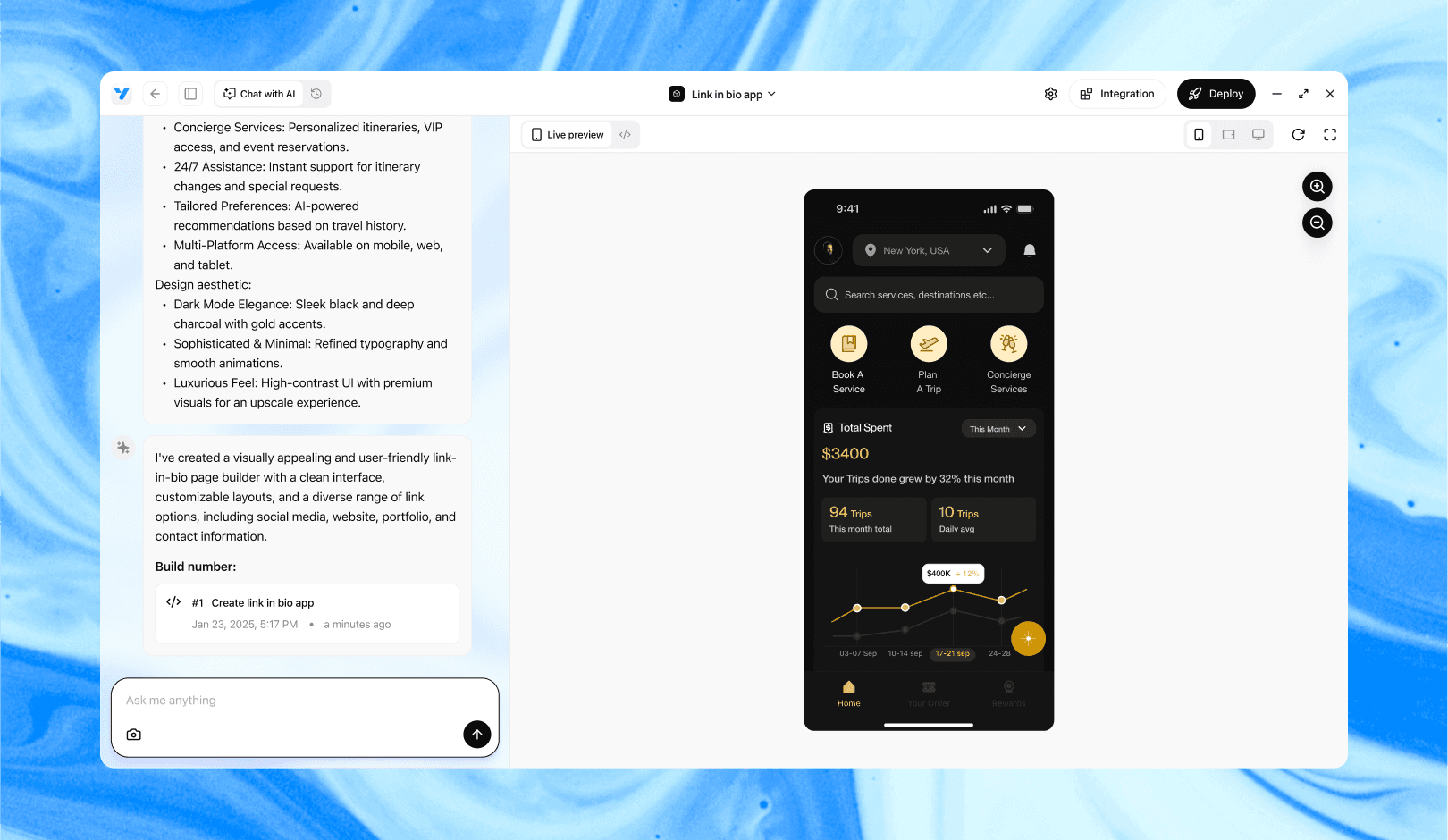
Vibe Studio, powered by Steve’s advanced AI agents, is a revolutionary no-code, conversational platform that empowers users to quickly and efficiently create full-stack Flutter applications integrated seamlessly with Firebase backend services. Ideal for solo founders, startups, and agile engineering teams, Vibe Studio allows users to visually manage and deploy Flutter apps, greatly accelerating the development process. The intuitive conversational interface simplifies complex development tasks, making app creation accessible even for non-coders.
Conclusion
Building an offline AI assistant with Flutter and Ollama is practical and delivers privacy, low-latency, and offline capabilities. The pattern is straightforward: run Ollama or its runtime locally, call it from Flutter using background workers, design a resilient conversational UI, and enrich prompts with local retrieval. Prioritize model size, streaming responses, and graceful handling of resource limits on mobile devices. With these building blocks, you can create robust mobile-first assistants that work reliably without a network connection.

Introduction
Building an offline AI assistant for mobile requires combining a lightweight, local model runtime with a responsive Flutter UI. Ollama provides a local inference engine you can run on-device or on a nearby server; Flutter gives you a cross-platform mobile framework to build the interface and glue logic. This tutorial focuses on practical integration patterns: running Ollama locally, calling its API from Flutter, handling offline data, and designing a conversational UI that feels native and responsive.
Setting Up Ollama Locally
Install and run Ollama on the development machine or a local edge device. The core idea is to keep inference local so the assistant works without external network access and to control model downloads and resource usage. After installing, download the model(s) you need and verify the local HTTP endpoint is reachable (typically a localhost port). Keep models minimal for mobile hardware: choose a quantized or mobile-optimized version.
Key operational points:
Ensure correct model placement and disk permissions.
Pre-download models before packaging or provide an in-app updater that downloads models to a secured local path.
Limit concurrent inferences to avoid memory spikes.
Integrating Ollama With Flutter
From Flutter, call the local Ollama HTTP API. Use the http package for straightforward requests or a native plugin for optimized transports. Run network calls in a background Isolate or use compute to avoid jank. Keep payloads small and stream responses when available so you can render partial outputs.
Minimal example: POST a prompt and receive a streaming/text response. Replace the endpoint and request body to match your Ollama version.
import 'package:http/http.dart' as http;
Future<String> generateFromOllama(String prompt) async {
final url = Uri.parse('http://127.0.0.1:11434/api/generate');
final resp = await http.post(url, body: '{"model":"local-model","prompt":"$prompt"}');
if (resp.statusCode == 200) return resp.body;
throw Exception('Ollama error: ${resp.statusCode}');
}Notes:
Wrap calls in try/catch and display offline-friendly errors.
When possible, use chunked responses and update the UI as tokens arrive.
Building Conversational UI
Design the UI to reflect local inference constraints: show progress indicators, allow interruption, and persist the conversation locally. Keep the conversation model simple: messages with role (user/assistant), timestamp, and optional metadata like source or confidence.
Example conversation state management (keeps in-memory list and persists to local storage):
class Message {
final String role;
final String text;
Message(this.role, this.text);
}
class ConversationState {
final List<Message> messages = [];
void addUser(String text) => messages.add(Message('user', text));
void addAssistant(String text) => messages.add(Message('assistant', text));
}Tips for UI responsiveness:
Optimistically append the user message and show a typing indicator while inference runs.
Allow Cancel: call a local cancel endpoint or drop the inflight future and mark the response as canceled.
Keep messages small: segment long tasks into chunked prompts to keep memory and latency bounded.
Handling Offline Data And Prompting
Offline assistants benefit immensely from local knowledge: preloaded documents, app state snapshots, and cached embeddings. Create a local retrieval step to enrich prompts. Workflow:
Index local documents (small corpus) into an on-device vector store or a simple inverted index.
At query time, retrieve the top-k relevant passages and include them as context in your prompt.
Use prompt templates to bound context length and ensure predictable token usage.
Practical constraints:
Maintain a small index size to fit mobile storage.
Update indexes incrementally when the user adds local content.
Sanitize context to avoid leaking private data into shared prompts or logs.
Performance considerations:
Profile model latency on your target device and set timeouts.
Use batching for background tasks like reindexing.
Provide a low-latency “quick answer” mode using smaller models and a fallback to larger models when needed.
Vibe Studio

Vibe Studio, powered by Steve’s advanced AI agents, is a revolutionary no-code, conversational platform that empowers users to quickly and efficiently create full-stack Flutter applications integrated seamlessly with Firebase backend services. Ideal for solo founders, startups, and agile engineering teams, Vibe Studio allows users to visually manage and deploy Flutter apps, greatly accelerating the development process. The intuitive conversational interface simplifies complex development tasks, making app creation accessible even for non-coders.
Conclusion
Building an offline AI assistant with Flutter and Ollama is practical and delivers privacy, low-latency, and offline capabilities. The pattern is straightforward: run Ollama or its runtime locally, call it from Flutter using background workers, design a resilient conversational UI, and enrich prompts with local retrieval. Prioritize model size, streaming responses, and graceful handling of resource limits on mobile devices. With these building blocks, you can create robust mobile-first assistants that work reliably without a network connection.

Build Flutter Apps Faster with Vibe Studio
Vibe Studio is your AI-powered Flutter development companion. Skip boilerplate, build in real-time, and deploy without hassle. Start creating apps at lightning speed with zero setup.