Building Flutter Apps with Temporal Workflows
Nov 13, 2025


Summary
Summary
Summary
Summary
Temporal should run as a backend orchestration layer while Flutter clients interact via REST/WebSocket. Start workflows server-side, use signals for user actions, expose queryable state, and push updates to mobile. Implement idempotent activities, persist workflow IDs on-device, and prefer subscriptions over polling for responsive UX.
Key insights:
Key insights:
Key insights:
Key insights:
Temporal Overview: Temporal provides durable workflows and activities; mobile apps should interact through a backend service rather than directly.
Designing Mobile-Friendly Workflows: Model user actions as signals and expose lightweight queryable state so the app can display progress without heavy polling.
Integrating Temporal With Flutter: Use a backend to start workflows, accept signals, and push updates via WebSocket or FCM; Flutter sends signals and subscribes to updates.
Implementing Workflows And Activities: Keep activities idempotent, maintain an event log inside workflows, and return compact status DTOs for mobile queries.
Testing And Error Handling: Unit-test workflows with the Temporal test harness, mock backend APIs in Flutter tests, and design workflows to surface retryable errors clearly.
Introduction
Temporal is a durable, stateful workflow engine that simplifies building reliable distributed systems. For mobile development with Flutter, Temporal is not a client-side library but a powerful backend orchestration layer. This tutorial shows how to design mobile-friendly workflows, integrate a Flutter app with a Temporal-backed API, implement client interaction patterns, and test and handle errors effectively. Expect concrete code examples for the Flutter side and practical architecture guidance.
Temporal Overview
Temporal executes long-running business logic as workflows and activities. Workflows are durable orchestrations (replayable by the engine); activities are the side-effecting units (HTTP calls, DB updates, push notifications). Key properties that matter for mobile development:
Durability: workflows survive process restarts and can wait for external events (user input, push confirmations).
Visibility: workflows expose IDs and queryable state so a mobile client can observe progress.
Asynchrony: mobile clients are best served by an API layer that starts workflows and pushes updates rather than blocking.
In practice, run Temporal in a backend (TypeScript, Go, Java, or .NET workers). The Flutter app communicates with that backend via REST/gRPC/WebSocket.
Designing Mobile-Friendly Workflows
Design workflows with mobile constraints in mind:
Use short-lived activities for device-bound actions (send push notification, request OTP) and keep durable decision logic in the workflow.
Model user interactions as signals: a mobile client sends a signal to an existing workflow when the user performs an action (approve, upload, confirm).
Emit queryable state snapshots so the mobile app can show progress without polling raw logs.
Example flow: user uploads a photo, server workflow validates, calls ML service asynchronously, then signals mobile when processing completes. The workflow stores a lightweight state object with stage, progress percentage, and error info.
Integrating Temporal With Flutter
Because Temporal lacks a Dart SDK, architecture typically places a backend service between Flutter and Temporal. The backend will:
Start workflows on user actions (create workflowId, return to client).
Accept signals from the client and forward them to workflows.
Provide a subscription or push channel (WebSocket or Firebase/FCM) to notify the app of state changes.
Offer REST endpoints for workflow queries and results.
On the Flutter side, use a short, clear pattern: start workflow -> subscribe to updates -> send signals as the user interacts -> fetch final result. Use WebSocket or Server-Sent Events for near-real-time updates; fallback to polling for simpler setups.
Example Flutter code (start workflow and poll status):
import 'dart:convert';
import 'package:http/http.dart' as http;
Future<String> startWorkflow(String apiUrl, Map payload) async {
final res = await http.post(Uri.parse('$apiUrl/workflows'),
body: jsonEncode(payload), headers: {'Content-Type': 'application/json'});
final body = jsonDecode(res.body);
return body['workflowId'];
}
Future<Map> getWorkflowStatus(String apiUrl, String id) async {
final res = await http.get(Uri.parse('$apiUrl/workflows/$id/status'));
return jsonDecode(res.body);
}Use WebSocket for push updates to reduce polling cost and latency.
Implementing Workflows and Activities
On the backend implement workflows that accept signals and expose queries. Typical responsibilities:
Start a workflow with a unique ID (e.g., userId + timestamp).
Persist mapping between mobile session and workflow ID.
Implement activities with idempotency to survive retries.
Use Signal to receive user confirmations (e.g., upload finished) and continue the workflow.
A recommended pattern: keep an immutable event log in workflow state and derive a small status DTO for queries. That lets you handle replays safely and present compact summaries to mobile.
Testing And Error Handling
Testing should cover the backend workflows and the Flutter integration.
Unit test workflows using Temporal SDK test harness (TypeScript/Go/Java) to simulate signals and time-based sleep.
For Flutter, write integration tests that mock the backend API and exercise the subscription and signal flows.
Design workflows to return explicit error states and retryable markers rather than opaque exceptions. When an activity fails, update workflow state and emit a queryable failure reason so the mobile app can display actionable messages.
Consider network partitions and mobile app restarts: always persist the workflowId on the device; on resume, re-subscribe or re-poll the workflow status.
Vibe Studio
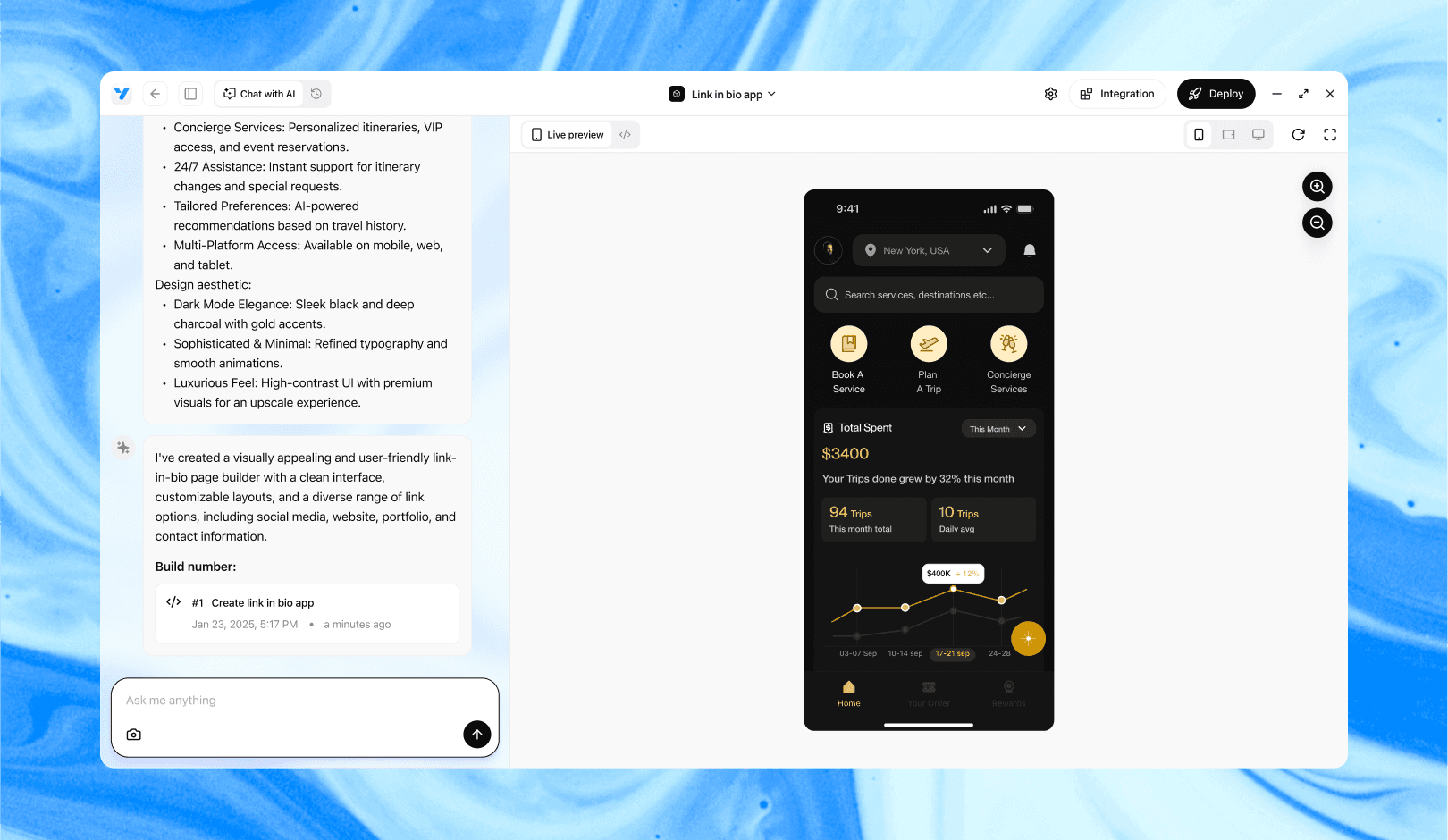
Vibe Studio, powered by Steve’s advanced AI agents, is a revolutionary no-code, conversational platform that empowers users to quickly and efficiently create full-stack Flutter applications integrated seamlessly with Firebase backend services. Ideal for solo founders, startups, and agile engineering teams, Vibe Studio allows users to visually manage and deploy Flutter apps, greatly accelerating the development process. The intuitive conversational interface simplifies complex development tasks, making app creation accessible even for non-coders.
Conclusion
Temporal provides a robust backend for orchestrating complex, long-running flows that mobile apps commonly need. For Flutter mobile development, the recommended architecture places Temporal in the backend, exposing clear REST/WebSocket endpoints that the app uses to start workflows, send signals, and receive updates. Design workflows to be signal-driven and query-friendly, implement idempotent activities, and use push mechanisms for a responsive mobile UX. With this approach you gain durable, observable business logic without complicating the Flutter client.

Introduction
Temporal is a durable, stateful workflow engine that simplifies building reliable distributed systems. For mobile development with Flutter, Temporal is not a client-side library but a powerful backend orchestration layer. This tutorial shows how to design mobile-friendly workflows, integrate a Flutter app with a Temporal-backed API, implement client interaction patterns, and test and handle errors effectively. Expect concrete code examples for the Flutter side and practical architecture guidance.
Temporal Overview
Temporal executes long-running business logic as workflows and activities. Workflows are durable orchestrations (replayable by the engine); activities are the side-effecting units (HTTP calls, DB updates, push notifications). Key properties that matter for mobile development:
Durability: workflows survive process restarts and can wait for external events (user input, push confirmations).
Visibility: workflows expose IDs and queryable state so a mobile client can observe progress.
Asynchrony: mobile clients are best served by an API layer that starts workflows and pushes updates rather than blocking.
In practice, run Temporal in a backend (TypeScript, Go, Java, or .NET workers). The Flutter app communicates with that backend via REST/gRPC/WebSocket.
Designing Mobile-Friendly Workflows
Design workflows with mobile constraints in mind:
Use short-lived activities for device-bound actions (send push notification, request OTP) and keep durable decision logic in the workflow.
Model user interactions as signals: a mobile client sends a signal to an existing workflow when the user performs an action (approve, upload, confirm).
Emit queryable state snapshots so the mobile app can show progress without polling raw logs.
Example flow: user uploads a photo, server workflow validates, calls ML service asynchronously, then signals mobile when processing completes. The workflow stores a lightweight state object with stage, progress percentage, and error info.
Integrating Temporal With Flutter
Because Temporal lacks a Dart SDK, architecture typically places a backend service between Flutter and Temporal. The backend will:
Start workflows on user actions (create workflowId, return to client).
Accept signals from the client and forward them to workflows.
Provide a subscription or push channel (WebSocket or Firebase/FCM) to notify the app of state changes.
Offer REST endpoints for workflow queries and results.
On the Flutter side, use a short, clear pattern: start workflow -> subscribe to updates -> send signals as the user interacts -> fetch final result. Use WebSocket or Server-Sent Events for near-real-time updates; fallback to polling for simpler setups.
Example Flutter code (start workflow and poll status):
import 'dart:convert';
import 'package:http/http.dart' as http;
Future<String> startWorkflow(String apiUrl, Map payload) async {
final res = await http.post(Uri.parse('$apiUrl/workflows'),
body: jsonEncode(payload), headers: {'Content-Type': 'application/json'});
final body = jsonDecode(res.body);
return body['workflowId'];
}
Future<Map> getWorkflowStatus(String apiUrl, String id) async {
final res = await http.get(Uri.parse('$apiUrl/workflows/$id/status'));
return jsonDecode(res.body);
}Use WebSocket for push updates to reduce polling cost and latency.
Implementing Workflows and Activities
On the backend implement workflows that accept signals and expose queries. Typical responsibilities:
Start a workflow with a unique ID (e.g., userId + timestamp).
Persist mapping between mobile session and workflow ID.
Implement activities with idempotency to survive retries.
Use Signal to receive user confirmations (e.g., upload finished) and continue the workflow.
A recommended pattern: keep an immutable event log in workflow state and derive a small status DTO for queries. That lets you handle replays safely and present compact summaries to mobile.
Testing And Error Handling
Testing should cover the backend workflows and the Flutter integration.
Unit test workflows using Temporal SDK test harness (TypeScript/Go/Java) to simulate signals and time-based sleep.
For Flutter, write integration tests that mock the backend API and exercise the subscription and signal flows.
Design workflows to return explicit error states and retryable markers rather than opaque exceptions. When an activity fails, update workflow state and emit a queryable failure reason so the mobile app can display actionable messages.
Consider network partitions and mobile app restarts: always persist the workflowId on the device; on resume, re-subscribe or re-poll the workflow status.
Vibe Studio

Vibe Studio, powered by Steve’s advanced AI agents, is a revolutionary no-code, conversational platform that empowers users to quickly and efficiently create full-stack Flutter applications integrated seamlessly with Firebase backend services. Ideal for solo founders, startups, and agile engineering teams, Vibe Studio allows users to visually manage and deploy Flutter apps, greatly accelerating the development process. The intuitive conversational interface simplifies complex development tasks, making app creation accessible even for non-coders.
Conclusion
Temporal provides a robust backend for orchestrating complex, long-running flows that mobile apps commonly need. For Flutter mobile development, the recommended architecture places Temporal in the backend, exposing clear REST/WebSocket endpoints that the app uses to start workflows, send signals, and receive updates. Design workflows to be signal-driven and query-friendly, implement idempotent activities, and use push mechanisms for a responsive mobile UX. With this approach you gain durable, observable business logic without complicating the Flutter client.

Build Flutter Apps Faster with Vibe Studio
Vibe Studio is your AI-powered Flutter development companion. Skip boilerplate, build in real-time, and deploy without hassle. Start creating apps at lightning speed with zero setup.