Building Flutter Apps Using Server-Driven UI
Dec 12, 2025


Summary
Summary
Summary
Summary
Server-driven UI lets Flutter apps render layouts described by a server-side schema. Design a compact JSON spec, implement a testable widget factory renderer, manage server and local state, and apply caching and validation to keep mobile development fast, secure, and maintainable.
Key insights:
Key insights:
Key insights:
Key insights:
What Is Server-Driven UI?: SDUI centralizes layout decisions on the server, enabling faster iteration while requiring a stable renderer in the client.
Designing The JSON UI Schema: Keep the schema minimal and versioned; prefer optional fields and strict validation to avoid breaking clients.
Implementing A Renderer In Flutter: Build a small, testable mapping from schema nodes to Widgets and handle actions natively rather than embedding logic in JSON.
Managing State And Updates: Separate server-owned state from local UI state; use state management and caching to enable offline and optimistic updates.
Performance And Caching: Validate schema depth/size, prefetch assets, and cache last-good schemas to ensure responsive, secure mobile experiences.
Introduction
Server-driven UI moves layout and behavior decisions from the client binary to a server-side description. For mobile development with Flutter, that means the app downloads a compact UI schema (JSON, YAML, or protobuf) and renders it dynamically. This approach reduces release cycles, enables A/B tests, and centralizes feature flags while keeping a single, stable renderer in the client. This article shows how to design a schema, implement a renderer in Flutter, and manage state and updates effectively.
What Is Server-Driven UI?
Server-driven UI (SDUI) separates the UI definition from rendering logic. The server provides a declarative description of components, properties, and actions. The Flutter app interprets that description and constructs Widgets at runtime. In mobile development, SDUI is valuable for content-driven screens, remote feature toggles, and experiments that require UI changes without publishing a new APK/IPA.
Advantages: faster iteration, centralized UX control, and smaller client changes. Trade-offs: renderer complexity, testing challenges, and possible latency or offline limitations. Design the renderer to be simple, extensible, and secure (validate incoming schemas and limit allowed actions).
Designing The JSON UI Schema
Design a compact, stable schema. Keep the vocabulary minimal: container types (column, row), primitives (text, image, button), layout props (padding, margin), and actions (navigate, fetch, openUrl). Version your schema and include a feature-gating field so the client can gracefully ignore unknown nodes.
Example minimal schema structure:
type: "column" or "row"
children: [ ... ]
props: { padding, alignment, styleRef }
action: { type: "navigate", route: "/detail", params: {} }
Validation rules: disallow scripts, limit image sizes, require whitelisted URLs for remote assets. Keep schema stable by adding new optional fields rather than changing existing semantics.
Implementing A Renderer In Flutter
Implement a parser that maps JSON nodes to Widget factories. Keep the renderer small and testable: one factory per node type, a properties mapper for styles, and an action dispatcher. Cache commonly used styles and images.
Fetching a UI schema and decoding it:
import 'dart:convert';
import 'package:http/http.dart' as http;
Future<Map<String,dynamic>> fetchUiSchema(String url) async {
final r = await http.get(Uri.parse(url));
return jsonDecode(r.body) as Map<String,dynamic>;
}A simple factory example (illustrative):
Widget renderNode(Map node) {
switch(node['type']) {
case 'text': return Text(node['props']['text'] ?? '');
case 'button': return ElevatedButton(onPressed: (){}, child: Text(node['props']['label']));
case 'column': return Column(children: (node['children'] ?? []).map<Widget>((n)=>renderNode(n)).toList());
default: return SizedBox.shrink();
}
}Keep rendering synchronous: parse JSON into a lightweight model first, then build Widgets from the model. Use composition, not reflection. Avoid building complex business logic into the schema; keep actions as identifiers handled by native code.
Managing State And Updates
Decide where state lives: server-owned state (forms, list data) and local UI state (animations, temporary input). For server-owned state, fetch data separately and reference it from the schema by IDs or paths. For optimistic updates, send user actions to the server and update the local model immediately, then reconcile when the server responds.
Use Streams or state management (Provider, Riverpod, Bloc) to notify the renderer of changes. For example, hold the latest schema in a ChangeNotifier; when the server pushes an updated schema (via WebSocket or push), update the model and call notifyListeners(). This allows the UI to re-render without rebuilding the app.
Caching and offline behavior: cache the last-good schema and assets. When offline, render cached schema and queue user actions. Evict caches based on version headers to avoid stale layouts.
Security and performance: validate schema sizes and types server-side; limit depth to prevent expensive recursive rendering. Decode images off the UI thread and prefetch assets used across screens.
Vibe Studio
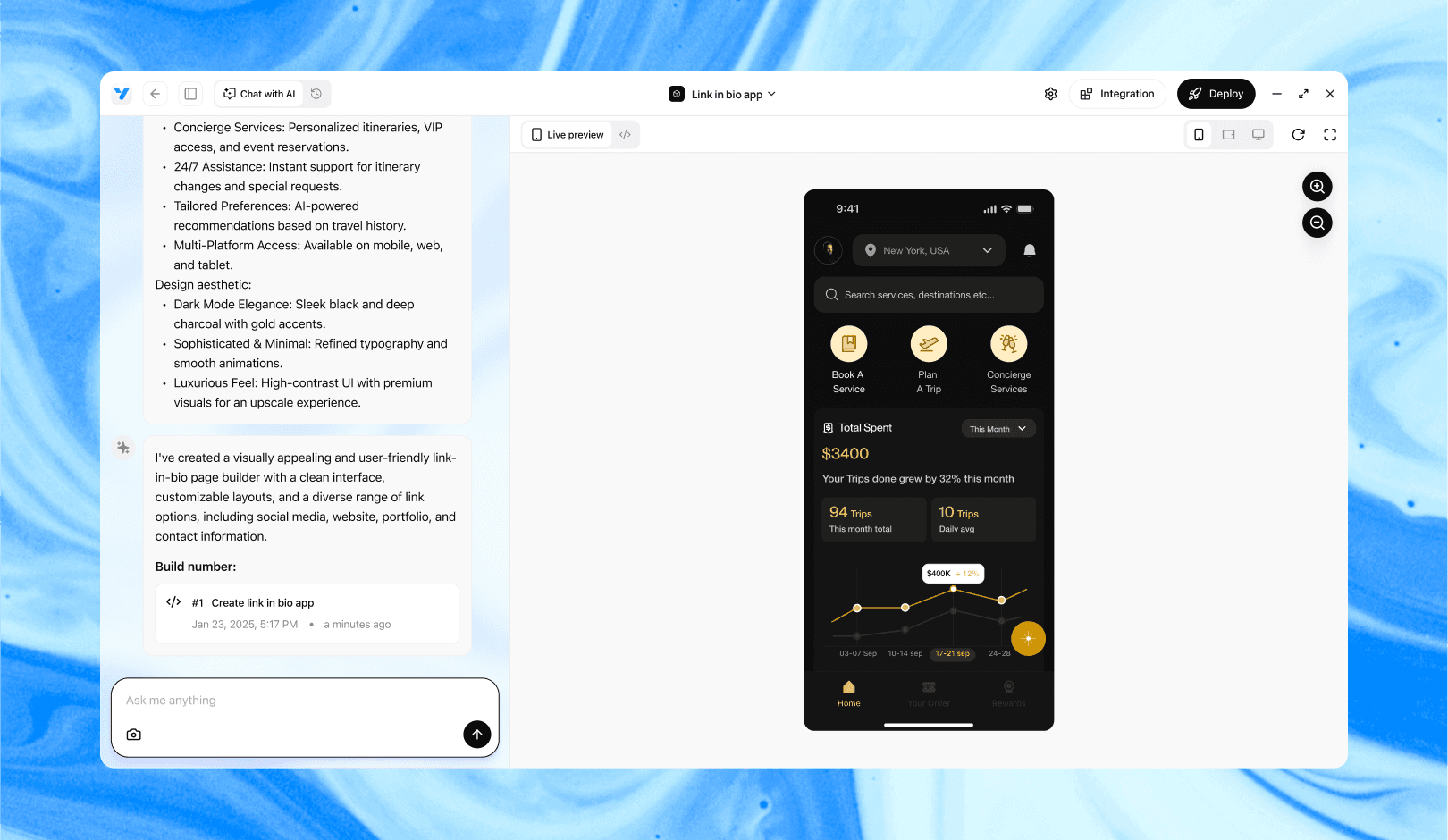
Vibe Studio, powered by Steve’s advanced AI agents, is a revolutionary no-code, conversational platform that empowers users to quickly and efficiently create full-stack Flutter applications integrated seamlessly with Firebase backend services. Ideal for solo founders, startups, and agile engineering teams, Vibe Studio allows users to visually manage and deploy Flutter apps, greatly accelerating the development process. The intuitive conversational interface simplifies complex development tasks, making app creation accessible even for non-coders.
Conclusion
Building server-driven UI with Flutter gives teams faster iteration and centralized control for mobile development. The key is designing a minimal, versioned schema; implementing a small, testable renderer; and handling state, caching, and security explicitly. Start by supporting a constrained vocabulary, instrument rendering performance, and expand node types conservatively. With a stable renderer and good schema practices, SDUI can dramatically shorten delivery cycles while preserving native-like performance and user experience.

Introduction
Server-driven UI moves layout and behavior decisions from the client binary to a server-side description. For mobile development with Flutter, that means the app downloads a compact UI schema (JSON, YAML, or protobuf) and renders it dynamically. This approach reduces release cycles, enables A/B tests, and centralizes feature flags while keeping a single, stable renderer in the client. This article shows how to design a schema, implement a renderer in Flutter, and manage state and updates effectively.
What Is Server-Driven UI?
Server-driven UI (SDUI) separates the UI definition from rendering logic. The server provides a declarative description of components, properties, and actions. The Flutter app interprets that description and constructs Widgets at runtime. In mobile development, SDUI is valuable for content-driven screens, remote feature toggles, and experiments that require UI changes without publishing a new APK/IPA.
Advantages: faster iteration, centralized UX control, and smaller client changes. Trade-offs: renderer complexity, testing challenges, and possible latency or offline limitations. Design the renderer to be simple, extensible, and secure (validate incoming schemas and limit allowed actions).
Designing The JSON UI Schema
Design a compact, stable schema. Keep the vocabulary minimal: container types (column, row), primitives (text, image, button), layout props (padding, margin), and actions (navigate, fetch, openUrl). Version your schema and include a feature-gating field so the client can gracefully ignore unknown nodes.
Example minimal schema structure:
type: "column" or "row"
children: [ ... ]
props: { padding, alignment, styleRef }
action: { type: "navigate", route: "/detail", params: {} }
Validation rules: disallow scripts, limit image sizes, require whitelisted URLs for remote assets. Keep schema stable by adding new optional fields rather than changing existing semantics.
Implementing A Renderer In Flutter
Implement a parser that maps JSON nodes to Widget factories. Keep the renderer small and testable: one factory per node type, a properties mapper for styles, and an action dispatcher. Cache commonly used styles and images.
Fetching a UI schema and decoding it:
import 'dart:convert';
import 'package:http/http.dart' as http;
Future<Map<String,dynamic>> fetchUiSchema(String url) async {
final r = await http.get(Uri.parse(url));
return jsonDecode(r.body) as Map<String,dynamic>;
}A simple factory example (illustrative):
Widget renderNode(Map node) {
switch(node['type']) {
case 'text': return Text(node['props']['text'] ?? '');
case 'button': return ElevatedButton(onPressed: (){}, child: Text(node['props']['label']));
case 'column': return Column(children: (node['children'] ?? []).map<Widget>((n)=>renderNode(n)).toList());
default: return SizedBox.shrink();
}
}Keep rendering synchronous: parse JSON into a lightweight model first, then build Widgets from the model. Use composition, not reflection. Avoid building complex business logic into the schema; keep actions as identifiers handled by native code.
Managing State And Updates
Decide where state lives: server-owned state (forms, list data) and local UI state (animations, temporary input). For server-owned state, fetch data separately and reference it from the schema by IDs or paths. For optimistic updates, send user actions to the server and update the local model immediately, then reconcile when the server responds.
Use Streams or state management (Provider, Riverpod, Bloc) to notify the renderer of changes. For example, hold the latest schema in a ChangeNotifier; when the server pushes an updated schema (via WebSocket or push), update the model and call notifyListeners(). This allows the UI to re-render without rebuilding the app.
Caching and offline behavior: cache the last-good schema and assets. When offline, render cached schema and queue user actions. Evict caches based on version headers to avoid stale layouts.
Security and performance: validate schema sizes and types server-side; limit depth to prevent expensive recursive rendering. Decode images off the UI thread and prefetch assets used across screens.
Vibe Studio

Vibe Studio, powered by Steve’s advanced AI agents, is a revolutionary no-code, conversational platform that empowers users to quickly and efficiently create full-stack Flutter applications integrated seamlessly with Firebase backend services. Ideal for solo founders, startups, and agile engineering teams, Vibe Studio allows users to visually manage and deploy Flutter apps, greatly accelerating the development process. The intuitive conversational interface simplifies complex development tasks, making app creation accessible even for non-coders.
Conclusion
Building server-driven UI with Flutter gives teams faster iteration and centralized control for mobile development. The key is designing a minimal, versioned schema; implementing a small, testable renderer; and handling state, caching, and security explicitly. Start by supporting a constrained vocabulary, instrument rendering performance, and expand node types conservatively. With a stable renderer and good schema practices, SDUI can dramatically shorten delivery cycles while preserving native-like performance and user experience.
Build Flutter Apps Faster with Vibe Studio
Vibe Studio is your AI-powered Flutter development companion. Skip boilerplate, build in real-time, and deploy without hassle. Start creating apps at lightning speed with zero setup.