Building a Flutter App With AI Text Generation Features

Summary
Summary
Summary
Summary

This tutorial shows how to build a Flutter mobile app with AI text generation: project setup, UI patterns for prompts and results, a service-based API client, provider-driven state management, error handling, and deployment/security best practices.

This tutorial shows how to build a Flutter mobile app with AI text generation: project setup, UI patterns for prompts and results, a service-based API client, provider-driven state management, error handling, and deployment/security best practices.

This tutorial shows how to build a Flutter mobile app with AI text generation: project setup, UI patterns for prompts and results, a service-based API client, provider-driven state management, error handling, and deployment/security best practices.

This tutorial shows how to build a Flutter mobile app with AI text generation: project setup, UI patterns for prompts and results, a service-based API client, provider-driven state management, error handling, and deployment/security best practices.

Key insights:
Key insights:
Key insights:
Key insights:
  • Setting Up The Project: Isolate API logic and use secure storage; keep dependencies minimal (http, provider).

  • Designing UI For Generation: Separate prompt input, controls, and result display; disable actions during loading and enable copy/share.

  • Calling The AI API: Encapsulate HTTP requests in a service with timeouts and clear error propagation; consider streaming for progressive updates.

  • Managing State And Error Handling: Use ChangeNotifier/Provider for predictable UI states; validate prompts and implement retry/backoff.

  • Deployment And Security Considerations: Never embed API keys in the binary; use a proxy for control, rate limiting, and policy enforcement.

Introduction

Building a Flutter app with AI text generation transforms static mobile experiences into dynamic, context-aware tools. This tutorial focuses on practical integration: project setup, UI patterns for generation, calling an AI text API securely, managing state and errors, and deployment best practices. You will learn patterns that fit mobile development constraints—latency, connectivity, and security—while keeping code maintainable.

Setting Up The Project

Start with a new Flutter project and add minimal dependencies: http (for API calls) and provider (for state management). Use secure storage or native keystore solutions for API keys in production; for development, keep keys out of source control and load them from environment variables or CI secrets.

pubspec.yaml (excerpt):

  • http: ^1.0.0

  • provider: ^6.0.0

Create a simple folder structure: lib/main.dart, lib/services/ai_service.dart, lib/models/generation_model.dart, and lib/screens/home_screen.dart. Keep networking logic isolated in ai_service.dart so you can replace the backend without touching UI.

Designing UI For Generation

A clean UI separates prompt input, generation controls, and result display. On mobile, optimize for quick interactions: a text field for prompt, an action button, and a scrollable result area. Show inline progress and allow cancelation if a request is taking long.

Key UI tips:

  • Use a TextEditingController for prompt input so you can prefill history or templates.

  • Disable the Generate button while awaiting a response.

  • Present results with selectable text and provide copy/share actions.

Example widget structure:

  • Column: TextField (prompt), Row (Generate, Clear), Expanded (ListView results)

Calling The AI API

Encapsulate API logic in a service class that accepts a prompt and returns generated text. Keep requests small and handle timeouts. Set a reasonable timeout (e.g., 15 seconds) and surface server errors to the UI with clear messages.

Example ai_service.dart (HTTP POST to a generic AI endpoint):

import 'dart:convert';
import 'package:http/http.dart' as http;

Future<String> generateText(String prompt, String apiKey) async {
  final resp = await http
      .post(Uri.parse('https://api.example.com/v1/generate'),
          headers: {'Authorization': 'Bearer $apiKey', 'Content-Type': 'application/json'},
          body: jsonEncode({'prompt': prompt, 'max_tokens': 150}))
      .timeout(Duration(seconds: 15));
  if (resp.statusCode == 200) return jsonDecode(resp.body)['text'] as String;
  throw Exception('Generation failed: ${resp.statusCode}');
}

Keep the service free of UI logic. If you need streaming responses (token-by-token), implement an event channel or WebSocket and update the UI progressively.

Managing State And Error Handling

Use Provider or another lightweight state solution to hold generation state: idle, loading, result, error. This makes UI predictable and testable. Provide retry logic and exponential backoff for transient failures.

Error-handling checklist:

  • Validate prompts locally (min/max length) before calling API.

  • Catch network errors and show human-friendly messages.

  • Log errors centrally for analytics (avoid logging API keys or sensitive prompts).

  • Offer retry and clear actions.

Small Dart snippet: a simple ChangeNotifier pattern to trigger generation and store result.

class GenerationModel extends ChangeNotifier {
  String result = '';
  bool loading = false;
  Future<void> generate(String prompt, String apiKey) async {
    loading = true; notifyListeners();
    try { result = await generateText(prompt, apiKey); }
    finally { loading = false; notifyListeners(); }
  }
}

Deployment And Security Considerations

On deployment, never embed API keys in the app binary. Use a proxy server to mediate requests, apply rate limits, and enforce content policies. If direct client calls are required, leverage mobile platform secure storage and rotate keys regularly.

Performance notes:

  • Cache recent generations when appropriate to avoid repeated calls.

  • Send concise prompts; larger prompts increase latency and cost.

  • Monitor usage and set quotas.

Accessibility and UX:

  • Provide alternative actions when offline.

  • Announce progress for screen readers.

Vibe Studio
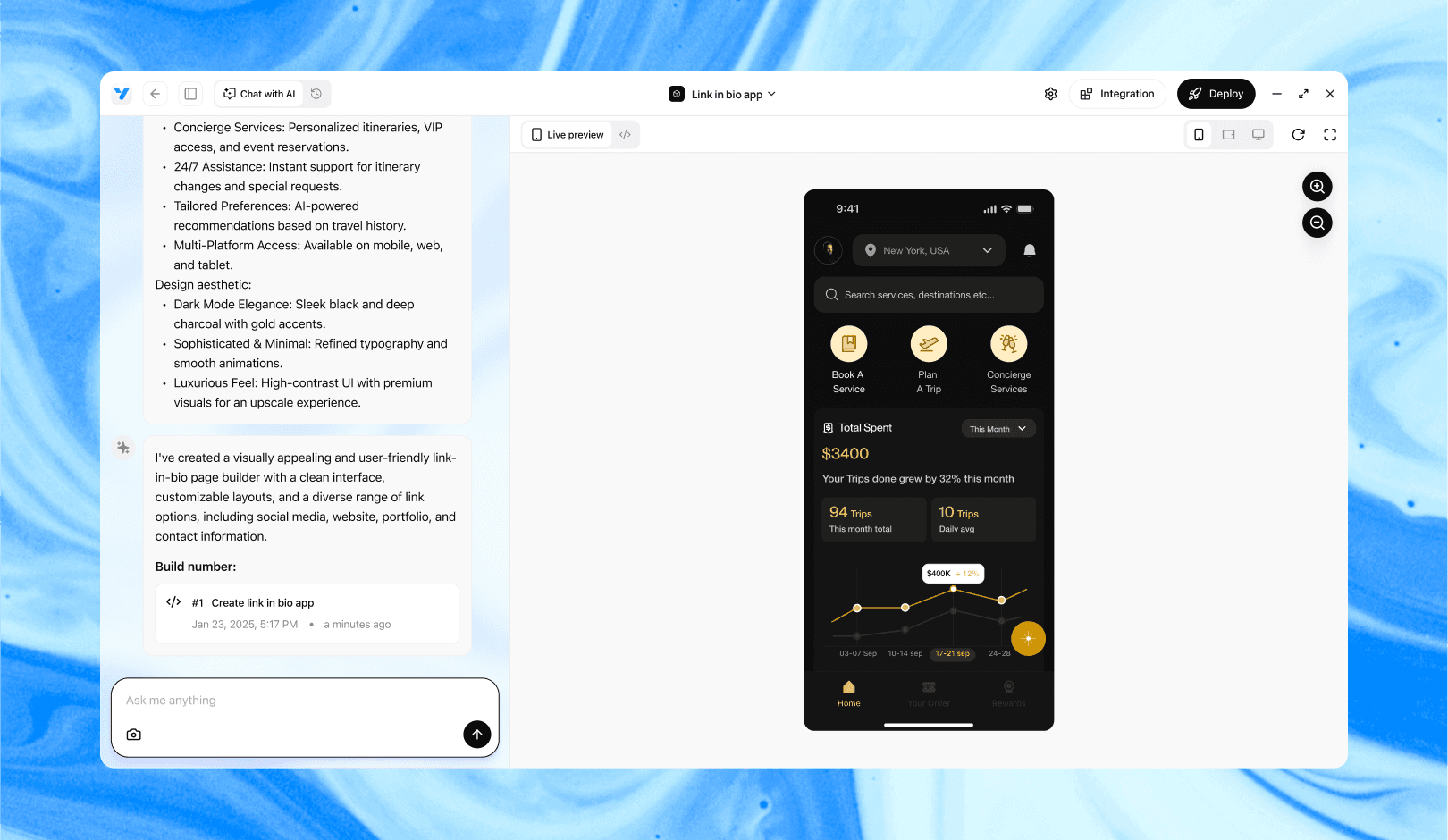
Vibe Studio, powered by Steve’s advanced AI agents, is a revolutionary no-code, conversational platform that empowers users to quickly and efficiently create full-stack Flutter applications integrated seamlessly with Firebase backend services. Ideal for solo founders, startups, and agile engineering teams, Vibe Studio allows users to visually manage and deploy Flutter apps, greatly accelerating the development process. The intuitive conversational interface simplifies complex development tasks, making app creation accessible even for non-coders.

Conclusion

Integrating AI text generation into a Flutter mobile app is straightforward when you separate concerns: isolated networking, clear state management, and responsive UI. Focus on secure key handling, graceful error states, and UX patterns that account for latency. With a small service layer and provider-based state, you can iterate quickly and swap models or endpoints without changing UI code, making your app resilient and maintainable.


Introduction

Building a Flutter app with AI text generation transforms static mobile experiences into dynamic, context-aware tools. This tutorial focuses on practical integration: project setup, UI patterns for generation, calling an AI text API securely, managing state and errors, and deployment best practices. You will learn patterns that fit mobile development constraints—latency, connectivity, and security—while keeping code maintainable.

Setting Up The Project

Start with a new Flutter project and add minimal dependencies: http (for API calls) and provider (for state management). Use secure storage or native keystore solutions for API keys in production; for development, keep keys out of source control and load them from environment variables or CI secrets.

pubspec.yaml (excerpt):

  • http: ^1.0.0

  • provider: ^6.0.0

Create a simple folder structure: lib/main.dart, lib/services/ai_service.dart, lib/models/generation_model.dart, and lib/screens/home_screen.dart. Keep networking logic isolated in ai_service.dart so you can replace the backend without touching UI.

Designing UI For Generation

A clean UI separates prompt input, generation controls, and result display. On mobile, optimize for quick interactions: a text field for prompt, an action button, and a scrollable result area. Show inline progress and allow cancelation if a request is taking long.

Key UI tips:

  • Use a TextEditingController for prompt input so you can prefill history or templates.

  • Disable the Generate button while awaiting a response.

  • Present results with selectable text and provide copy/share actions.

Example widget structure:

  • Column: TextField (prompt), Row (Generate, Clear), Expanded (ListView results)

Calling The AI API

Encapsulate API logic in a service class that accepts a prompt and returns generated text. Keep requests small and handle timeouts. Set a reasonable timeout (e.g., 15 seconds) and surface server errors to the UI with clear messages.

Example ai_service.dart (HTTP POST to a generic AI endpoint):

import 'dart:convert';
import 'package:http/http.dart' as http;

Future<String> generateText(String prompt, String apiKey) async {
  final resp = await http
      .post(Uri.parse('https://api.example.com/v1/generate'),
          headers: {'Authorization': 'Bearer $apiKey', 'Content-Type': 'application/json'},
          body: jsonEncode({'prompt': prompt, 'max_tokens': 150}))
      .timeout(Duration(seconds: 15));
  if (resp.statusCode == 200) return jsonDecode(resp.body)['text'] as String;
  throw Exception('Generation failed: ${resp.statusCode}');
}

Keep the service free of UI logic. If you need streaming responses (token-by-token), implement an event channel or WebSocket and update the UI progressively.

Managing State And Error Handling

Use Provider or another lightweight state solution to hold generation state: idle, loading, result, error. This makes UI predictable and testable. Provide retry logic and exponential backoff for transient failures.

Error-handling checklist:

  • Validate prompts locally (min/max length) before calling API.

  • Catch network errors and show human-friendly messages.

  • Log errors centrally for analytics (avoid logging API keys or sensitive prompts).

  • Offer retry and clear actions.

Small Dart snippet: a simple ChangeNotifier pattern to trigger generation and store result.

class GenerationModel extends ChangeNotifier {
  String result = '';
  bool loading = false;
  Future<void> generate(String prompt, String apiKey) async {
    loading = true; notifyListeners();
    try { result = await generateText(prompt, apiKey); }
    finally { loading = false; notifyListeners(); }
  }
}

Deployment And Security Considerations

On deployment, never embed API keys in the app binary. Use a proxy server to mediate requests, apply rate limits, and enforce content policies. If direct client calls are required, leverage mobile platform secure storage and rotate keys regularly.

Performance notes:

  • Cache recent generations when appropriate to avoid repeated calls.

  • Send concise prompts; larger prompts increase latency and cost.

  • Monitor usage and set quotas.

Accessibility and UX:

  • Provide alternative actions when offline.

  • Announce progress for screen readers.

Vibe Studio

Vibe Studio, powered by Steve’s advanced AI agents, is a revolutionary no-code, conversational platform that empowers users to quickly and efficiently create full-stack Flutter applications integrated seamlessly with Firebase backend services. Ideal for solo founders, startups, and agile engineering teams, Vibe Studio allows users to visually manage and deploy Flutter apps, greatly accelerating the development process. The intuitive conversational interface simplifies complex development tasks, making app creation accessible even for non-coders.

Conclusion

Integrating AI text generation into a Flutter mobile app is straightforward when you separate concerns: isolated networking, clear state management, and responsive UI. Focus on secure key handling, graceful error states, and UX patterns that account for latency. With a small service layer and provider-based state, you can iterate quickly and swap models or endpoints without changing UI code, making your app resilient and maintainable.

Build Flutter Apps Faster with Vibe Studio

Build Flutter Apps Faster with Vibe Studio

Build Flutter Apps Faster with Vibe Studio

Build Flutter Apps Faster with Vibe Studio

Vibe Studio is your AI-powered Flutter development companion. Skip boilerplate, build in real-time, and deploy without hassle. Start creating apps at lightning speed with zero setup.

Vibe Studio is your AI-powered Flutter development companion. Skip boilerplate, build in real-time, and deploy without hassle. Start creating apps at lightning speed with zero setup.

Vibe Studio is your AI-powered Flutter development companion. Skip boilerplate, build in real-time, and deploy without hassle. Start creating apps at lightning speed with zero setup.

Vibe Studio is your AI-powered Flutter development companion. Skip boilerplate, build in real-time, and deploy without hassle. Start creating apps at lightning speed with zero setup.

Other Insights

Other Insights

Other Insights

Other Insights

Join a growing community of builders today

Join a growing community of builders today

Join a growing community of builders today

Join a growing community of builders today

Join a growing community of builders today

28-07 Jackson Ave

Walturn

New York NY 11101 United States

© Steve • All Rights Reserved 2025

28-07 Jackson Ave

Walturn

New York NY 11101 United States

© Steve • All Rights Reserved 2025

28-07 Jackson Ave

Walturn

New York NY 11101 United States

© Steve • All Rights Reserved 2025

28-07 Jackson Ave

Walturn

New York NY 11101 United States

© Steve • All Rights Reserved 2025

28-07 Jackson Ave

Walturn

New York NY 11101 United States

© Steve • All Rights Reserved 2025

28-07 Jackson Ave

Walturn

New York NY 11101 United States

© Steve • All Rights Reserved 2025